

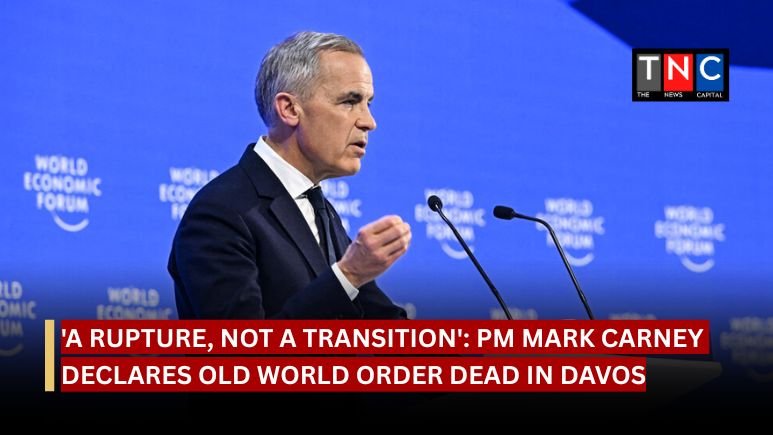

In a searing critique of current global power dynamics, Canadian Prime Minister Mark Carney warned world elites at the World Economic Forum that the U.S.-led “rules-based order” has vanished, replaced by a “brutal reality” where trade and integration are weaponized by hegemons. Addressing a packed hall at the 2026 World Economic Forum on Tuesday, January 20, Carney delivered what many are calling the most provocative speech of his young premiership, asserting that the international system is enduring a “rupture” from which there is no return, as great powers increasingly use “economic integration as weapons, tariffs as leverage, and supply chains as vulnerabilities to be exploited.”
Carney’s address focused on the collapse of the multilateral systems that governed the post-WWII era, urging middle powers to “stop mourning” a world that no longer exists and instead adapt to new realities.
- Trade as a Weapon: Carney noted that the era of mutual benefit through integration has been replaced by a system of coercion. “You cannot live within the lie of mutual benefit when integration becomes the source of your subordination,” he said, referencing recent U.S. threats to impose 25% tariffs on Canada over issues ranging from trade deficits to the Greenland dispute.
- The Thucydides Trap: Invoking the ancient historian’s account of the Peloponnesian War, Carney warned against the logic that “the strong do what they can, and the weak must suffer what they must.” He argued that countries attempting to “go along to get along” with hegemons are merely accepting subordination rather than partnership.
- The ‘Menu’ Metaphor: Reverting to a campaign-trail favourite, he warned, “In this new world, if you are not at the table, you are on the menu” suggesting that nations without agency in shaping the international order become victims of it.
- Permanent Change: The “rupture” framing deliberately contrasts with softer language of “transition,” signalling Carney’s belief that the old order is irretrievably gone rather than temporarily disrupted.
The Prime Minister’s rhetoric in Davos follows a week of intense diplomatic activity aimed at diversifying Canada’s economic dependencies away from Washington, most notably through the controversial Beijing reset.
- The China Deal: Just days prior, Carney returned from a historic four-day visit to Beijing the first by a Canadian leader in eight years. He finalized a “New Strategic Partnership” with President Xi Jinping, which includes a preliminary trade deal to lower tariffs on Canadian canola and restore market access worth potentially $3 billion.
- EV Compromise: The agreement includes a quota for 49,000 Chinese electric vehicles to enter Canada at a preferential 6.1% tariff rate, returning to 2023 levels before protective measures were imposed, representing a significant reversal of previous policy.
- Energy Independence: Carney emphasized that Canada is building “systems of resilience,” including a deal to double fossil fuel exports to non-U.S. markets, specifically targeting the energy-hungry Chinese and Indian sectors as alternatives to American dependence.
- Strategic Autonomy Defence: He defended the Beijing reset as a necessity, stating that Canada must “name reality” and build strength at home because “a country that can’t feed itself, fuel itself, or defend itself has few options” when facing coercion from more powerful neighbours.
The Paradigm Shift: Old Rules vs. New Reality
Carney presented a stark comparison between the international system that existed for seven decades and the one that has emerged in its place.
| Global Metric | The “Rules-Based” Era | The 2026 “Rupture” Era |
| Trade Logic | Mutual integration for profit | Integration as a vulnerability/weapon |
| Middle Power Strategy | Bilateral alliance with a hegemon | Multilateral “Third Path” coalitions |
| Sovereignty Basis | Grounded in international rules | Anchored in ability to withstand pressure |
| US-Canada Trade | Stable via USMCA | Volatile; threatened by “51st state” rhetoric |
| Conflict Resolution | Multilateral institutions (WTO, UN) | Bilateral coercion and economic warfare |
| Supply Chains | Efficiency-optimized | Weaponized and security-focused |
Greenland Solidarity: Standing with Denmark
Carney also utilized the global platform to voice full solidarity with Denmark and Greenland, positioning Canada firmly against Trump’s territorial ambitions in the Arctic.
- Dangerous Escalation: He called Trump’s tariff threats against eight European allies a “dangerous escalation” that threatens the foundation of the Western alliance and sets a precedent for territorial revisionism.
- Sovereignty Principle: “Decisions about the future of Greenland are for Greenland and Denmark to decide,” Carney stated, echoing a sentiment that has unified European leaders in Davos this week and establishing a clear red line against American territorial acquisition.
- Arctic Implications: As an Arctic nation itself, Canada has direct interests in ensuring that sovereignty principles are respected in the region, where territorial boundaries and resource rights remain contested.
- Alliance Fracture: The statement positions Canada with European NATO members against the United States on a fundamental question of alliance solidarity and territorial integrity.
Carney’s speech articulated a strategic vision for how middle powers should navigate a world where neither alignment with the United States nor submission to China offers acceptable outcomes.
- Multilateral Coalitions: Rather than bilateral dependence on any single hegemon, Carney advocates for middle powers forming coalitions that collectively possess sufficient economic and strategic weight to maintain autonomy.
- Diversification Imperative: The China deal, EU negotiations, and outreach to other partners represent practical implementation of diversification strategy to reduce vulnerability to any single power.
- Self-Sufficiency: Emphasis on the ability to “feed itself, fuel itself, or defend itself” suggests investments in agricultural security, energy independence, and defence capabilities as foundations of sovereignty.
- Naming Reality: Carney’s call to “name reality” rather than pretending the old order still functions represents a pragmatic acknowledgment that wishful thinking about American restraint or multilateral institutions prevents adaptation.
The speech, delivered just 24 hours before President Donald Trump was set to take the same stage, signalled Canada’s decisive shift toward strategic autonomy and created a deliberate contrast in worldviews.
- Deliberate Contrast: Scheduling the speech immediately before Trump’s appearance created a stark juxtaposition between Carney’s multipolar vision and Trump’s unilateral approach.
- Davos Audience: The World Economic Forum crowd of global business and political elites provided the ideal audience for articulating an alternative vision to American hegemony.
- European Receptivity: With European leaders furious over Greenland tariff threats, Carney’s message found a receptive audience among allies seeking alternatives to American dominance.
- Domestic Politics: The speech serves Canadian domestic politics by demonstrating Carney is standing up to American pressure rather than capitulating, important for a leader who took office only months ago.
Carney’s “rupture” thesis has profound implications for international relations, alliance structures, and the architecture of global governance.
- Post-American Order: The speech effectively declares the end of the American-led liberal international order, suggesting middle powers must prepare for a world where Washington is one competitor among several rather than a benevolent hegemon.
- China Opportunity: By embracing China as a strategic partner despite human rights concerns, Carney signals that sovereignty and economic security trump values-based foreign policy in the new era.
- NATO Tensions: The simultaneous embrace of China and criticism of American territorial ambitions places Canada in an uncomfortable position within NATO, where unity against authoritarian powers has been a foundational principle.
- WTO Irrelevance: The description of trade as weaponized rather than rules-based effectively acknowledges the World Trade Organization and similar institutions have lost authority to constrain great power behaviour.
“You cannot live within the lie of mutual benefit when integration becomes the source of your subordination.”
“The strong do what they can, and the weak must suffer what they must but we refuse to accept this logic.”
“In this new world, if you are not at the table, you are on the menu.”
“A country that can’t feed itself, fuel itself, or defend itself has few options.”
The Risk: Between Two Hegemons
While Carney frames the China pivot as strategic autonomy, critics warn Canada is trading dependence on one hegemon for vulnerability to another.
- Beijing’s Track Record: China has demonstrated willingness to use economic coercion against Canada, Australia, and other partners when political disagreements arise, raising questions about reliability.
- Security Dilemma: Deepening economic ties with China while remaining in Five Eyes intelligence alliance and NATO creates contradictions that may become untenable.
- American Retaliation: Trump’s “51st state” rhetoric and tariff threats suggest Washington may respond to the China pivot with even more aggressive economic pressure.
- European Scepticism: While Europeans appreciate Carney’s Greenland solidarity, many remain wary of deepening Chinese economic ties that could compromise security cooperation.
Mark Carney’s Davos declaration that the rules-based international order has experienced an irreversible “rupture” represents the most explicit articulation yet by a Western leader that the post-World War II system is dead and cannot be revived through appeals to multilateralism or alliance solidarity. His prescription strategic autonomy through diversified partnerships, self-sufficiency in critical domains, and willingness to engage authoritarian powers when necessary charts a “third path” for middle powers trapped between American unilateralism and Chinese authoritarianism. The China deal finalized days before the speech provides concrete evidence that Canada is implementing this vision rather than merely theorizing about it, with billions in trade, energy deals, and EV market access demonstrating Carney’s willingness to subordinate traditional alliance considerations to economic and strategic necessity. The timing 24 hours before Trump’s Davos appearance and amid the Greenland crisis creates maximum contrast between Carney’s multipolar vision and Trump’s zero-sum approach to international relations. Whether the “rupture” thesis proves prescient or premature depends on questions Canada cannot answer alone: Will Trump’s tariff threats moderate or escalate? Will China honour commitments or weaponized Canadian dependence as it has with other partners? Can middle power coalitions generate sufficient collective strength to resist great power coercion? The old world order Carney declared dead was built on American security guarantees, multilateral institutions, and faith that economic integration served mutual benefit. The new order he describes is built on self-reliance, diversified dependencies, and recognition that integration creates vulnerabilities hegemons will exploit. For Canada a nation of 40 million bordering a superpower of 330 million that just threatened to make it the 51st state the choice between subordination and autonomy is existential. Carney’s Davos speech announced that Canada chooses autonomy, even if the price is courting Beijing, defying Washington, and declaring that the rules-based order its own citizens helped build seven decades ago is gone forever.
Also Read / Turning the Page: PM Mark Carney and Xi Jinping Launch ‘New Strategic Partnership’ in Beijing.






Leave a comment