

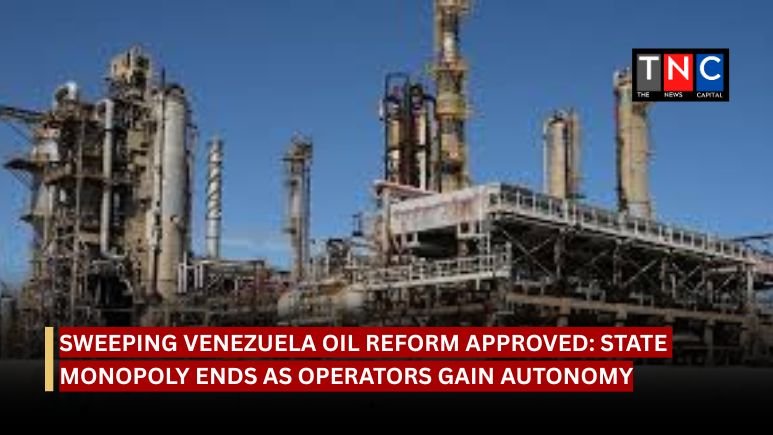

Twenty years of socialist energy policy, built on the dream of resource nationalism and state control over the “people’s oil,” unravelled in a single legislative session. The revolution that Hugo Chávez began nationalizing Venezuela’s petroleum industry, expelling foreign companies who wouldn’t accept minority positions, and declaring oil wealth belonged exclusively to the Venezuelan people ended Thursday night with the stroke of Acting President Delcy Rodríguez’s pen. What rose in its place looks remarkably like what existed before Chávez: foreign companies controlling operations, American courts settling disputes, and Washington calling the shots? They’re calling it reform. History might call it surrender.
Acting President Delcy Rodríguez signed a landmark oil sector reform into law late Thursday evening (January 29, 2026), just hours after its final approval by Venezuela’s National Assembly in a hastily convened session that saw virtually no opposition hardly surprising given that most opposition legislators fled the country, were imprisoned, or were never allowed to take their seats. The sweeping legislation formally and definitively ends the era of state-dominated “Chavismo” in Venezuela’s energy sector, allowing foreign and private companies to independently manage their own production operations, sales contracts, and logistics networks without the stifling oversight and mandatory partnership with the notoriously corrupt and incompetent state oil company PDVSA that has characterized Venezuelan petroleum policy since 2007.
The government, now operating under de facto U.S. supervision following the January 3 military operation that captured and extracted former President Nicolás Maduro, has characterized the reform as a “historic qualitative leap” that will rescue Venezuela from economic collapse and restore the country’s position as a major global oil exporter. The legislation’s passage coincided almost certainly not by accident with an immediate and comprehensive easing of U.S. sanctions by the Trump administration, which has made clear it now considers itself “in charge” of Venezuela’s energy sector reconstruction.
The new legal framework represents a systematic dismantling of virtually every principle that animated Hugo Chávez’s resource nationalism and the Bolivarian Revolution’s approach to petroleum wealth:
- Operational Autonomy Restored: Private and foreign firms operating in Venezuela can now exercise complete “technical and operational management” authority over oilfields, production facilities, and export operations even when they hold only minority equity stakes in joint ventures. This effectively and completely ends the mandatory requirement, enshrined in the 2007 nationalization decrees, that the state-owned Petróleos de Venezuela (PDVSA) must hold majority control and exercise final decision-making authority over every aspect of every project. Under the old system, even when international oil majors like ExxonMobil, ConocoPhillips, or Chevron provided the capital, technology, and expertise, PDVSA plagued by political appointments, corruption, and technical incompetence had veto power over all operational decisions, leading to catastrophic mismanagement that destroyed production capacity.
- Independent International Arbitration: In perhaps the most significant concession to international oil majors, commercial disputes arising from Venezuelan operations will now be settled through independent international arbitration mechanisms (likely the International Chamber of Commerce or similar bodies) or directly in U.S. federal courts completely bypassing Venezuela’s domestic judicial system, which has been internationally condemned as politically compromised, corrupt, and subservient to executive branch pressure. This addresses one of the primary reasons major companies fled Venezuela in the 2000s: the impossibility of enforcing contracts or protecting property rights when courts simply rubber-stamped whatever the government wanted.
- Flexible Fiscal Terms: The reform grants the executive branch unprecedented authority to dramatically reduce royalty rates previously a rigid, constitutionally mandated 33% of gross production value down to as low as 0-15% for “special projects” requiring massive upfront capital expenditure to repair decades of neglect, underinvestment, and deliberate sabotage of Venezuela’s oil infrastructure. While this flexibility is economically rational for attracting the tens of billions needed to restore production capacity, it also means Venezuela will receive far less revenue per barrel than during the boom years effectively trading sovereignty and future income for immediate foreign investment.
The reform legislation is explicitly designed as the legal foundation for the Trump administration’s ambitious $100 billion reconstruction plan for Venezuela’s devastated energy industry, following the controversial January 3 “Operation Absolute Resolve” that saw U.S. special forces capture President Nicolás Maduro and his wife in a brazen raid:
- Immediate Sanctions Relief: Within literally one hour of the law’s formal passage coordination that suggests the legislation’s text was written in Washington rather than Caracas the U.S. Treasury Department’s Office of Foreign Assets Control (OFAC) issued a comprehensive general license explicitly authorizing American energy companies to lift, transport, process, refine, and sell Venezuelan crude oil without fear of sanctions penalties. This reverses nearly a decade of punishing restrictions that had effectively shut Venezuela out of global oil markets and devastated the country’s economy.
- American “Supervision” and Market Control: President Trump has stated with characteristic bluntness that Washington is now effectively “in charge” of overseeing Venezuela’s oil industry revival, with the explicit goal of redirecting Venezuelan crude exports away from China (which had been receiving heavily discounted Venezuelan oil in exchange for loans and political support) and back to U.S. Gulf Coast refineries specifically designed to process Venezuela’s heavy, high-sulfur crude. The administration frames this as beneficial for stabilizing global energy prices and reducing American dependence on Middle Eastern imports, though critics note it also gives Washington enormous leverage over Venezuela’s economic future.
- Revenue Control and “Reconstruction”: The U.S. Department of Energy has already begun directly marketing millions of barrels of Venezuelan crude oil that had been sitting in storage terminals with nowhere to go during the sanctions period. Proceeds from these sales which legally should belong to Venezuela are being directed into U.S.-controlled accounts ostensibly intended to fund infrastructure reconstruction and currency stabilization programs designed to bring “happiness and prosperity” to the Venezuelan people, though the mechanism for how ordinary Venezuelans will actually benefit remains conspicuously vague.
The before-and-after transformation:
| Policy Feature | Old Law (Chávez/Maduro Era 2007-2026) | New Reform (2026) |
| PDVSA Control | Mandatory majority ownership (minimum 60%) and absolute operational management authority over all decisions | Foreign/private minority partners can independently lead technical operations, production decisions, and export sales |
| Royalty Rates | Constitutionally fixed at 33% of gross production value; inflexible regardless of project economics | Flexible rates negotiable down to 15% or even lower for capital-intensive rehabilitation projects |
| Dispute Resolution | Venezuelan courts exclusively; international arbitration explicitly prohibited | International arbitration through ICC or similar bodies; U.S. federal courts explicitly authorized |
| Sales & Marketing | All crude oil sales handled exclusively by PDVSA marketing division; producers couldn’t sell their own output | Private companies can directly sell their allocated production to international buyers |
| Foreign Investment | Heavily restricted; majority of projects closed to new foreign capital after 2007 nationalizations | Actively encouraged; comprehensive legal protections for foreign investors |
While the reform represents a definitive pivot toward liberalization and privatization that would have been politically impossible under Maduro’s government, significant legal uncertainties remain that could complicate implementation:
- Constitutional Conflicts: Legal scholars have noted that certain provisions of the new law may directly conflict with Article 302 of Venezuela’s 1999 Bolivarian Constitution, which explicitly declares that “The State reserves to itself, through the pertinent organic law… the petroleum activity and other industries, exploitations, services and goods of public interest and of a strategic nature.” The constitution was specifically written during Chávez’s presidency to enshrine permanent state control over petroleum resources as a fundamental national principle not subject to ordinary legislation.
- “PDVSA” as Legal Fiction: While the reform maintains Petróleos de Venezuela as a nominally state-owned entity for joint ventures allowing the government to claim continuity with constitutional requirements PDVSA has been effectively gutted of all meaningful authority and reduced to a shell entity that exists on paper but exercises no real operational control. Whether this legal fiction will withstand constitutional challenges remains uncertain, though given that Venezuela’s Supreme Court is now effectively supervised by the U.S.-backed transition government, such challenges seem unlikely to succeed.
- Sovereignty Questions: The broader question of whether a government installed following foreign military intervention, operating under explicit U.S. supervision, and passing legislation drafted to benefit American companies actually has the democratic legitimacy to sign away permanent control of Venezuela’s natural resources represents a fundamental challenge that extends beyond narrow legal technicalities into questions of national sovereignty and self-determination.
Despite these legal and political uncertainties, the market reaction to the reform has been swift and overwhelmingly positive from the perspective of international oil companies:
Global petroleum majors, including Chevron (which maintained a skeleton presence in Venezuela even during the worst sanctions), European firms like Repsol and Eni, and potentially ExxonMobil and ConocoPhillips (who left Venezuela after 2007 nationalizations and have massive outstanding arbitration claims), are reportedly already in advanced negotiations to dramatically expand operations as Venezuela positions itself to reclaim its historical role as one of the world’s leading oil exporters.
“We are talking about the country that we are going to give to our children. This is about securing Venezuela’s future prosperity,” Acting President Delcy Rodríguez stated during the bill signing ceremony, her language carefully chosen to frame the surrender of state control as a gift to future generations rather than a capitulation to foreign pressure.
“This reform creates the legal certainty and operational flexibility that international investors require. Venezuela has the world’s largest proven oil reserves over 300 billion barrels. With proper investment and technology, production could return to 3 million barrels per day within five years,” commented Francisco Monaldi, director of the Latin America Energy Program at Rice University’s Baker Institute.
“Let’s be honest about what this is: the complete reversal of everything Chávez built, implemented by a government that exists only because American special forces kidnapped the elected president. This isn’t reform it’s regime change followed by resource appropriation,” argued Miguel Tinker Salas, professor of Latin American history at Pomona College and longtime Venezuela observer.
The transformation is undeniable. Venezuela’s oil industry, built over a century, nationalized dramatically in the 1970s, and then re-nationalized even more aggressively under Chávez in the 2000s on the principle that petroleum wealth should belong exclusively to the Venezuelan people and fund social programs for the poor, has been handed back to foreign corporations under terms more favorable to them than anything that existed even before nationalization.
Whether this represents economic pragmatism that will rescue Venezuela from collapse and restore prosperity, or represents neocolonial resource extraction that will enrich foreign companies while ordinary Venezuelans remain impoverished, depends largely on who you ask and whether you believe the Venezuelan government currently signing these agreements actually represents Venezuelan interests or American ones.
The oil will flow again. The refineries will restart. Production will climb. And the billions will be generated.
Also Read / ‘Make a Deal Before It’s Too Late’: Trump Issues Ultimatum to Cuba as Venezuelan Oil Lifeline Vanishes.







Leave a comment