

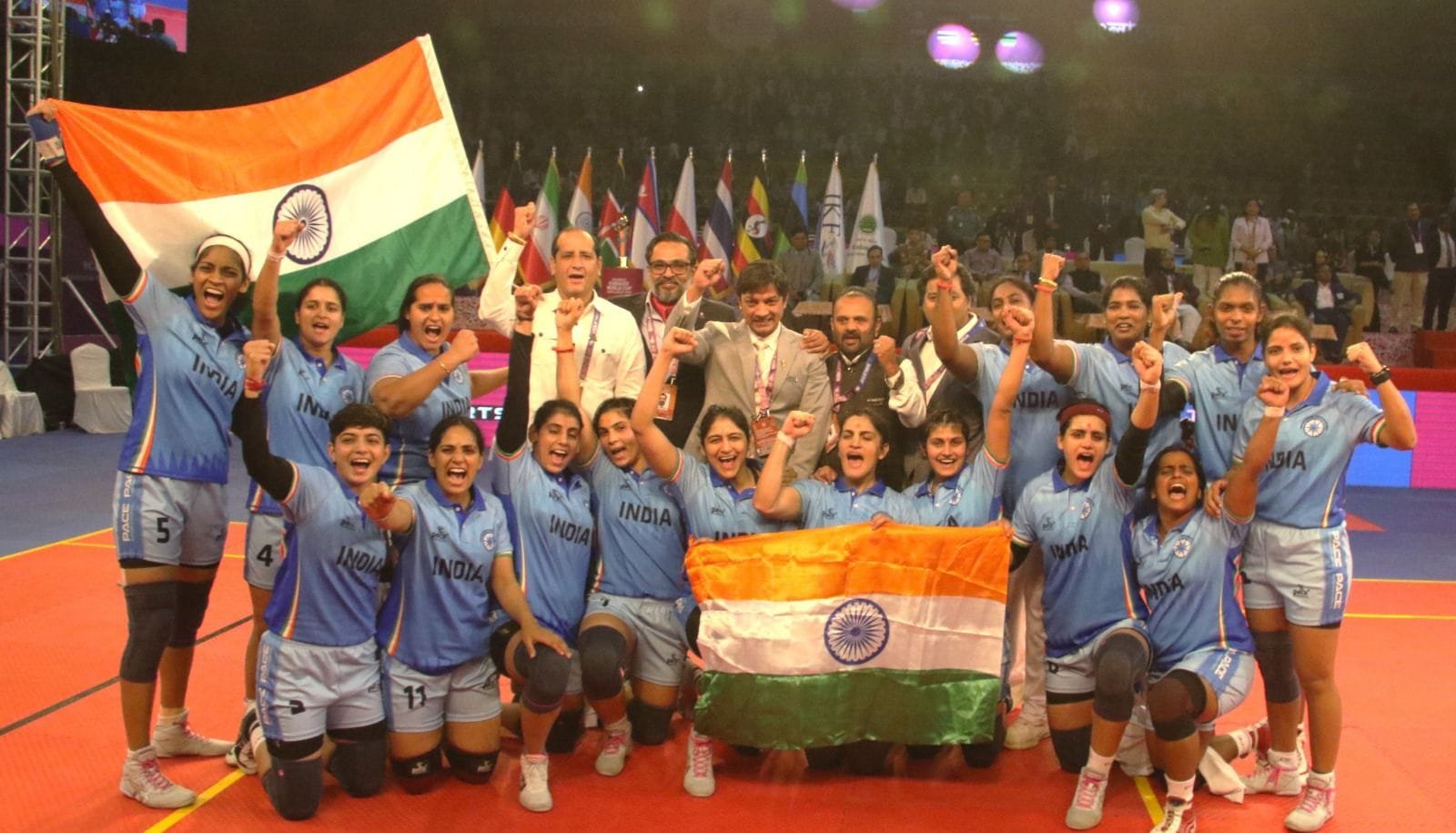

India women’s Kabaddi World Cup 2025. India defeats Chinese Taipei 35 to 28 in Dhaka to secure a second successive world title and strengthen its position at the top of international women’s kabaddi.
India Secures Back to Back World Titles in Dhaka
India’s women’s kabaddi team claimed the 2025 Women’s Kabaddi World Cup with a 35 to 28 victory over Chinese Taipei in a closely contested final held at the Shaheed Suhrawardy Indoor Stadium in Dhaka. The squad completed the tournament without a single defeat, adding a second consecutive world title to its growing legacy.
The final brought together two of the most consistent sides in the competition, offering a disciplined defensive battle and sustained attacking pressure from both ends of the mat.
India’s Unbeaten Route to the Championship Match
India advanced to the final through a commanding group stage and a strong semifinal performance. The team recorded decisive wins over Thailand, Bangladesh, Germany, and Uganda while outscoring opponents by wide margins. Their semifinal match against Iran required a structured defensive response and controlled raiding, resulting in a 33 to 21 win.
Chinese Taipei followed a similar path. After an efficient group stage campaign, the team defeated hosts Bangladesh 25 to 18 in the semifinal. Their progress created anticipation for a competitive final between two squads known for consistent execution and tactical clarity.
Details From the Final: Early Edge and Late Composure
India opened the final with active forward movement and precise defensive formations. Captain Ritu Negi and senior players Sanju Devi and Pushpa Rana contributed key points during a balanced first half. India held a 20 to 16 lead at the break, though Chinese Taipei maintained pressure through quick counter attacks.
The second half saw repeated attempts by Chinese Taipei to close the gap. India’s defenders responded with a series of coordinated blocks and controlled tackles that prevented any major shift in momentum. A crucial super tackle in the closing minutes prevented a late Taipei surge and allowed India to secure the final margin at 35 to 28.
Structure, Conditioning, and Team Coordination
India’s win was supported by months of training and a focus on strategic discipline. Several players from Himachal Pradesh formed the core of the squad, offering a consistent understanding of each other’s style. Coaches cited the group’s fitness levels, communication on court, and adaptability to varied opponents as major contributors to the title run.
Coach Manpreet Singh and mentor Ajay Thakur credited the team for applying match plans with accuracy and maintaining focus throughout pressure situations. Observers noted the clear balance between experienced voices and emerging talent.
National Recognition and Rising Public Interest
The victory brought widespread acknowledgment from sporting authorities and the public. Prime Minister Narendra Modi issued a message congratulating the team for its performance, describing the result as a source of national pride. The statement received significant attention online and added to the growing visibility of women’s kabaddi in India.
The women’s kabaddi program has expanded at both national and state levels, supported by improved training infrastructure and increased participation among young athletes. The final in Dhaka highlighted the sport’s growing reach across Asia, with eleven nations competing in the 2025 edition.
Impact on Women’s Sports and Grassroots Growth
India’s consecutive World Cup victories reinforce the country’s influence in international kabaddi and contribute to a wider conversation about women’s sports development. The success of the team is expected to encourage higher enrollment in kabaddi academies, new investments in coaching programs, and broader media coverage of women’s competitions.
The achievement also strengthens the presence of kabaddi among school and college level athletes. Sports development officials note that visibility of accomplished women athletes helps reduce barriers for girls seeking access to competitive sports.
Kabaddi’s Expanding Global Footprint
The 2025 tournament demonstrated kabaddi’s increasing global audience. Countries from multiple regions participated, and broadcasters provided extended coverage of the final rounds. India’s competitive excellence, combined with the popularity of the Pro Kabaddi League, has helped elevate the sport’s profile and set higher performance standards for international teams.
Federations expect more countries to invest in structured women’s programs before the next World Cup cycle. Analysts believe that India’s continued success will encourage stronger competition in upcoming events.
Summary India completed an unbeaten run at the 2025 Women’s Kabaddi World Cup and secured a second straight title with a 35 to 28 win over Chinese Taipei. The victory underscores the team’s tactical strength and its role in expanding the presence of women’s kabaddi regionally and internationally.














Leave a comment