

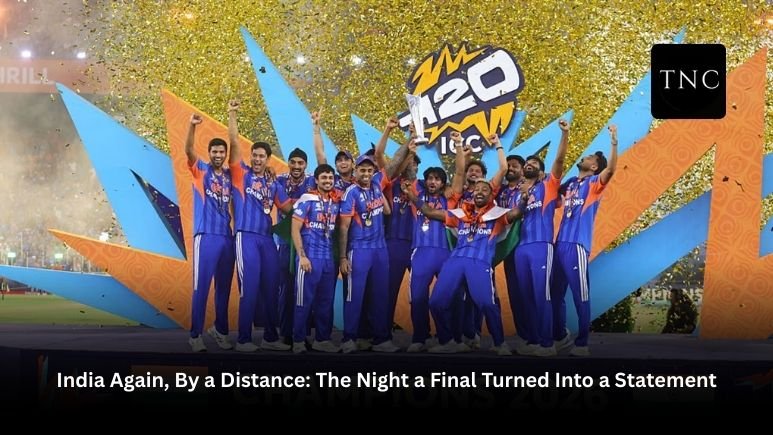

The scoreboard kept climbing long after the crowd had lost its voice.
Under the floodlights, Indian batters kept swinging. Boundaries thudded into advertising boards. Fielders chased balls that refused to slow down. On the other side, New Zealand’s players drifted between overs, hands on hips, the game slipping further away with every run.
By the time the innings ended, the number on the giant screen looked almost surreal: 255.
In a World Cup final, that isn’t just a total. It’s a declaration.
When New Zealand walked out to chase, the pressure wasn’t subtle. It was heavy, immediate, and relentless. Within a few overs, the chase began to crumble. Wickets fell. The asking rate ballooned. And the final, once billed as a contest between two elite teams, slowly turned into a procession.
India didn’t just win.
They won by 96 runs, lifting their third ICC Men’s T20 World Cup title and leaving little doubt about who ruled the tournament.
This final wasn’t simply another trophy for India. It was a demonstration of how modern T20 cricket is evolving and how India has positioned itself at the center of that evolution.
The match answered a broader question lingering over global cricket: which team truly defines the modern T20 blueprint?
In this tournament, and especially in the final, India provided a decisive answer. Their aggressive batting, adaptable bowling, and fearless approach created a margin of dominance rarely seen in championship matches.
The result wasn’t just victory. It was separation.
Start with the batting.
India’s 255-run total wasn’t built on cautious accumulation. It was built on intent. From the powerplay onward, the Indian lineup attacked the bowlers, turning the early overs into a scoring frenzy and forcing New Zealand immediately onto the defensive.
That early assault mattered.
In T20 cricket, the powerplay often determines the emotional tone of the match. India’s aggressive start reportedly producing a massive 92 runs in the powerplay effectively tilted the final before the chase even began.
Then came the bowling.
Defending a huge total can tempt teams into complacency. India did the opposite. Their bowlers attacked relentlessly, squeezing the middle overs and striking at key moments. The strategy was simple: never allow the chase to breathe.
New Zealand never found momentum.
The margin 96 runs tells the story better than any tactical breakdown. In a final between top teams, such a gap is rare. It reflects not just skill, but complete control.
And perhaps most importantly, it highlights the depth of India’s modern T20 structure: explosive top-order hitters, adaptable middle-order finishers, and bowlers capable of defending even the most aggressive game plans.
This is not accidental dominance.
It is engineered.
Cricket finals are usually tight, nervous affairs. This one wasn’t.
India turned the sport’s biggest stage into a showcase of power, precision, and confidence. By the time the final ball was bowled, the message was unmistakable:
The gap between India and the rest of the T20 world isn’t just visible. It’s widening.
And on that night, under those lights, the scoreboard said it all.
India again. By a distance.
Also Read / Finn Allen Smashes Fastest T20 World Cup Century as New Zealand Storm Into Final.














Leave a comment