

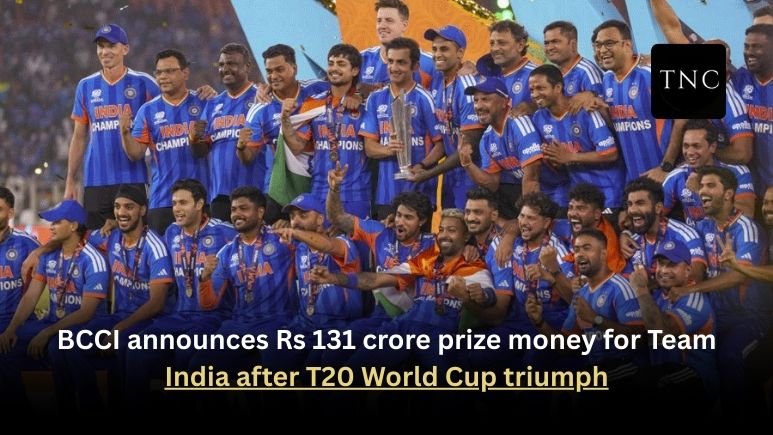

The fireworks had barely faded above the vast stands of the Narendra Modi Stadium when Jasprit Bumrah walked back toward the dressing room, sweat still clinging to his jersey. On the giant screen behind him, the scoreboard flashed the final numbers: India 255/5. New Zealand 159.
It had been a ruthless performance. Sanju Samson’s blazing innings tore apart the bowling attack, and Bumrah’s spell four wickets for just 14 runs ended any hope of a comeback. Around them, nearly 90,000 fans roared as blue jerseys flooded the field.
The trophy was already India’s. But another surprise was waiting.
Two days later, the Board of Control for Cricket in India made a stunning announcement: ₹131 crore in prize money for the players, coaches, and support staff who delivered the country its latest cricketing triumph.
It was the biggest reward the board had ever announced for a cricket team.
India’s victory in the 2026 ICC Men’s T20 World Cup was historic in more ways than one. By defeating New Zealand national cricket team in the final, India not only lifted the trophy but also became the first team in tournament history to successfully defend a T20 World Cup title.
To mark the achievement, the Indian cricket board unveiled the massive ₹131-crore reward package, a financial gesture that dwarfs the official prize money awarded by the International Cricket Council.
The decision highlights a larger truth about modern cricket: India isn’t just winning matches it’s shaping the economics of the sport.
The numbers tell the story.
The ICC’s official prize for winning the tournament was roughly $2.34 million (around ₹21.5 crore).
The BCCI’s bonus? ₹131 crore more than six times larger.
That gap explains why the Indian cricket board is widely regarded as the richest governing body in the sport. Its revenue streams from broadcasting rights to the Indian Premier League allow it to reward players at levels few other boards can match.
But the money also carries symbolism.
First, it reinforces a culture of excellence. When players deliver on the world stage, the board responds with unprecedented recognition.
Second, it reflects India’s growing dominance in global cricket. The 2026 victory marked the country’s third T20 World Cup title and its first successful title defense, cementing a new era of consistency and power in white-ball cricket.
Finally, it underscores how cricket in India has evolved from a sport into a billion-dollar industry. The financial ecosystem from television deals to sponsorships means victories now carry enormous commercial and cultural value.
For players like Samson, Bumrah, and their teammates, the reward is more than a bonus. It is proof that Indian cricket’s global influence has never been stronger.
Team India’s T20 World Cup victory delivered glory on the field.
The ₹131-crore reward delivered something else: a clear reminder that in modern cricket, India doesn’t just win tournaments it sets the financial standard for the sport.
Also Read / India Again, By a Distance: The Night a Final Turned Into a Statement.













Leave a comment