

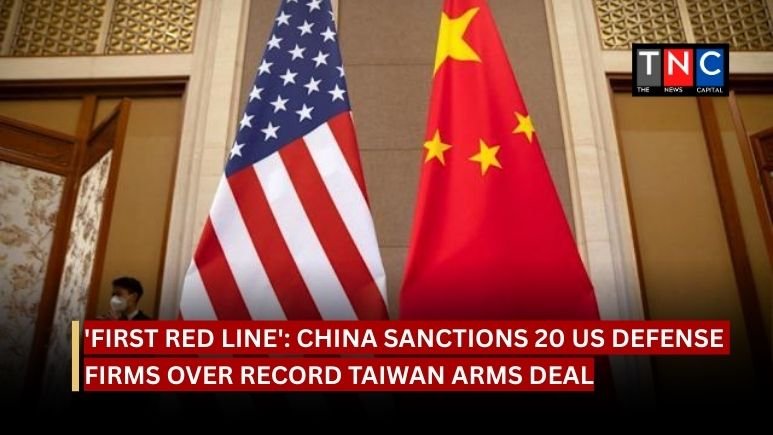

Beijing has retaliated against the Trump administration’s approval of a historic $11.1 billion weapons package for Taiwan, freezing the assets of major American defense giants and banning their top executives from entering Chinese territory.
The Chinese Foreign Ministry announced Friday (December 26, 2025) a sweeping set of countermeasures against 20 U.S. defense-related companies and 10 senior executives. The move is a direct response to Washington’s decision to authorize the largest-ever arms sale to Taiwan, which includes medium-range missiles, drones, and HIMARS rocket systems. Beijing described the sale as a “serious provocation” that undermines China’s sovereignty and territorial integrity.
The sanctions, which took effect immediately, freeze all movable and immovable properties of the listed firms within China. Additionally, Chinese organizations and individuals are strictly banned from doing any business or cooperating with the targeted entities.
Key targets of the sanctions include:
- Aerospace Giants: Northrop Grumman Systems Corporation, L3Harris Maritime Services, and Boeing’s defense hub in St. Louis, Missouri.
- Defense Technology: Companies like Anduril Industries, Sierra Technical Services, and Gibbs & Cox.
- Executives: 10 high-ranking individuals, including Anduril founder Palmer Luckey and L3Harris VP John Cantillon, who are now barred from entering mainland China, Hong Kong, and Macau.
The $11.1 billion package, the first major arms deal since President Donald Trump’s return to the White House, surpasses the $8.4 billion in sales recorded during the entire Biden administration. It’s seen as a move to boost Taiwan’s “asymmetric warfare” capabilities amid rising fears of a potential cross-strait conflict.
“The Taiwan question is at the very core of China’s core interests and the first red line that must not be crossed,” a Chinese Foreign Ministry spokesperson said. “Any company or individual who engages in arms sales to Taiwan will pay the price for the wrongdoing.”
While the U.S. State Department maintains the sales are consistent with the Taiwan Relations Act to ensure the island’s self-defense, Beijing argues the move “seriously violates the one-China principle and the three China-US Joint Communiques.”
Analysts view these sanctions as largely symbolic, given that most major U.S. defense contractors have limited direct business operations in mainland China. But the timing is critical. The move signals a sharp hardening of Beijing’s stance as the new Trump administration seeks to leverage military support for Taipei against potential trade and economic deals with China.
With the arms package still needing final approval from Congress, where it has strong bipartisan support, tensions in the Taiwan Strait are expected to stay at a fever pitch. China’s military has already ramped up its presence in the region, conducting near-daily joint drills with warships and fighter jets near the island.
Also Read / China Warns Citizens Against Japan Travel as Taiwan Tensions Spike in 2025.









Leave a comment