

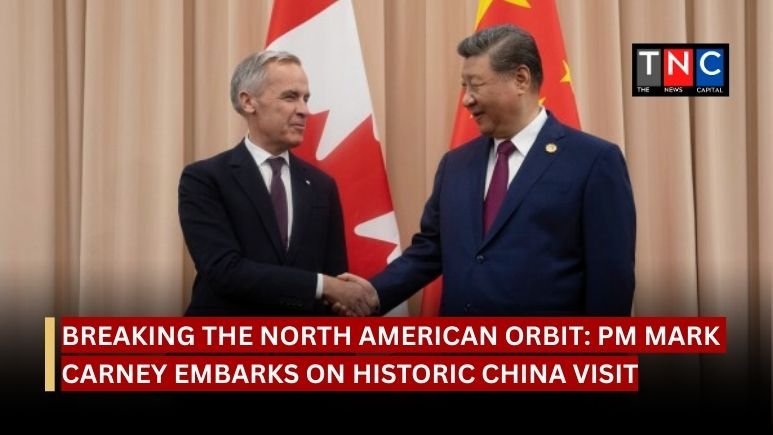

The Boeing 737 carrying Prime Minister Mark Carney will touch down at Beijing Capital International Airport on Wednesday at 2:15 PM local time. It will be the first time a Canadian head of government has stepped onto that tarmac in nearly a decade. Carney will emerge into Beijing winter air carrying a briefcase full of trade proposals and a political mandate to answer the question that has haunted Canadian sovereignty since Confederation: what happens when your entire economy depends on a neighbour who just threatened to annex you as the 51st state? The answer, apparently, involves a handshake with Xi Jinping and a gamble that China can replace what America has been for 150 years, a customer who buys three-quarters of everything Canada sells.
Prime Minister Mark Carney arrives in Beijing Wednesday for Canada’s first leader-level visit to China since 2017, launching a high-stakes pivot away from overwhelming economic dependence on the United States. The four-day mission aims to forge “strategic resilience” by doubling non-U.S. exports within a decade, a response to escalating trade friction with the Trump administration and provocations about Canadian statehood. Carney’s China gambit reveals how middle powers trapped between superpowers resort to dangerous rebalancing acts, betting they can cultivate authoritarian trade partners without compromising security or values, and hoping the math works before the neighbour they’re fleeing notices and retaliates.
Prime Minister Mark Carney lands in China on Wednesday, January 14, 2026, for a four-day official visit marking the first trip by a Canadian head of government to the People’s Republic since 2017. The mission comes just ten months after Carney took office following Justin Trudeau’s resignation and represents a major rethink of Canada’s global trade strategy amid escalating friction with Washington.
The Carney government’s centrepiece economic policy, the “Reliance to Resilience” plan, seeks to mitigate risks of single-partner trade dependency. Currently, the U.S. accounts for roughly 75% of Canadian exports. Carney’s stated goal is to double non-U.S. exports within the next decade. He’s scheduled to meet President Xi Jinping on Friday, January 16, to “offer new strategic guidance” for bilateral relations. He’ll also hold talks with Premier Li Qiang and business leaders. Discussions will prioritize trade, energy including conventional and green technology, agriculture, and international security.
The visit follows provocative rhetoric from Washington. President Trump has mused that Canada could become “the 51st state” and imposed heavy tariffs that shook the North American trade bloc. Carney’s team uses a Trade Diversification Index to measure success, calculating concentration of exports across global partners. A lower TDI value indicates a healthier, more distributed export portfolio. The formula is straightforward: sum the squares of each country’s share of total exports. By increasing non-U.S. trade, Ottawa hopes to lower vulnerability to localized economic shocks.
The focus is economic, but Carney faces intense pressure from domestic and international rights groups. Human Rights Watch urged the Prime Minister to prioritize issues including the detention of media figure Jimmy Lai in Hong Kong, allegations of transnational repression targeting critics within Canada, and concerns over forced labour and the ongoing crisis in Xinjiang. Canadian officials noted that while Carney intends to raise these “tricky topics,” the visit is primarily a pragmatic effort to re-energize a dormant partnership.
The China visit is only the first leg of an intensive global diplomatic tour. After departing Beijing on Saturday, Carney travels to Qatar to secure energy and investment partnerships before heading to the World Economic Forum in Davos, Switzerland, on January 19. “At a time of global trade disruption, Canada is focused on building a more competitive, sustainable, and independent economy,” Carney said. “We’re forging new partnerships to transform an economy that has been reliant on a single partner.”
Zhu Feng, Dean of International Studies at Nanjing University, framed it differently: “Carney’s visit reflects the new space for development in China-Canadian relations under the current U.S. trade protectionism.” As the first “economist-in-chief” to lead Canada, Carney’s success in Beijing will be judged by his ability to secure tangible trade concessions, such as removal of retaliatory tariffs on Canadian canola and pork, without appearing to compromise on security or democratic values.
Carney is flying to Beijing because Trump joked about annexation and imposed tariffs, which means Canada’s China pivot isn’t a strategy, it’s a panic response dressed in economic theory and Trade Diversification Index formulas. The math is simple: 75% dependence on one partner is dangerous, especially when that partner threatens to make you a state instead of a country. The problem is also simple: replacing American customers with Chinese ones doesn’t reduce dependence, it just trades one vulnerability for another, and Beijing’s track record on detentions, forced labour, and transnational repression suggests the new partner comes with costs Carney will discover only after the contracts are signed. For a nation that has defined itself by the relationship with its southern neighbour for 150 years, Wednesday’s landing in Beijing doesn’t mark independence. It marks the moment Canada admitted it would rather risk authoritarian entanglement than continue begging Washington for respect it will never receive.
Also Read / Leverage Over ‘Blood Money’: Trump Greenlights 500% Tariff Bill Targeting India and China.










Leave a comment