

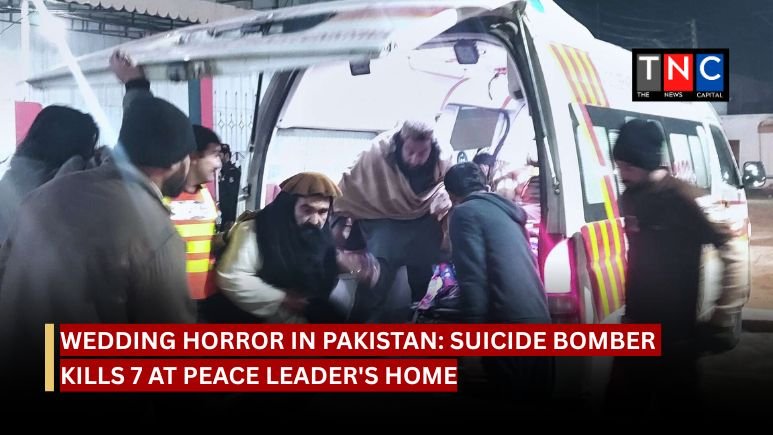

The drums were beating, the guests were dancing, and a family was celebrating what should have been one of the happiest days of their lives. Then, in an instant, the music stopped. The celebration became a massacre. And a wedding hall in northwest Pakistan transformed into a scene of carnage that will haunt survivors forever another grim reminder that in some parts of the world, even joy itself can be a target.
A joyous marriage ceremony in Pakistan’s restive Khyber Pakhtunkhwa province was violently shattered on Friday, January 23, 2026, when a suicide bomber detonated an explosive vest in the middle of a crowded celebration, turning what witnesses described as a scene of “pure jubilation” into a “war zone” within seconds. The explosion occurred at the home of Noor Alam Mehsud, a prominent pro-government peace committee leader in the Dera Ismail Khan district, a region that has become increasingly volatile as militant groups reassert control following the Taliban’s 2021 takeover of neighboring Afghanistan.
Local police have confirmed that at least seven people were killed instantly in the blast, with 25 others wounded many of whom remain in critical condition at overcrowded local hospitals, their families keeping vigil and praying that the death toll doesn’t continue climbing as the most severely injured fight for survival.
Witnesses who survived the blast described a celebration that had reached its peak energy guests dancing energetically to the traditional rhythmic beat of dhol drums, families mingling across the crowded hall, children running between adults, the bride and groom surrounded by well-wishers offering blessings for their new life together. It was a scene repeated at thousands of weddings across Pakistan every day, ordinary and joyful and utterly normal.
- The Infiltration: The attacker, wearing traditional clothing that allowed him to blend seamlessly with other male guests, had somehow bypassed whatever minimal security existed at the venue. He was clad in an explosive-laden suicide vest hidden beneath his shalwar kameez, carrying enough explosives to maximize casualties in the confined, crowded space.
- The Detonation: Witnesses report the bomber positioned himself in the centre of the main celebration hall where the largest concentration of guests had gathered for dancing. Without warning, without any final statement or declaration, he triggered the device. The explosion was instantaneous and devastating a flash of blinding light, a deafening roar, and then screaming, smoke, and the metallic smell of blood mixed with the acrid odor of explosives.
- Structural Collapse: The force of the blast was so immense that it caused the ceiling of the room to partially collapse, bringing down heavy beams and sections of roof that trapped several victims beneath the rubble. The structural failure severely complicated rescue efforts, as emergency responders had to carefully extract wounded individuals from beneath debris while worried that further collapse could kill both victims and rescuers.
- Emergency Response: Following the attack, an emergency was immediately declared at the District Headquarters (DHQ) Hospital in Dera Ismail Khan, with all available doctors and nurses called in to handle the sudden influx of blast victims. Rescue 1122 emergency teams Pakistan’s primary disaster response service worked throughout the night using whatever equipment they had available to extricate those pinned beneath collapsed sections of the building, often digging with bare hands when machinery couldn’t reach victims without risking further injury.
The targeted nature of the attack:
While the suicide bomber killed and maimed indiscriminately victims included women, children, and elderly guests who had no connection to politics or security matters investigators believe the attack was a carefully planned, targeted strike against pro-government figures who have actively resisted militant influence in the region:
- The Primary Target: Among the confirmed dead was Waheedullah Mehsud, also known locally as “Jigri Mehsud,” a peace committee leader who had become a prominent voice advocating cooperation with government security forces. Significantly, reports indicate Waheedullah was a former Taliban fighter what locals sometimes refer to as a “good Talib” who had surrendered to authorities, renounced violence, and subsequently worked with the Pakistani state to stabilize the region and encourage other militants to lay down arms. His transformation from insurgent to peace advocate made him a particularly valuable ally for the government and an intolerable traitor in the eyes of militant groups still committed to armed struggle.
- The Broader Pattern: This wedding bombing is not an isolated incident but part of an escalating campaign of assassinations targeting pro-government community leaders throughout Khyber Pakhtunkhwa. Earlier in January 2026, four additional peace committee members were killed in coordinated attacks in the nearby Bannu district, signalling a systematic effort to eliminate local figures who collaborate with security forces and provide intelligence on militant activities.
| Metric | Details (January 23-24, 2026) |
| Confirmed Dead | 7 (including peace leader Waheedullah Mehsud) |
| Wounded | 25 (several remain in critical condition, death toll may rise) |
| Attack Location | Residence of Noor Alam Mehsud, Qureshi Mor area, Dera Ismail Khan |
| Suspected Perpetrators | Tehrik-e-Taliban Pakistan (TTP) |
| Method | Suicide vest detonated inside crowded wedding celebration |
| Recent Context | Fourth major attack on peace committee members in January 2026 |
While no militant group has formally issued a claim of responsibility as of Friday evening sometimes groups delay acknowledgment to avoid immediate retaliation or to assess the propaganda value of an attack security analysts, intelligence officials, and local police all point toward the Tehrik-e-Taliban Pakistan (TTP) as the most likely perpetrator.
The TTP resurgence:
The TTP, also known as the Pakistani Taliban, has experienced a dramatic resurgence in operational capability and territorial influence since the Afghan Taliban’s 2021 takeover of Afghanistan. Despite being a separate organization, the TTP maintains close ideological and operational ties with the Afghan Taliban, and many TTP commanders are believed to operate from sanctuaries inside Afghanistan, where they enjoy de facto protection from the ruling government despite official Pakistani protests and demands for their extradition or elimination.
The group’s strategic objectives include establishing strict Islamic governance in Pakistan’s tribal regions, undermining the Pakistani state’s authority, and punishing anyone perceived as collaborating with government security forces precisely the profile that made Waheedullah Mehsud and his peace committee colleagues targets.
“Those responsible for this heinous act committed on a day meant for celebration and family unity will be brought to justice. We will not be intimidated by these cowardly attacks on our community leaders who have bravely chosen the path of peace,” declared Sohail Afridi, Chief Minister of Khyber Pakhtunkhwa province, in a statement issued late Friday night.
“They bombed a wedding. A wedding. They killed people who were dancing, celebrating love and new beginnings. What kind of ideology justifies this? What God do they think approves of murdering children at a marriage ceremony?” asked a local imam in Dera Ismail Khan who spoke on condition of anonymity due to fear of becoming a target himself.
“My sister was there with her children. Two of my nephews are in the hospital. One might not survive. They went to a wedding. Just a wedding. And now we’re planning funerals instead of celebrating,” said a grief-stricken relative outside DHQ Hospital, her words capturing the cruel randomness of terrorist violence that can transform life’s most joyful moments into unimaginable tragedy.
The attack on the wedding celebration represents a particularly cruel manifestation of the insurgent strategy in Pakistan’s northwest: by targeting social gatherings, community celebrations, and family events, militants send a message that nowhere is safe, that even the most innocent and apolitical settings can become killing grounds, and that anyone who cooperates with the government or even associates with those who do puts their entire extended family and community at risk.
This terrorism-by-association creates a climate of fear that extends far beyond the immediate victims. How many other peace committee members will now reconsider their cooperation with authorities, worried that their own family weddings, funerals, or celebrations could become the next target? How many community leaders will decide that the personal risk of working with the government has become too great when the price might be paid by their innocent relatives?
For the families affected by Friday’s bombing, these strategic calculations are abstractions. Their reality is hospital beds and shrouded bodies, shattered limbs and orphaned children, a celebration that should have created joyful memories but instead created trauma that will echo through generations.
Seven confirmed dead, though that number may rise as the critically injured continue fighting for survival. Twenty-five wounded, some of whom will carry physical and psychological scars for the rest of their lives. Dozens more traumatized witnesses who will forever associate wedding celebrations with terror and death. And one more data point in the grim statistics documenting Pakistan’s ongoing struggle with militant violence in its north western borderlands.
The wedding was supposed to be a beginning the start of a new family, new hopes, new possibilities. Instead, it became an ending for seven people whose only crime was celebrating love in a region where even joy itself has become dangerous.
The investigations continue, the funerals are being planned, and the wounded fight for survival. And somewhere in the mountains along the Afghanistan-Pakistan border, the men who planned this attack are likely already selecting their next target, preparing the next suicide bomber, and planning the next massacre.
Because in their ideology, there is no such thing as innocent celebration, no space for apolitical joy, and no wedding too sacred to become a battlefield in their endless war against a world that has moved beyond their medieval vision.
Also Read / Terror in the Enclave: Deadly Blast Rocks Central Kabul’s Shahr-e-Naw Area.













Leave a comment