

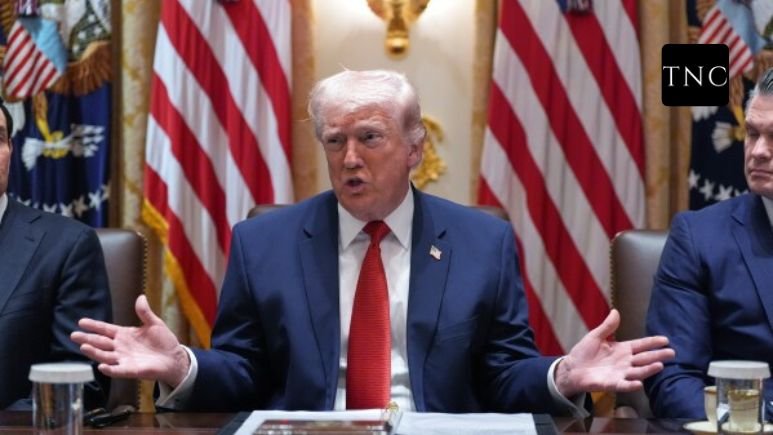

U.S. President Donald Trump said Tuesday that the military campaign against Iran could be wrapped up within two to three weeks but economists, oil analysts, and his own administration privately acknowledge that even a swift end to the fighting would not quickly restore the flow of energy through the choked arteries of global trade. For millions of households from Tokyo to London, the war’s economic aftershocks may outlast the war itself.
Trump Signals an Exit, With Conditions
Trump told reporters that after the war with Iran ends, other countries will “be able to fend for themselves” if they need to import oil or natural gas via the Strait of Hormuz. In a separate social media post directed at European allies, the president was blunter still: “All of those countries that can’t get jet fuel because of the Strait of Hormuz, like the United Kingdom, which refused to get involved in the decapitation of Iran, I have a suggestion for you: Number 1, buy from the U.S., we have plenty, and Number 2, build up some delayed courage, go to the Strait, and just TAKE IT.”
Yet within the same 24-hour news cycle, Trump renewed his threat to devastating effect if diplomacy collapsed. On Monday he posted on Truth Social that if a deal was not “shortly reached” and the Strait of Hormuz was not “immediately open for business,” U.S. forces would “blow up and completely obliterate all of their Electric Generating Plants, Oil Wells and Kharg Island, and possibly all desalination plants which we have purposefully not yet touched.”
The White House confirmed that Trump would address the nation in a prime-time speech on Wednesday evening to provide what it called “an important update on Iran.”
The Hormuz Problem: Harder to Fix Than to Cause
Trump’s administration increasingly believes it may have to end the Iran war without being able to promise that the Strait of Hormuz will reopen on the same timeline. Top officials have privately acknowledged they cannot both achieve their military objectives quickly and vow to reopen the strait within the same window, according to sources familiar with those talks.
The strait’s closure is already inflicting measurable damage. Roughly 27% of the world’s maritime trade in crude oil and petroleum products normally passes through the approximately 100-mile-long waterway bordering Iran. Starting March 4, Iranian forces declared the strait “closed,” threatening and carrying out attacks on ships attempting transit.
Iran’s selective blockade has impacted thousands of vessels. The waters are now exposed to mines and explosive drones, underscoring the risks facing commercial shipping. Since the start of the conflict, there have been at least seven seafarer deaths and more than a dozen vessels attacked near Iran.
Even if the war ends quickly, experts warn the damage is not instantly reversible. Tom Kloza, an independent oil analyst and adviser to Gulf Oil, noted bluntly, “There’s an old expression: gas prices go up like a rocket and come down like a feather.”
A Ticking Economic Clock
The world does not have the luxury of patience. Oil executives and analysts have warned that the Strait of Hormuz needs to be reopened by mid-April or oil-supply disruptions will get significantly worse. Geopolitical strategist Marko Papic of BCA Research estimated that the world has already lost 4.5 to 5 million barrels per day of oil supply due to the war, amounting to about 5% of global supply. He warned that number could double by mid-April, making it the largest loss of crude supply on record.
An Iranian attack that took out 17% of Qatar’s liquefied natural gas export capacity could take three to five years to be fully repaired, QatarEnergy’s CEO told Reuters. Alternative routing offers only limited relief. The Saudi East-West Pipeline can move up to 2 million barrels per day in total, with 1 to 1.5 million barrels per day accessible to ships, a fraction of the roughly 20 million barrels that would normally flow through the Strait of Hormuz on a regular day.
At the pump, the consequences are already visible. Average domestic petrol prices in the U.S. jumped past $4 a gallon this week for the first time in almost four years, driven by Iran’s attacks on Gulf oil facilities and its continued squeezing of fuel supplies through the strait.
Markets Cautiously Optimistic, Analysts Wary
Financial markets reflected Trump’s exit signals with a degree of relief on Tuesday. Wall Street analyst Adam Crisafulli of Vital Knowledge said the day’s rally was “thanks in large part to anticipation of a further deescalation in the war,” pointing to a Wall Street Journal report that Trump is weighing ending the conflict without insisting on a formal military reopening of the strait.
Yet oil markets told a more complex story. Brent crude was up 4.9% to just over $118 a barrel for May deliveries, while the more widely traded June delivery contract fell 3.6% to around $103.50 a split reflecting both near-term scarcity fears and longer-term hopes for resolution.
Iran’s Conditions, Europe’s Predicament
Iranian President Masoud Pezeshkian said Tuesday that his country is ready to stop fighting, provided it receives guarantees it will not be attacked again. Foreign Ministry officials simultaneously continued to reject the U.S. 15-point peace proposal as “unrealistic and unreasonable,” and denied that direct negotiations were under way.
Meanwhile, Iran’s parliament moved to institutionalise its leverage over global trade. Lawmakers approved a plan to impose tolls on ships using the Strait of Hormuz, including an outright ban on U.S. and Israeli vessels and new financial regulations for all other traffic, denominated in the Iranian rial.
For European governments, Trump’s message has been unambiguous: the U.S. expects them to secure their own energy supply lines. British Prime Minister Keir Starmer reiterated this week that the United Kingdom would not get involved militarily in the conflict, a position Trump has publicly ridiculed. Secretary of State Marco Rubio said Washington was still working to form an international coalition to police the strait long-term, but acknowledged it was “a longer-term goal.”
Whether the war ends in two weeks or two months, the world’s energy infrastructure bears wounds that will take far longer to heal and the Strait of Hormuz, once one of the most trafficked waterways on earth, will carry the scars of this conflict for years to come.










Leave a comment