


By 6 a.m., the queue had already curled around the corner.
In Nagpur, a delivery truck idled outside a gas agency while men clutched booking slips and women balanced empty cylinders against their hips. Someone muttered that the next refill might take days. Inside, the manager kept refreshing his screen, waiting for confirmation that another shipment had docked somewhere along India’s vast coastline. It hadn’t. Not yet.
A few weeks earlier, the routine had been invisible. Cylinders arrived, kitchens ran, and the system was fragile as it was held. Now, every delay had a face. Every shortage had a line.
This is what a distant conflict looks like when it reaches a kitchen.
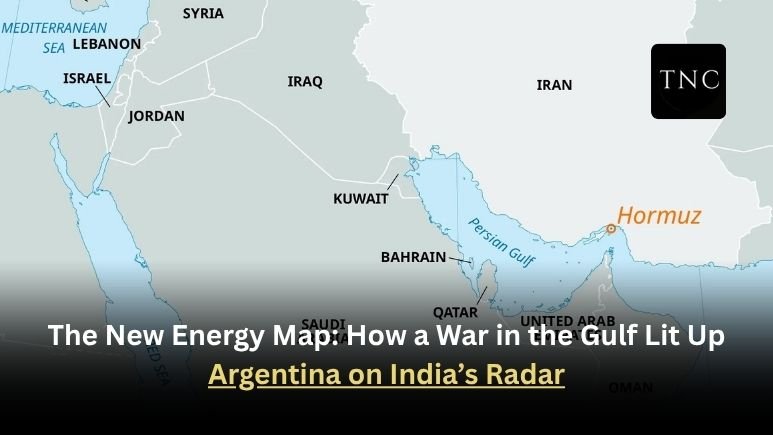
The ongoing West Asia crisis, particularly disruptions around the Strait of Hormuz, has choked one of the world’s most critical energy arteries. For India, which depends on imports for more than half of its LPG needs, the shock has been immediate and severe.
Into that vacuum stepped an unlikely player: Argentina.
In just three months, shipments of LPG from the South American nation to India more than doubled, transforming a marginal trade link into a strategic lifeline.
The story is no longer just about a shortage. It is about how global energy routes are being redrawn in real time.
Energy systems are built on geography. Wars break them.
For decades, India’s LPG supply chain leaned heavily on the Gulf. The logic was simple: shorter routes, lower freight costs, and stable long-term contracts. But that efficiency came with a hidden risk: concentration. Nearly 90% of India’s LPG imports pass through the Strait of Hormuz, a narrow choke point now caught in geopolitical crossfire.
When that route faltered, the consequences rippled instantly. Ships stalled. Prices jumped. Households waited.
Argentina’s emergence is not accidental, it is structural.
The country has been quietly expanding its LPG production, driven by natural gas output and infrastructure upgrades. In early 2026, it shipped about 50,000 tonnes of LPG to India—more than double its entire supply the previous year. What had been a peripheral trade relationship suddenly became essential.
But this pivot comes at a cost.
Distance matters. Cargoes from Argentina take significantly longer to reach India than those from the Gulf, with higher shipping costs and tighter vessel availability. In energy markets, time is money and sometimes, survival.
So why does India still turn to Argentina?
Because resilience now outweighs efficiency.
The crisis has exposed a fundamental weakness: India has limited LPG storage capacity and cannot easily buffer supply shocks. Unlike crude oil, which can be stockpiled in strategic reserves, LPG requires specialized infrastructure. When imports slow, shortages appear quickly and visibly.
That urgency is forcing a broader recalibration.
India is now pulling supplies from wherever it can, the United States, Europe, and increasingly Latin America. Argentina is not replacing the Gulf. It is supplementing it, buying time in a system under stress.
And beyond the numbers lies a deeper shift.
Energy trade is no longer just about proximity. It is about flexibility. The ability to reroute, renegotiate, and respond faster than the crisis evolves. Argentina’s rise in India’s LPG map is a case study in that new reality where geography bends under pressure, and new alliances form not out of strategy, but necessity.
A war thousands of kilometers away has rewritten India’s energy playbook.
Argentina didn’t plan to become India’s LPG lifeline. The crisis made it one.
The lesson is stark: in a volatile world, the countries that adapt fastest, not the ones closest, keep the lights on and the kitchens running.
Also Read / The Illusion of Energy Independence: Lessons From the Hormuz Shock.











Leave a comment