

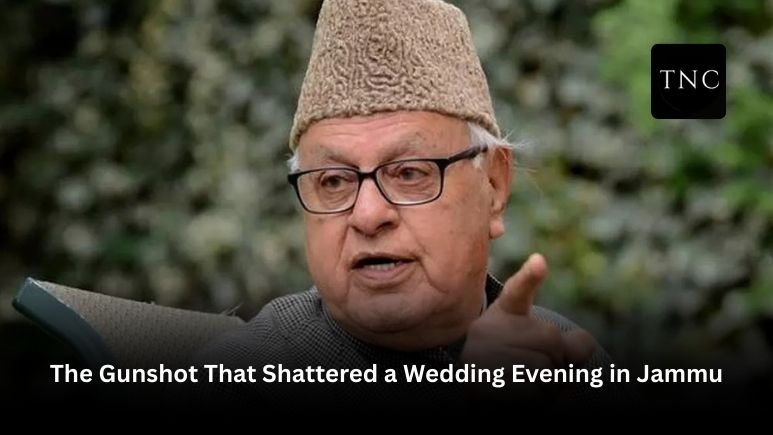

The music was still playing when the shot rang out.
Guests at a wedding reception in Jammu’s Greater Kailash neighborhood had gathered near the exit, waiting for the groom’s relatives to arrive. Laughter mixed with the clatter of plates. Then a sharp crack cut through the evening air. For a moment, people thought it was a firecracker common enough at celebrations in northern India.
But it wasn’t.
Just a few steps away stood Farooq Abdullah, the 88-year-old veteran politician and former chief minister of Jammu and Kashmir. Behind him, a man raised a pistol and fired from close range. In seconds, security commandos lunged forward, pushing the attacker aside before the bullet could hit its target. Chaos erupted. Guests scattered. Security forces tackled the gunman.
The shooter identified as Kamal Singh Jamwal, a local resident was quickly detained as stunned onlookers tried to understand how a man with a weapon had come within arm’s reach of a leader protected by Z+ security.
The failed assassination attempt on Farooq Abdullah did more than interrupt a wedding. It exposed unsettling questions about security, political tensions, and the fragile sense of stability in Jammu and Kashmir.
The incident occurred while Abdullah was attending a private marriage function in Jammu, accompanied by senior political leaders including the region’s deputy chief minister. A gunman managed to approach within point-blank range before firing, and only the quick reaction of security personnel prevented a tragedy.
Authorities have arrested the suspect and begun questioning him, but the motives remain unclear. For a region with a long history of political violence and security challenges, the attack has reignited concerns about how vulnerable even heavily protected leaders can be.
The most troubling question is simple: How did the attacker get so close?
Abdullah is not an ordinary political figure. As president of the National Conference and a former chief minister, he travels with one of the highest levels of security available in India. Such protection typically includes armed escorts, advance reconnaissance of venues, and strict access control.
Yet in this case, a man carrying a pistol was able to blend into a social gathering and approach the leader from behind.
Security experts say events like weddings or private ceremonies are particularly vulnerable. Unlike official rallies or government buildings, guest lists are fluid and screenings can be less rigorous. A determined attacker can exploit the informality of such settings.
But the implications go deeper than a single security lapse.
For decades, Jammu and Kashmir has been a political flashpoint. Abdullah himself has remained a central figure in the region’s politics, navigating tensions between local aspirations and New Delhi’s authority. Incidents targeting high-profile leaders risk reigniting fears of political instability especially when motives remain murky.
In the immediate aftermath of the attack, Abdullah himself appeared calm. He later said he initially thought the gunshot was a firecracker and credited divine intervention for his survival.
Still, questions linger:
- Was this an isolated act or something more organized?
- Did security protocols fail?
- And what does the incident reveal about the risks facing public figures in Kashmir’s volatile political environment?
For now, investigators are searching for answers.
The bullet missed. The consequences did not.
The attempted assassination of Farooq Abdullah is a reminder that in Jammu and Kashmir, politics still moves under the shadow of danger. One quick intervention by security officers prevented a national crisis. But until the deeper questions are answered, the echo of that single gunshot will linger far beyond a wedding hall in Jammu.
Also Read / Wedding Horror in Pakistan: Suicide Bomber Kills 7 at Peace Leader’s Home.











Leave a comment