

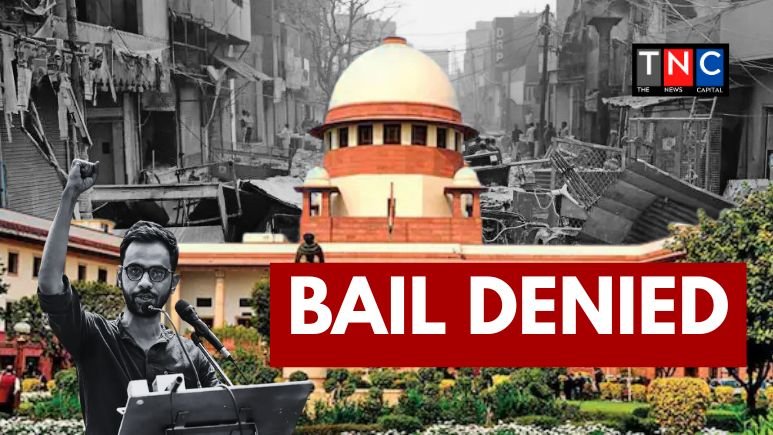

After five years behind bars without trial, they finally got their day before India’s highest court. For five of the accused, it brought freedom. For two of the most prominent faces of the movement, it brought only the prospect of more years in prison their roles deemed too central, their alleged crimes too serious, their liberty subordinate to national security concerns enshrined in one of India’s most stringent laws.
The Supreme Court on Monday (January 5, 2026) refused to grant bail to former JNU student leader Umar Khalid and activist Sharjeel Imam in the case involving an alleged pre-planned conspiracy behind the February 2020 Northeast Delhi riots that left 53 dead and over 700 injured. However, in a split outcome that will bring relief to some families and heartbreak to others, a bench comprising Justices Aravind Kumar and N.V. Anjaria granted bail to five other co-accused Gulfisha Fatima, Meeran Haider, Shifa Ur Rehman, Mohd. Saleem Khan, and Shadab Ahmad citing their “subsidiary and ancillary” roles compared to the “central” roles attributed to Khalid and Imam.
The Supreme Court’s decision created a hierarchy of alleged culpability, essentially dividing the accused into masterminds and followers, architects and participants, leaders and foot soldiers.
The court’s differentiated approach:
| Accused | Verdict | Court’s Reasoning |
| Umar Khalid | Bail Denied | Roles were “central” and “formative” in orchestrating the conspiracy; speeches and activities indicated leadership position. |
| Sharjeel Imam | Bail Denied | Speeches and planning suggested a “higher footing” in the conspiracy hierarchy; allegations more serious in nature. |
| Gulfisha Fatima | Bail Granted | Allegations were “subsidiary” in nature compared to alleged masterminds; had spent 5.5 years in custody. |
| Meeran Haider | Bail Granted | Granted relief subject to stringent conditions including periodic reporting and travel restrictions. |
| Shifa Ur Rehman | Bail Granted | Released after over five years of incarceration without trial; role deemed ancillary. |
| Mohd. Saleem Khan | Bail Granted | Ancillary role attributed in the prosecution narrative; statutory UAPA threshold not as heavily attracted. |
| Shadab Ahmad | Bail Granted | Evidence against him not as compelling as against the alleged primary conspirators. |
The Court emphasized that Section 43(D)(5) of the Unlawful Activities (Prevention) Act (UAPA) creates a distinct and punishing statutory framework where bail becomes the exception rather than the rule if the court finds reasonable grounds to believe the accusations are prima facie true. It’s a provision that civil liberties advocates have long argued essentially reverses the presumption of innocence that normally governs criminal law.
The court’s key legal findings:
- No Parity with Earlier Releases: The bench explicitly rejected defense arguments that Khalid and Imam should receive the same treatment as fellow activists like Natasha Narwal and Devangana Kalita, who were granted bail back in 2021. The court held that the roles attributed to Khalid and Imam were “prima facie graver” and more central to the alleged conspiracy, making their cases fundamentally different.
- Incarceration Time vs. Statutory Bars: While acknowledging that both men had been imprisoned for over five years without their trial even concluding a period that would exceed many actual sentences for less serious crimes the court held that the “statutory threshold” established by UAPA’s stringent bail provisions outweighed normal constitutional protections of personal liberty at this stage of proceedings.
- Future Hope, But Distant: In what defense lawyers called a “slight silver lining” in an otherwise devastating ruling, the bench granted Khalid and Imam liberty to revive their bail applications after the examination of protected witnesses (whose identities are being kept secret for security reasons) or upon the completion of one year from today’s ruling meaning at the earliest, January 2027.
“The fact that the accused has been in custody for a considerable period is not in itself sufficient to grant bail under UAPA if the prima facie case against them appears strong,” the bench observed in its written judgment, articulating the harsh reality of India’s anti-terror laws.
“I heard the judgment… I don’t want to say anything,” said Syed Qasim Rasool Ilyas, Umar Khalid’s father, his brief statement heavy with the weight of five years of waiting and the prospect of many more to come.
“After nearly 2,000 days in judicial custody, Gulfisha and the others can finally go home. But the fact that Umar and Sharjeel remain inside despite spending the same amount of time in prison without trial raises serious questions about what justice actually means,” commented one of the defence lawyers, speaking on condition of anonymity.
The “larger conspiracy” case (FIR 59/2020) relates to the communal violence that erupted in Northeast Delhi in February 2020, coinciding with protests against the controversial Citizenship Amendment Act (CAA) and proposed National Register of Citizens (NRC). The riots resulted in 53 deaths primarily from the Muslim community and over 700 injuries, with entire neighbourhoods burned and thousands displaced.
The Delhi Police have consistently maintained that the violence was not spontaneous but rather a “well-orchestrated and pre-planned” conspiracy designed to destabilize the Indian state, timed deliberately to coincide with then-U.S. President Donald Trump’s visit to India. According to the prosecution narrative, Khalid and Imam served as the intellectual architects who used inflammatory speeches and organizational capabilities to mobilize protesters with the ultimate goal of creating chaos and violence.
The defense has vehemently denied these allegations, arguing that the accused were engaged in legitimate democratic protest against what they viewed as discriminatory legislation, and that the conspiracy charges are a politically motivated attempt to criminalize dissent and silence opposition voices. They point to the five-year imprisonment without conviction as evidence that the case is weak and that the process itself has become the punishment.
The split verdict creates a complicated moral and legal landscape. On one hand, five individuals who have spent over 1,800 days in prison without trial will finally taste freedom, reunite with families, and attempt to rebuild lives put on hold since 2020. On the other hand, two men deemed the masterminds based on prosecution allegations that remain unproven in court will continue their indefinite imprisonment, their liberty subordinated to national security concerns encoded in a law that makes bail exceptionally difficult.
For Khalid and Imam, the timeline is now brutally clear: at minimum, another year in prison before they can even reapply for bail. And even then, there’s no guarantee. The trial itself shows no signs of concluding soon with hundreds of witnesses yet to be examined and the procedural complexities of a UAPA case virtually guaranteeing years more of litigation.
Civil liberties organizations have seized on the verdict as evidence of UAPA’s draconian nature, arguing that laws allowing five-year pre-trial detention based solely on police allegations undermine fundamental constitutional guarantees. Government defenders counter that serious national security threats require exceptional legal frameworks, and that the Supreme Court’s careful differentiation between accused demonstrates the law is being applied judiciously rather than arbitrarily.
The families of those granted bail will celebrate tonight, marking the end of an ordeal that’s consumed five years of their lives. But in another corner of Delhi, Umar Khalid’s father will return home to an empty room, and Sharjeel Imam’s family will mark another night of an imprisonment that now extends indefinitely into an uncertain future.
The verdict is final, but the questions it raises about justice, liberty, and the balance between security and freedom will continue long after the five walk free and the two remain behind bars.
Also Read / Supreme Court to weigh Trump’s challenge to birthright citizenship.










Leave a comment