

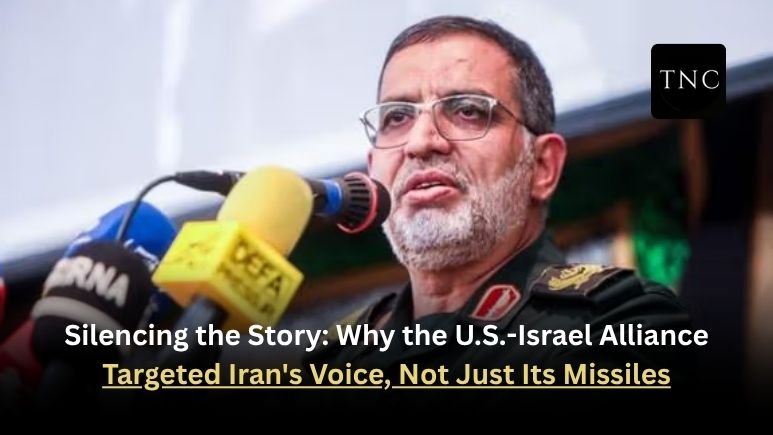

The studio lights were still warm when Ali Mohammad Naini leaned toward the microphone, his voice steady, almost defiant. Hours earlier, he had dismissed claims that Iran’s military capabilities were crumbling, insisting the country’s missile program remained intact. Outside, Tehran was bracing for another uneasy night siren, distant explosions, the low hum of a city learning to live with war. By morning, the man who had shaped that message for the world was dead, killed in a strike attributed to U.S. and Israeli forces.
The death of Naini, the spokesperson of Iran’s Islamic Revolutionary Guard Corps (IRGC), is not just another casualty in an expanding conflict it signals a shift in strategy. This is no longer a war of infrastructure and proxies. It is a war aimed at dismantling leadership, narrative, and psychological control.
In modern conflict, the spokesperson is not merely a messenger. He is the architect of perception. By targeting Naini, the U.S.-Israel alliance appears to be striking at the IRGC’s ability to project confidence, maintain morale, and control the story inside and outside Iran.
Naini was not a battlefield general in the traditional sense. He was something more modern and, in some ways, more dangerous. A specialist in “cognitive warfare” and psychological operations, he helped shape how Iran explained the war to its own people and the world.
His killing fits a pattern. In recent days, several high-ranking Iranian figures including senior political and military leaders have been eliminated in targeted strikes. These are not random hits. They are calculated removals of influence.
This strategy does three things at once:
1. It disrupts command and communication
Removing leadership creates confusion. Orders slow. Coordination weakens. In a fast-moving conflict, even hours of uncertainty can shift outcomes.
2. It fractures public messaging
War is fought as much in perception as in territory. Naini’s role was to reassure Iranians, counter enemy narratives, and project strength. Without him, the state’s messaging machine loses coherence.
3. It escalates the stakes dramatically
Targeting top officials raises the conflict to a new level. It signals that no one is off-limits not politicians, not generals, not even those behind the podium.
At the same time, the broader war is widening. Strikes on energy infrastructure, attacks across Gulf states, and threats to the Strait of Hormuz are pushing global markets and regional stability to the edge. Oil prices fluctuate. Supply chains tremble. The battlefield is no longer confined to borders it is embedded in the global economy.
And Iran, for its part, is signaling defiance. Even in his final statements, Naini rejected claims that the country’s military capabilities had been neutralized. His message survives him but the question is for how long, and with what credibility.
Killing a spokesperson doesn’t end a war. But it changes how the war is told and who controls the story.
In this conflict, power is no longer just about missiles and territory. It is about narrative, perception, and the people who shape both.
Ali Mohammad Naini’s death is a reminder: when wars reach this stage, they are no longer just being fought on the ground, they are being fought inside the minds of millions.
Also Read / Pakistan Burns Inside While Its Army Chief Warns: This War Is Not Yours.











Leave a comment