

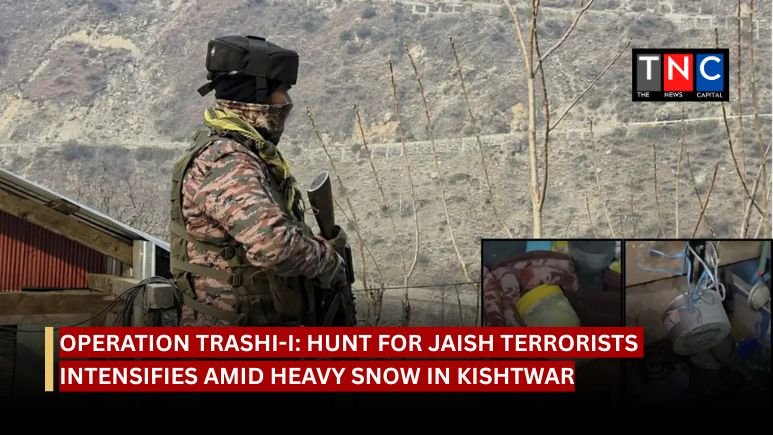

Thirteen days. Three terrorists. Over two feet of fresh snow. Sub-zero temperatures that make breathing painful and fingers numb within minutes. Dense forest so thick that visibility drops to mere meters. And a group of highly trained militants who know these mountains intimately, using every natural advantage to evade India’s most elite soldiers. This is asymmetric warfare at its most brutal where technological superiority matters less than endurance, where billion-rupee surveillance equipment struggles against weather and terrain, and where the hunters sometimes become the hunted in forests that have swallowed armies before.
Security forces on Friday (January 30, 2026) dramatically intensified “Operation Trashi-I” in the remote Chatroo belt of eastern Kishtwar district, pursuing what intelligence agencies have identified as a small but extremely dangerous cell of three Jaish-e-Mohammad (JeM) militants who have managed to evade capture for nearly two weeks despite being surrounded by thousands of troops equipped with cutting-edge surveillance technology. As the manhunt entered its critical 13th day, the Jammu and Kashmir Home Department ordered the continued suspension of mobile internet services across the Singhpora, Chingam, and Chatroo areas a digital blackout covering dozens of villages and affecting tens of thousands of civilians to prevent what officials characterize as potential “misuse by anti-national elements and over-ground workers” during the operation’s most sensitive tactical phase.
The operation, which commenced on January 18 following specific intelligence inputs about militant movement in the area, has evolved into a grueling high-altitude pursuit punctuated by brief, violent firefights as the terrorists repeatedly slip away using the challenging terrain, extreme weather conditions, and their apparent intimate knowledge of the forest networks.
- The January 18 Opening Battle: The operation’s first major contact occurred in the dense Sonnar forest area near the Mandral-Singhpora sector when security forces, acting on specific intelligence, attempted to cordon off the suspected location of the militant group. What followed was an intense firefight lasting several hours that resulted in the “supreme sacrifice” (the military’s term for death in action) of one paratrooper from an elite special forces unit and left seven other soldiers wounded, three seriously. Despite the overwhelming numerical advantage and firepower superiority enjoyed by security forces, the three terrorists managed to break the cordon and escape by exploiting the thick vegetation, difficult terrain characterized by steep ravines and narrow forest paths, and the approaching darkness that severely limited visibility.
- Subsequent Running Battles: Additional significant firefights were reported at Mali Dana top on January 22 a high-altitude ridge offering commanding views but also treacherous footing and exposure to brutal winds and again at Janseer-Kandiwar on January 25. In each encounter, the pattern repeated frustratingly: brief contact, intense exchange of fire, then the insurgents using the natural cover of darkness and increasingly heavy snowfall to break contact and melt back into the forest before reinforcements could arrive to seal escape routes. The fact that the same three individuals have successfully evaded capture through multiple cordons suggests either exceptional training, detailed prior reconnaissance of the area, or assistance from local over-ground workers who provide real-time information on security force positions.
- The Hideout Discovery: Earlier this month, during systematic combing operations expanding outward from contact points, security forces discovered and destroyed a sophisticated terrorist hideout located on a precarious cliff slope chosen specifically because its dangerous approach would deter casual discovery. The cache contained gas cylinders for cooking and heating, large quantities of packaged food supplies indicating preparation for extended operations, and other materials suggesting this was a pre-positioned logistical base rather than a temporary shelter. The discovery confirmed intelligence assessments that this group had been planning a significant attack and had spent considerable time preparing the operational environment.
Despite more than two feet of accumulated snowfall that has buried trails, obscured visual markers, and made movement exhausting even for highly fit soldiers, the Indian Army and Jammu & Kashmir Police have deployed an impressive and sophisticated array of military assets to maintain pursuit:
- Multi-Layer Aerial Surveillance: Drones ranging from small tactical quadcopters to larger fixed-wing UAVs, along with Army helicopters equipped with thermal imaging and night vision capabilities, are being employed to continuously monitor the high-altitude ridges and forest canopy of the Chenab Valley region. However, persistent low cloud cover, frequent snowfall, and the dense tree canopy have significantly limited the effectiveness of aerial surveillance, with thermal signatures often obscured by weather conditions and the militants’ apparent knowledge of how to avoid detection from above.
- Elite Special Forces Deployment: The operation involves India’s most capable counter-insurgency units: Para (Special Forces) commandos trained specifically for high-altitude operations, Rashtriya Rifles (RR) battalions with years of experience in Kashmir’s difficult terrain, and the Special Operations Group (SOG) of the J&K Police local officers who bring invaluable knowledge of the region, local languages, and social networks that outsiders cannot replicate.
- K9 Tracker Teams: Specialized military working dog units, including German Shepherds and Belgian Malinois trained specifically for tracking human scent in challenging conditions, have been deployed extensively through the Singhpora and Chatroo forests. However, the continuous snowfall keeps burying scent trails, and the extreme cold affects even these highly trained animals’ ability to maintain pursuit over extended periods.
Operation status and broader context:
| Operational Element | Current Status (January 30, 2026) |
| Primary Targets | Three Jaish-e-Mohammad militants, identities partially known through intelligence |
| Security Force Casualties | One paratrooper killed in action; eight soldiers wounded, three serious and five moderate |
| Digital Communications | Complete mobile internet suspension from 2G to 5G within a six kilometer operational radius |
| Parallel Operations | Simultaneous search for two additional suspects in the Surankote sector, Poonch district |
| Civilian Impact | Over forty thousand residents affected by internet shutdown; movement restrictions in upper reaches |
| Weather Conditions | Sub-zero temperatures, over twenty four inches of accumulated snow, with intermittent snowfall continuing |
The intensification of Operation Trashi-I follows what security officials characterize as a significant tactical victory last week when a high-ranking Pakistani national and senior Jaish-e-Mohammad operative was neutralized (killed) during an encounter in the Kathua district of Jammu region. Intelligence officials believe with high confidence that the group currently being hunted in Kishtwar’s mountains is part of a coordinated, desperate attempt by JeM handlers operating from across the Line of Control in Pakistan-administered Kashmir to execute what they term a “spectacular” attack a high-casualty strike designed to generate international headlines, demonstrate the group’s continuing operational capability, and divert attention from the demonstrably successful results of India’s comprehensive counter-infiltration strategy, Operation Sindoor.
Operation Sindoor, launched in late 2024 and involving enhanced surveillance along the LoC, improved intelligence coordination, and aggressive domination of traditional infiltration routes, has achieved what security officials describe as “nearly zero” infiltration rates over the past six months the lowest in over two decades of counter-insurgency operations in Kashmir. This operational success has severely constrained Pakistan-based militant groups’ ability to insert fresh fighters into the Kashmir Valley, forcing them to rely on small cells of highly trained operatives who infiltrated months or years earlier and have been lying dormant waiting for opportunities.
“These three individuals represent exactly the kind of threat we’re most concerned about: highly trained, well-equipped, familiar with the terrain, and committed to executing a major attack to demonstrate JeM’s relevance at a time when their operational capacity has been severely degraded,” stated a senior Army officer involved in the operation, speaking on condition of anonymity due to the sensitive ongoing nature of the manhunt.
“The fact that they’ve evaded capture for thirteen days despite being effectively surrounded demonstrates both their training level and the inherent advantages defenders have in this kind of terrain. Every soldier deployed knows that in these forests, in this weather, the militants have all the advantages except numbers,” noted Lt. Gen. (Retd.) H.S. Panag, former Northern Army Commander with extensive Kashmir experience.
As the internet suspension remains in effect until at least midnight on January 30 likely to be extended if the operation continues local residents have been issued advisories strongly discouraging any movement toward the upper reaches of the Chatroo belt while security forces continue their systematic sweep of the snow-clad peaks, ravines, and forest areas where the militants are believed to be hiding.
The operation has created significant hardship for local civilians, who face not only movement restrictions and the complete absence of mobile internet connectivity affecting everything from business communications to accessing government services to staying in touch with family members but also the constant anxiety of living in an active conflict zone where firefights can erupt without warning and where the presence of thousands of heavily armed security personnel fundamentally disrupts normal life.
For the soldiers conducting the manhunt, the challenge is both physical and psychological: maintaining high alertness and operational tempo in brutally cold conditions that sap energy and blur judgment, knowing that a moment’s inattention could mean an ambush, while simultaneously trying to distinguish between the three dangerous militants they’re hunting and the innocent civilians who live and work in these same forests.
Thirteen days in, with one soldier dead and eight wounded, with thousands of troops deployed, with millions of rupees in equipment and operational costs expended, the hunt continues. The three militants remain at large, moving through forests they apparently know intimately, surviving conditions that would kill most people within days, and waiting for their moment either to execute the attack they came to carry out, or to achieve the martyrdom that their ideology promises.
The snow keeps falling. The drones keep circling. The soldiers keep searching. And somewhere in the forests of Kishtwar, three men with guns are deciding whether to fight, flee, or wait.
Also Read / Terror in the Enclave: Deadly Blast Rocks Central Kabul’s Shahr-e-Naw Area.














Leave a comment