

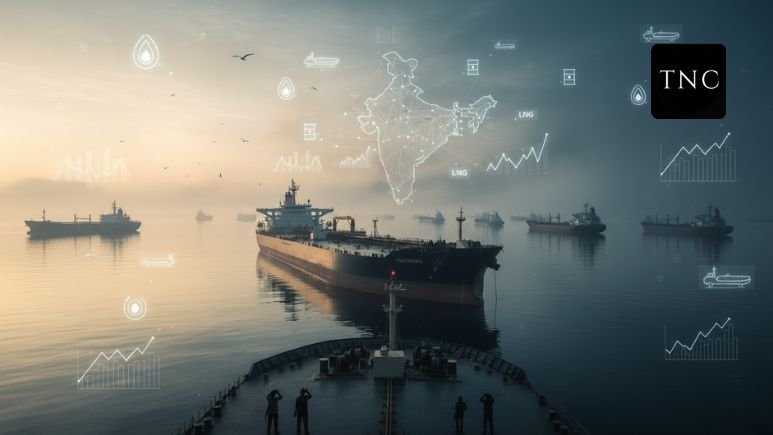

At dawn, the tanker waited.
Off the mouth of the Persian Gulf, its engines idled, its cargo tanks half-prepared, its crew scanning a horizon that had turned from trade route to war zone. Radio chatter crackled warnings, reroutes, silence. For days, vessels like this one bound for India’s refineries and kitchens had been stranded near the Strait of Hormuz, a narrow stretch of water that suddenly carried the weight of a global crisis. Some ships turned back. Others waited for naval escorts. A few pushed forward, gambling on safe passage.
Behind each delayed shipment was a chain reaction: a factory slowing production, a household gas cylinder running late, a government recalculating risk in real time.
India’s urgent push to revive liquefied natural gas (LNG) deals with Russia is not just a diplomatic maneuver, it is a response to one of the most severe energy disruptions in modern history. The ongoing conflict in West Asia has effectively choked the Strait of Hormuz, a passage that handles roughly 20% of global oil and significant LNG flows, sending shock waves through energy markets.
For a country that imports nearly 90% of its crude and relies heavily on Gulf energy supplies, the crisis has exposed a single, uncomfortable truth: energy security is no longer just about price, it’s about survival.
The numbers tell a stark story.
India once sourced over 40% of its oil from the Middle East. Now, with shipping routes disrupted and tankers stranded, the government has scrambled to diversify, securing supplies from more than 40 countries and stockpiling reserves that can last about two months.
But oil is only part of the equation.
Liquefied natural gas critical for power, industry, and urban households has become the real pressure point. The Gulf supplies nearly half of India’s LNG, and disruptions have already forced a shift toward coal and emergency procurement strategies.
That’s where Russia re-enters the picture.
After months of dialing back Russian imports amid geopolitical pressure, India is now quietly reversing course. Talks to restart LNG purchases from Moscow once paused due to sanctions and shifting alliances have gained urgency.
This is not just opportunistic diplomacy. It’s a strategic recalibration.
Russian energy offers three immediate advantages:
- Geographic diversification, reducing dependence on a single volatile region
- Pricing leverage, especially if sanctions waivers are secured
- Supply continuity, even as global LNG markets tighten into a seller’s market
Yet the move carries risk.
Leaning too heavily on Russia could expose India to future sanctions shocks or diplomatic friction with Western partners. At the same time, the current crisis has shown that overdependence on the Middle East is equally dangerous.
India is not choosing between partners, it is building redundancy into a fragile system.
Meanwhile, the global backdrop remains volatile. The Hormuz disruption has already slashed oil flows, driven prices past $100 per barrel, and triggered what analysts describe as the worst energy shock since the 1970s.
In this environment, energy strategy is no longer a long-term policy, it is a daily operational decision.
The tanker at the edge of Hormuz is no longer just a ship. It’s a signal.
India’s pivot toward Russian LNG is less about geopolitics and more about insulation against choke points, conflicts, and the unpredictability of global supply chains.
Because in a world where a single strait can stall an entire economy, energy security isn’t about where fuel comes from.
It’s about never depending on just one way to get it.
Also Read / When the Tankers Stop Coming: How Qatar’s LNG Crisis Is Reshaping the World’s Energy Order.









Leave a comment