

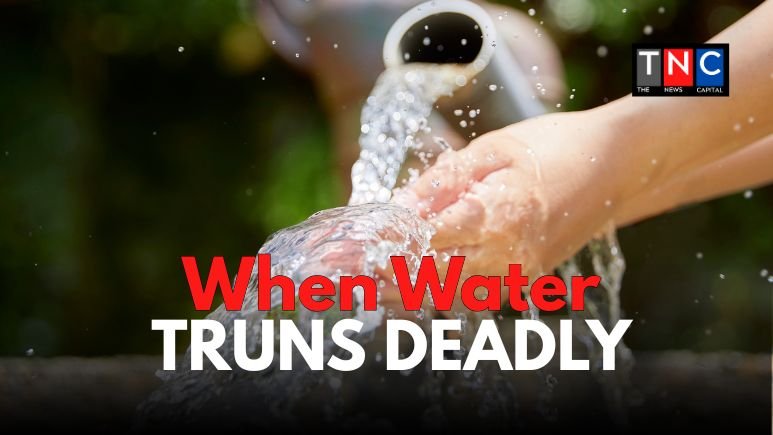

The irony is almost too bitter to swallow literally. India’s “cleanest city” for eight consecutive years, the poster child for urban sanitation success, is now synonymous with something far darker: contaminated water killing people in their own homes. The taps that were supposed to deliver life delivered death instead, and now a city celebrated for its hygiene is counting bodies and demanding answers.
The district administration in Indore, Madhya Pradesh, confirmed on Saturday (January 3, 2026) that the death toll from a devastating water contamination outbreak in the Bhagirathpura neighbourhood has risen to six. Collector Shivam Verma acknowledged that while six deaths are officially verified, over 200 people remain hospitalized across 41 medical facilities throughout the city, with 34 patients clinging to life in Intensive Care Units (ICUs), their bodies ravaged by severe vomiting, diarrhea, and dehydration.
The crisis has delivered a crushing blow to Indore’s carefully cultivated reputation as India’s model of urban cleanliness a title it has proudly held for eight consecutive years under the Swachh Survekshan rankings. The city that was supposed to show India how to get sanitation right is now a cautionary tale about what happens when infrastructure fails and warnings are ignored.
How sewage contaminated an entire neighborhood’s water supply:
- The Contamination Source: Laboratory analysis from MGM Medical College revealed catastrophic bacterial contamination in 26 out of 50 water samples tested. Investigators traced the deadly pollution to a main water pipeline running directly beneath a public toilet near a police outpost a design flaw that seems almost incomprehensible in retrospect. A leakage in the pipeline allowed raw sewage to seep directly into the drinking water supply, essentially turning residents’ taps into conduits for waste.
- The Disputed Death Count: While the administration officially recognizes six deaths, local residents and opposition Congress party leaders have alleged the actual toll is significantly higher. Residents claim as many as 16 people have died, including a six-month-old infant whose brief life ended before it truly began. Mayor Pushyamitra Bhargava previously estimated the death toll at 10, creating confusion and fueling suspicions of an official cover-up to minimize political damage.
- Swift Administrative Punishment: Facing mounting public fury over negligence, Chief Minister Mohan Yadav took decisive action on Friday, ordering the immediate removal of Municipal Commissioner Dilip Kumar Yadav the man ultimately responsible for the city’s water infrastructure. Additionally, Additional Municipal Commissioner Rohit Sissoniya and Superintendent Engineer Sanjeev Shrivastava have been suspended pending investigation, their careers potentially ruined by the disaster that unfolded under their watch.
The Bhagirathpura neighborhood has become ground zero for a tragedy that seems preventable in hindsight but was devastating in real-time. Families have shared horrifying accounts of loved ones falling violently ill almost immediately after drinking tap water the very water they’d trusted for years without a second thought.
The human stories behind the statistics:
- The Infant Who Never Had a Chance: In perhaps the most heart breaking case, a family who had waited 10 years to conceive lost their six-month-old baby to contaminated water. According to reports, they rejected the government’s compensation offer outright, demanding accountability and justice instead of money a powerful statement that no amount of cash can replace a child.
- Court-Ordered Free Treatment: The Madhya Pradesh High Court, taking a stern view of the government’s failures, has directed the state to provide completely free medical treatment to all affected citizens. The court also ordered immediate refunds of any deposits or fees already paid by patient’s recognition that victims shouldn’t bear financial costs for a crisis the government created through negligence.
- Human Rights Commission Involvement: The National Human Rights Commission (NHRC) has issued a formal notice to the Madhya Pradesh Chief Secretary, demanding a detailed report within two weeks explaining why residents’ repeated complaints about “foul-smelling water” were ignored for days before action was taken. The question hangs heavy: how many lives could have been saved if someone had listened sooner?
- Emergency Response: Medical teams are now conducting door-to-door health screenings of over 8,500 residents in the affected area, checking for symptoms and providing treatment before minor illness becomes life-threatening. Authorities have distributed chlorine tablets for water purification and stationed water tankers throughout the neighbourhood to provide a safe alternative supply measures that should have been in place before people started dying.
“At present, 203 patients are undergoing treatment… 34 are in the ICUs. We have fixed the leakage point that could have contaminated the water, but the situation is being monitored minute-to-minute,” Collector Shivam Verma stated, his words careful and measured, a bureaucrat navigating a crisis that has become intensely political.
“This is a grave sin. Poisoned water has swallowed so many lives in India’s cleanest city. Those responsible stand in the dock of crime against the people,” declared senior BJP leader Uma Bharti, her unusually harsh criticism of her own party’s government signaling just how serious the political fallout has become.
“They told us to be proud that Indore is the cleanest city. But what is the use when we cannot even drink water safely? My mother is in the hospital fighting for her life because she drank water from our own tap,” said Rajesh Sharma, a Bhagirathpura resident whose anger reflects the broader community’s sense of betrayal.
While the government insists the situation is now under “effective control” the standard bureaucratic language deployed in every crisis residents remain deeply skeptical. Trust, once broken, isn’t easily restored, especially when that trust involved something as fundamental as the safety of drinking water.
The administration has issued a standing advisory for all citizens in affected zones to boil water before consumption, a medieval solution in a city that prides itself on modernity. A standard operating procedure (SOP) for drinking water infrastructure across the entire state is reportedly being developed to prevent future disasters closing the barn door after the horses have bolted, as the saying goes.
The broader questions loom large: How did a pipeline end up beneath a public toilet in the first place? Who approved that design? Why were residents’ complaints about foul-smelling water dismissed or ignored for days? How many other neighbourhoods across India might be drinking from similarly compromised systems without knowing it?
Indore’s fall from grace is particularly striking because the city had become a symbol of what Indian urban governance could achieve when properly managed. Its eight consecutive “cleanest city” awards weren’t just ceremonial they represented visible improvements in waste management, sanitation, and public health infrastructure that other cities tried to emulate.
Now that reputation lies in tatters, contaminated like the water that caused this tragedy. The awards and accolades don’t mean much to families mourning loved ones who died from something as preventable as sewage in the water supply.
Six confirmed dead. Thirty-four fighting for their lives. Over 200 hospitalized. And countless others now wondering whether the water coming from their taps safe or whether they’re the next victim is waiting to happen.
India’s cleanest city learned the hardest possible lesson: cleanliness awards don’t matter if the basic infrastructure meant to sustain life fails. And when it does, no amount of PR, no number of suspensions, and no government compensation can undo the damage or bring back those who are gone.
Also Read / Trump threatens fresh tariffs on Indian rice over ‘dumping’ claims.













Leave a comment