

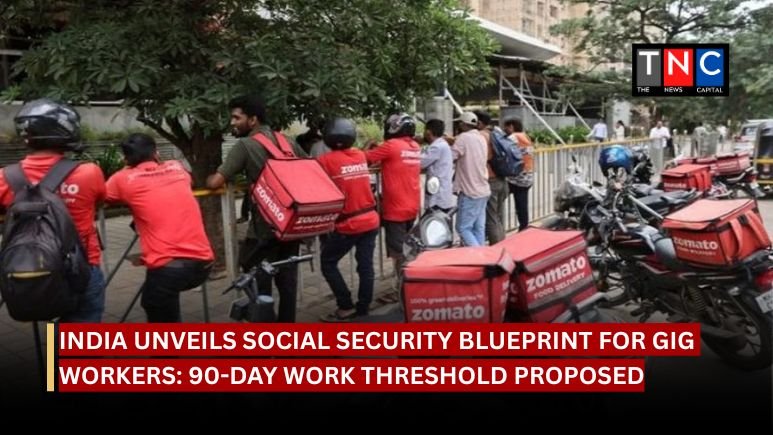

In a landmark move to formalize the “app-based” workforce, the Union Labour Ministry has released draft rules requiring gig workers to meet a minimum annual work threshold to unlock essential welfare benefits including health, life, and accident insurance.
The Union Ministry of Labour and Employment has proposed that gig and platform workers must be engaged with an aggregator for at least 90 days in a financial year to qualify for social security benefits under the new Code on Social Security, 2020. According to the draft rules released for public comment on Friday (January 2, 2026), the threshold increases to 120 days for those working across multiple platforms, like Zomato, Swiggy, and Uber.
The draft rules aim to provide a safety net for an estimated 8 million workers while setting clear eligibility criteria for government-led welfare schemes:
- Defining “Engagement”: A worker is considered “engaged” on any calendar day they earn an income from an aggregator, regardless of the amount. For those juggling multiple apps, workdays will be counted cumulatively across all platforms.
- Registration & Identity: All gig workers aged 16 to 60 must undergo Aadhaar-linked registration on the e-Shram portal. This will generate a Universal Account Number and a digital or physical identity card, ensuring benefits can move with them across different states and platforms.
- Core Benefits: Eligible workers will get access to life and disability cover, accident insurance, and healthcare under the Ayushman Bharat (PM-JAY) scheme. The government also hinted at potential future pension eligibility based on contributions.
- Funding the Fund: The social security schemes will be financed by a Social Security Fund, with aggregators required to contribute 1–2% of their annual turnover, capped at 5% of the total amount paid to workers.
The notification, dated December 30, 2025, comes at a critical time for the industry. It follows a widespread New Year’s Eve strike where thousands of delivery partners logged off to demand higher pay and better working conditions. While the rules offer long-term security, some unions have expressed concerns that the 90-day threshold might exclude “part-time” or seasonal workers who rely on the gig economy for extra income.
“This is a major step toward recognizing the contribution of platform workers to the national economy. By creating a Universal Account Number, we are ensuring that their benefits stay with them even if they switch platforms,” a senior official from the Union Labour Ministry said.
“While we welcome the formalization, the 90-day requirement needs careful study. Many gig workers are transient; we must ensure the most vulnerable don’t fall through the cracks of these eligibility windows,” noted Shaik Salauddin, National General Secretary of the Indian Federation of App-Based Transport Workers.
The government has invited feedback from stakeholders over the next 30 to 45 days. If finalized, the implementation of the four major Labour Codes, including these social security rules, is expected to begin on April 1, 2026. A National Social Security Board will also be set up to monitor these schemes and identify new types of aggregators as the digital economy continues to evolve.
Also Read / Party Plans vs. Protest: Gig workers launch New Year’s Eve strike; Zomato, Swiggy dangle ₹10,000 incentives.














Leave a comment