

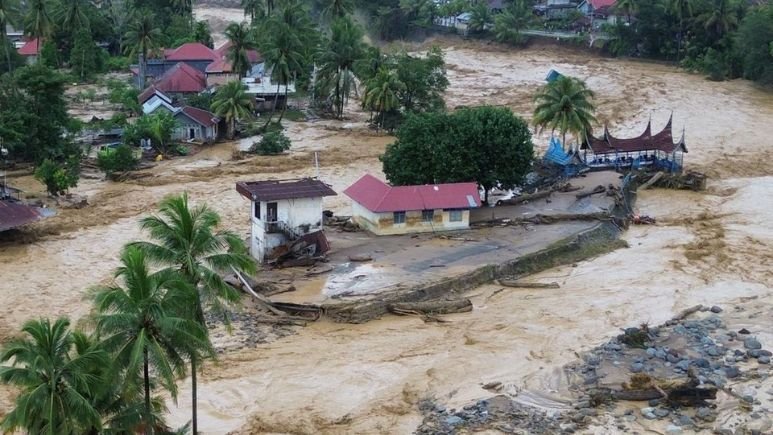

Survivors in Sumatra describe the terrifying moment walls of water swept away their homes, as rescue teams struggle to reach isolated villages amidst a rising death toll.
The death toll from catastrophic flash floods and landslides in Indonesia has risen to at least 712, with hundreds more still missing. In the worst-hit provinces of Aceh and North Sumatra, survivors are beginning to recount harrowing stories of escape after a rare equatorial cyclone triggered the disaster.
Heavy monsoon rains, intensified by Tropical Cyclone Senyar, inundated vast swathes of Sumatra island earlier this week. The disaster has displaced an estimated 1.1 million people and left entire villages buried under mud and debris.
In the city of Langsa, floodwaters rose so rapidly that residents had minutes to flee. Nurdin, a 71-year-old stroke survivor who uses a wheelchair, described resigning himself to his fate as the water burst into his home. “I was just waiting to die. I didn’t want to leave my home… I decided I would just die there,” he told reporters.
“As I was being carried, we got hit by a strong water current… I started to drown as I couldn’t stand up, and I thought ‘This is it’,” Nurdin recalled, crediting his survival to his wife’s insistence that they evacuate.
Busra Ishak, 60, from Pidie Jaya, survived by clinging to a coconut tree for 12 hours after his house was swept away. “There were hundreds of tons of logs, and even an elephant could be killed by the incredibly strong current,” he said.
The sheer scale of the destruction has been blamed on a collision of extreme weather and environmental degradation. Meteorologists note that it is highly unusual for cyclones to form so close to the equator, a phenomenon driven by rising sea temperatures.
However, environmental groups point to a man-made crisis exacerbating the natural one. Millions of cubic meters of felled timber were washed down from the mountains during the floods, sparking public anger over illegal logging and deforestation that stripped the landscape of its natural defenses.
Rescue operations remain hampered by severed roads and collapsed bridges, with some remote areas in North Sumatra still inaccessible days after the disaster. While the rains have begun to recede in some areas, the humanitarian crisis is acute, with survivors facing shortages of clean water, food, and clothing in overcrowded shelters.
Also Read / Death toll in Asian floods nears 1,000 as rare equatorial cyclone batters Indonesia and Thailand.














Leave a comment