

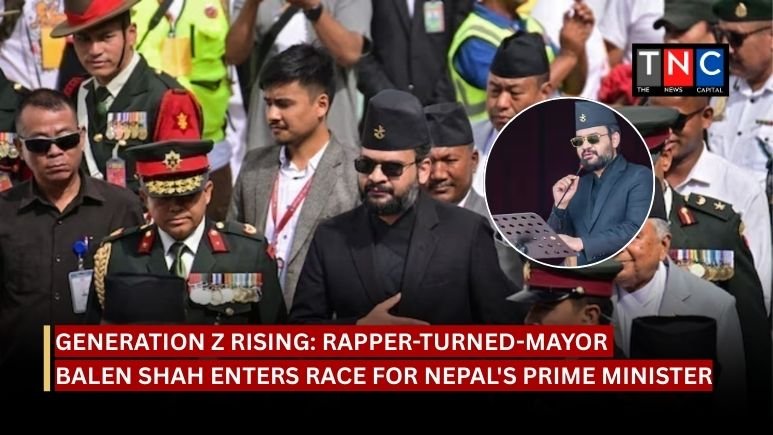

The establishment never saw him coming. A hip-hop artist who traded the microphone for municipal governance, and now wants to run an entire country. In Nepal, where politics has been the exclusive domain of dynastic families and aging party bosses for generations, Balendra “Balen” Shah represents something unprecedented: the possibility that the kids might actually take over.
Balendra Shah, the former rapper and current Kathmandu Mayor known simply as “Balen” to millions of young Nepalis, officially announced his candidacy for Prime Minister on Monday (December 29), striking a landmark alliance with the Rastriya Swatantra Party (RSP) that could fundamentally reshape Nepal’s political landscape. Under the agreement, if the RSP wins the upcoming parliamentary elections, Balen will become Prime Minister while party founder Rabi Lamichhane remains chairperson a power-sharing arrangement designed to unite reform energy with organizational structure.
The timing isn’t coincidental. This announcement comes just months after a massive youth-led uprising that shook Nepal to its foundations and forced the government to its knees, signaling that the country’s young people are done waiting their turn.
The alliance emerges directly from the ashes of the September 2025 “Gen Z” protests a movement that exploded when the government made a catastrophic miscalculation: they tried to silence the internet generation by banning 26 social media platforms, including YouTube, Facebook, and X (formerly Twitter). The reaction was swift, furious, and ultimately unstoppable.
The uprising and its aftermath:
- Deadly Confrontation: Tens of thousands of young Nepalis flooded the streets in what became the largest demonstrations since the country’s transition to democracy. The protests turned violent as security forces cracked down, leaving 77 people dead many of them students and young workers who’d never attended a political rally before but couldn’t stomach the government’s authoritarian overreach.
- Government Collapse: The sustained pressure worked. Prime Minister K.P. Sharma Oli’s government, which had seemed untouchable just weeks earlier, crumbled. He resigned, and an interim administration led by Sushila Karki making history as Nepal’s first female Prime Minister now oversees the transition until elections scheduled for March 5, 2026.
- Electoral Revolution: Nearly one million new voters, overwhelmingly young people, registered in the wake of the protests. They’re angry, they’re mobilized, and they’re expected to be the deciding factor in the March elections. This isn’t the electorate the old parties know how to manage.
- The Reform Agenda: Balen and Lamichhane are running on a platform built around “digital freedom” (never again will platforms be banned), administrative transparency (making government operations visible and accountable), and dismantling the political “inheritance” system where party leadership passes from father to son like family heirlooms.
“Consensus should not be what a leader wants. It should be what the country needs,” Rabi Lamichhane declared during the announcement press conference, his words clearly aimed at the backroom deal-making that’s characterized Nepali politics for decades. “We are here to represent the voices that were silenced by the digital blackout.”
“It is a strategic step to bring Balen and his young supporters into the party line,” observed political analyst Bipin Adhikari, trying to make sense of how dramatically the landscape has shifted. “This alliance bridges the gap between urban reform and national legislative power.”
“For the first time in my life, I actually believe my vote might change something. These aren’t the same old uncles promising the same old lies,” said Priya Shrestha, a 23-year-old university student who participated in the September protests and sports a scar on her arm from a police baton.
Balen Shah’s political journey reads like something that shouldn’t be possible in traditional politics—which is precisely why it resonates. In 2022, running as an independent with virtually no campaign infrastructure, he won the Kathmandu mayoral race in a stunning upset that humiliated both the established Nepali Congress and Communist parties. They’d assumed the capital city was theirs by birthright. Balen proved them spectacularly wrong.
Since taking office, he’s gained national fame for his “no-nonsense” approach to urban governance: actually fixing roads, confronting corrupt officials publicly, live-streaming municipal meetings, and generally behaving as if government should work for citizens rather than the other way around. His social media presence ironic given the recent ban has made him the most visible politician in Nepal among anyone under 35.
But not everyone is convinced this translates to national leadership. The established parties have dismissed the Balen-Lamichhane alliance as “overhyped,” pointing to several potential vulnerabilities. Most notably, Lamichhane faces ongoing legal challenges regarding the alleged misuse of cooperative funds—accusations that could become a major liability if they gain traction during the campaign. Critics argue that charisma and social media popularity don’t equal the complex coalition-building required to govern a fractious parliament.
With parliamentary elections set for March 5, 2026, the campaign ahead promises to be the most contentious in Nepal’s modern democratic history. The Balen-Lamichhane ticket faces a monumental challenge: converting viral videos and street protests into an actual parliamentary majority. They need to win seats across the country, not just in urban centers where their message resonates most strongly. They need to build an organization capable of competing with parties that have operated for decades. And they need to do it all while the old guard throws everything they have at stopping this threat to their dominance.
If they succeed, it would mark the first time a non-traditional political force has led Nepal, potentially ending the era of the “old guard” who’ve recycled power among themselves since the country became a republic. It would prove that the generation raised on smartphones and social media can translate digital organizing into real political power.
If they fail, it becomes another story of youthful enthusiasm crushed by institutional reality a cautionary tale the establishment will cite for years as proof that kids should stay in their lane.
Either way, Nepal’s youth have made one thing abundantly clear: they’re not asking for permission anymore. They’re taking the microphone, and they expect everyone to listen.
The vote is in March. The old guard is nervous. And Balen Shah, the rapper who became a mayor who wants to become Prime Minister, is betting everything that Nepal is finally ready for something new.
Also Read / Nepal imposes curfew as Gen Z protesters defy authorities.














Leave a comment