

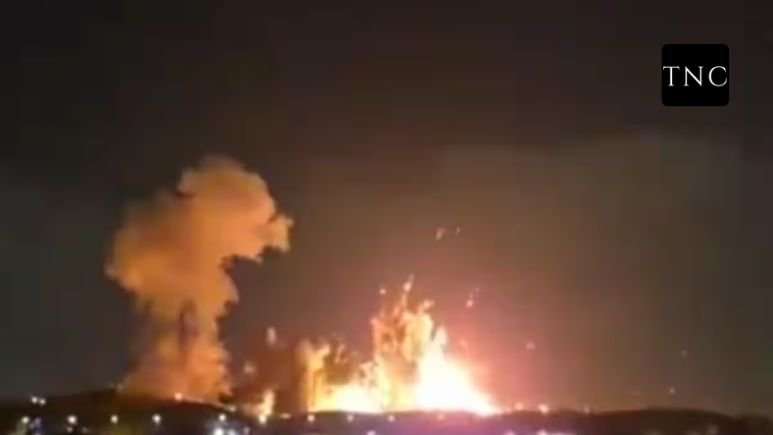

The United States struck a large ammunition depot in the Iranian city of Isfahan overnight, deploying a high volume of 2,000-pound bunker-buster bombs in one of the most dramatic and destructive single strikes of the now month-long conflict. The attack triggered a chain of secondary explosions that sent towering fireballs into the night sky and shook the ground across a wide radius, with footage of the blasts shared personally by President Donald Trump on his Truth Social platform.
Walls of Fire Over Iran’s Third-Largest City
The Wall Street Journal quoted a U.S. official confirming that forces hit the ammunition depot in Isfahan with 2,000-pound bunker-buster bombs, noting that “a high volume of bunker busters, or penetrator munitions, was used for the strike.” The primary detonation set off a cascade of secondary blasts consistent with the ignition of stored ammunition missiles, artillery rounds, and rocket propellants held within the hardened bunkers below.
Isfahan, one of Iran’s main cities, is located in the centre of the country, 270 miles south of Tehran, along the Zayandeh River, and is Iran’s third-most populous city. It is also believed to hold most of Iran’s stockpile of enriched uranium, as well as a sprawling underground complex known as “missile city,” according to Rafael Grossi, Director General of the International Atomic Energy Agency.
Fire-tracking satellites from NASA indicate that the blast occurred near Mount Soffeh, a region believed to house military positions. The strike was described as part of Operation Epic Fury, reportedly carried out using B-2 stealth bombers equipped with bunker-buster munitions.
Why Bunker-Busters?
The choice of weapon speaks to both the nature of the target and the intent of the operation. A 2,000-pound bunker-buster bomb is designed to penetrate hardened surfaces, reinforced concrete, or shallow underground structures before detonation. Unlike general-purpose bombs, penetrator munitions concentrate destructive force below the surface, making them suitable for destroying bunkers, underground depots, and fortified command facilities. The use of these weapons against an ammunition depot indicates an effort to degrade Iran’s ability to sustain missile launches, drone attacks, or resupply military units, with the destruction of stockpiles having a direct effect on operational tempo, particularly if the site served as a regional logistics node.
Trump Shares the Video
In a departure from standard military communications protocol, President Trump shared a video on Truth Social showing a series of explosions followed by large fires lighting up the night sky in bright orange, leaving behind plumes of smoke, without providing detailed context for the footage. The post drew immediate global attention, with the clip going viral within minutes. Iran has not issued an official public statement in direct response to the Isfahan strike.
The Bigger Campaign
The United States said its forces have now struck more than 10,000 Iranian military sites over the past month, while Israel’s military said it had hit over 3,000 Iran-related targets. The Isfahan strike represents a marked intensification in the scale and precision of individual operations, suggesting a deliberate shift in targeting doctrine toward logistics and supply chain degradation rather than purely defensive or symbolic strikes.
A Kuwaiti Tanker Hit; Hormuz Fears Deepen
Amid the bunker-buster attack on Isfahan, an Iranian drone struck the Al Salmi, a fully laden Kuwaiti tanker carrying 2 million barrels of oil near the Strait of Hormuz, raising fears of an oil spill in the Gulf. Kuwait Petroleum Corporation confirmed that the tanker was hit while anchored at Dubai port, causing damage to the vessel and a fire on board. Dubai authorities confirmed that maritime firefighting teams had extinguished the blaze, though the company warned of a possible oil spill in surrounding waters.
Iran’s parliament moved simultaneously to tighten its grip on the Strait. Lawmakers approved plans for a toll system on ships using the waterway, including an outright ban on U.S. and Israeli vessels, new financial regulations, and tolls denominated in the Iranian rial for vessels passing through.
Nuclear Stakes Loom Large
The Isfahan strike has also reignited concern about Iran’s nuclear posture. Reports suggested that Iran may have moved its highly enriched uranium stockpiles estimated at around 540 kilograms to an underground facility in Isfahan ahead of the strikes. The U.S. strikes come after reports that Trump had been considering a special forces operation deep inside Iran to physically seize enriched uranium stockpiles from sites including Isfahan.
Britain, meanwhile, has yet to issue a formal response to the global energy crisis, with crude oil prices having surged by 60% since the U.S. and Israel began their offensive on Iran. Energy bills for the average household in the United Kingdom are projected to rise by as much as £288 a year, according to an Ofgem price cap prediction.
With bunker-buster bombs now being deployed at scale, a tanker on fire in Dubai waters, and Iran’s parliament voting to weaponise the Strait of Hormuz, the conflict has reached an inflection point where the window for a negotiated settlement is narrowing by the hour even as Pakistani-led diplomacy continues to seek, with increasing urgency, a way out.
Also Read / TEHRAN IN THE CROSSHAIRS: ESCALATING STRIKES AND STALLED DIPLOMACY LEAVE CONFLICT AT DANGEROUS IMPASSE.










Leave a comment