

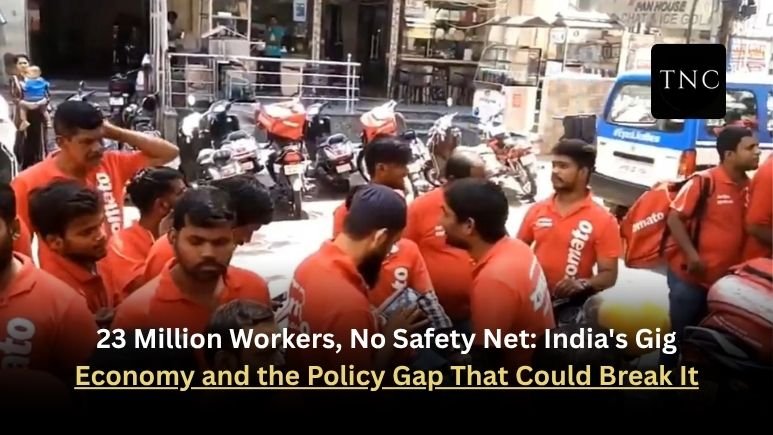

Ravi Yadav checks his phone at a traffic signal in Mumbai. The app flashes red another delayed delivery. A countdown timer blinks beside the order, shaving seconds off his already thin margin for error. He twists the throttle, weaving past buses and auto-rickshaws. A late delivery means a penalty. Too many penalties mean fewer orders. Fewer orders mean less income. By the time he reaches the customer, the app has already made its judgment.
There is no supervisor to argue with. Only an algorithm.
The Policy Gap Behind the App Economy
Ravi’s story is no longer an exception; it is the operating system of India’s digital platform economy. From ride-hailing to food delivery, millions of workers now rely on apps for their livelihood. The sector is expanding rapidly, expected to employ over 23 million workers by 2030 and contribute significantly to GDP.
But beneath this growth lies a structural weakness: fragmented and uneven policy frameworks. Different states experiment with their own rules. National laws exist on paper but lag in implementation. Platforms operate across borders, but protections do not.
This fragmentation is not just a labor issue, it is an economic one. Without coherent policy, the very engine driving India’s digital growth risks slowing down.
A System Built for Growth, Not Stability
India’s gig economy has scaled with astonishing speed. The number of workers jumped from roughly 7.7 million in 2021 to around 12 million by 2025, a 55% surge fueled by smartphones, cheap data, and digital payments.
Yet the system that governs this workforce remains patchy.
At the center of the problem is classification. Gig workers are typically labeled as “partners,” not employees. This distinction allows platforms to avoid obligations like minimum wages, insurance, or job security. While the Code on Social Security (2020) recognized gig workers, many of its protections remain weak or unimplemented.
The result is a paradox: a modern, tech-driven economy running on an informal labor foundation.
Income instability is the most visible symptom. Nearly 40% of gig workers earn less than ₹15,000 per month, according to the Economic Survey.
Behind that number is a deeper issue: workers bear the risks of fluctuating demand, algorithmic decisions, and rising costs, while platforms retain control over pricing and allocation.
Fragmentation Is the Real Bottleneck
India’s policy response has been active but scattered.
Some states like Rajasthan and Karnataka have introduced welfare measures. Maharashtra has begun mapping gig workers to design targeted protections. Meanwhile, the central government is still refining rules under national labor codes.
At the same time, policymakers are debating everything from mandatory worker registration to social security contributions by platforms.
The intent is clear. The execution is not.
This fragmented approach creates three major risks:
1. Regulatory Uncertainty for Platforms
Companies operating across states face different compliance requirements, increasing costs and complexity.
2. Uneven Worker Protection
A delivery rider in Bengaluru may have access to benefits that a worker in another state does not.
3. Slower Innovation and Investment
Investors prefer predictable environments. Policy inconsistency introduces friction in a sector built on speed and scale.
In effect, India’s gig economy is being pulled in different directions by growth ambitions on one side and policy confusion on the other.
The Power Imbalance at the Core
At its heart, the issue is not just about laws, it is about power.
Platforms control demand, pricing, and visibility. Workers supply labor but have little say in how the system operates. Algorithms decide who gets work, how much they earn, and how they are rated.
This imbalance is not unique to India, but it is amplified here by the absence of unified safeguards.
Even well-intentioned policies can backfire if not coordinated. Strict regulations in one state may push platforms to scale back operations there, while looser regimes elsewhere attract more activity. The result: a patchwork economy where both workers and businesses face uncertainty.
Toward a Coherent Framework
The challenge is not to slow down the gig economy, it is to stabilize it.
A coherent national framework could include:
- Portable benefits that follow workers across platforms
- Clear definitions of worker status and rights
- Mandatory contributions to social security funds
- Transparency in algorithmic decision-making
Such measures would not just protect workers, they would strengthen the ecosystem itself.
Because sustainability, not just scale, determines long-term growth.
India’s gig economy is expanding at breakneck speed, but its policy foundation remains fractured. Without a unified approach, the country risks building a trillion-rupee digital economy on unstable ground.
Ravi’s race against the clock is not just about one delivery. It is a glimpse into a system where growth has outpaced governance and where the next phase of India’s digital story will depend on closing that gap.
Also Read / India unveils Social Security blueprint for Gig Workers: 90-day work threshold proposed.













Leave a comment