

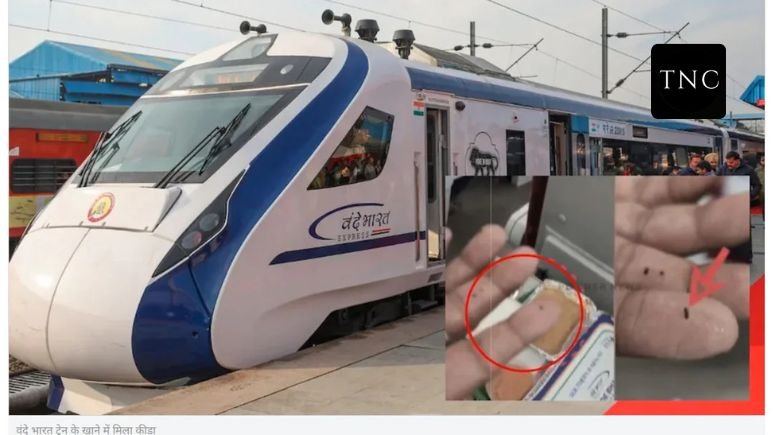

The man in seat C3 barely glanced at his meal when it arrived, foil peeled back, the faint smell of curd and rice rising into the air. Around him, the sleek interiors of the Vande Bharat Express hummed with quiet confidence: LED panels glowing, attendants moving briskly, the promise of a “world-class” journey unfolding at 160 km/h.
Then he saw it.
A small, dark shape nestled inside the food. Not a spice. Not seasoning. Something alive or recently so. Conversations stopped. Phones came out. Within minutes, the image had left the train and entered the bloodstream of the internet, where outrage travels faster than any rail line.
By the time the train reached its destination, the damage was already done.
What happened inside that train compartment wasn’t just a case of bad catering. It became a stress test for India’s ambition to modernize its public infrastructure. The Vande Bharat Express is marketed as the future of Indian Railways, fast, efficient, premium.
But a single contaminated meal exposed a deeper tension: can the system deliver world-class experiences at scale without compromising basic hygiene?
The Railways responded swiftly, imposing a ₹10 lakh fine on IRCTC and a much steeper ₹50 lakh penalty on the catering vendor, whose contract was terminated.
The message was clear. The question is whether the system heard it.
Indian Railways operates on a scale that few systems globally can match serving roughly 58 crore meals annually.
Officials point to a microscopic complaint rate of about 0.0008% as evidence that the system largely works.
But statistics don’t travel the way images do.
A single video of a worm in curd or an insect in a meal carries more emotional weight than millions of successful deliveries. It reshapes perception. It raises uncomfortable questions:
- Who audits the vendors?
- How often are kitchens inspected?
- Where does accountability break down at packaging, transport, or service?
The Railways’ response to heavy fines, contract termination suggests a system trying to enforce discipline after the fact.
But enforcement is not prevention.
What’s emerging is a pattern:
India is upgrading hardware faster trains, better coaches but the software of service delivery, especially outsourced catering, struggles to keep pace.
Even reforms announced in 2026 stricter vendor checks, expanded food partnerships, and improved monitoring signal recognition of the problem.
Yet they also reveal something deeper: modernization is uneven.
You can redesign the train.
But trust rides on what’s served inside it.
A premium train loses its meaning when a passenger hesitates before opening a meal tray.
The ₹10 lakh fine is not the story.
The real story is this: in a system as vast as Indian Railways, trust is built not at 160 km/h but in the smallest details, like what’s on your plate.
Also Read / Upma on the Table Again? What That Actually Means in an Indian Home.











Leave a comment