

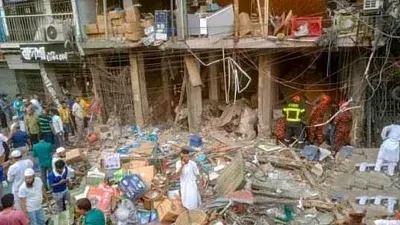

Dhaka bomb blast 2025 incidents have plunged Bangladesh’s capital into a security nightmare. Between November 1 and November 11, crude bombs exploded at 17 different locations across Dhaka, targeting religious establishments, government offices, political party headquarters, and public spaces. The wave of violence has left a nation on edge as it navigates a precarious democratic transition.
The attacks are not random acts of violence. They represent a calculated campaign of terror that coincides with the banned Awami League’s call for a “Dhaka Lockdown” on November 13 and comes ahead of the International Crimes Tribunal’s scheduled verdict date against ousted Prime Minister Sheikh Hasina.
The Night of Terror: November 10-11
The most dramatic Dhaka bomb blast 2025 incidents occurred over a 24-hour period beginning on the evening of November 10. Crude bombs were hurled at 11 locations throughout the day, while three buses were set on fire, prompting authorities to ramp up security.
At approximately 7:10 AM on November 10, two crude bombs targeted the business premises of Fisheries and Livestock Adviser Farida Akhter on Sir Syed Road. One bomb landed inside the premises while the other exploded on the street. The targeting of a government adviser’s property marked a dangerous escalation in the violence.
Later that evening at 6:50 PM, unidentified miscreants detonated three crude bombs in front of Shah Ali Market in Mirpur-10, creating panic among locals and causing them to run for safety. Around the same time, another explosion rocked the Khilgaon flyover.
The day’s most dramatic incident occurred around 11:10 PM when attackers on a motorcycle hurled a crude bomb at the National Citizens Party (NCP) office at Bangla Motor, leaving a bystander with minor injuries. Party activists gave chase and detained five suspects following the blast.
Remarkably, despite the widespread nature of these attacks, no fatalities were reported. However, the psychological impact on Dhaka’s residents has been profound.
Religious Sites Under Attack
Perhaps most troubling among the Dhaka bomb blast 2025 incidents has been the targeting of religious establishments. On November 7, a crude bomb exploded at St Mary’s Cathedral in Dhaka’s Kakrail area at around 10:45 PM, while another remained unexploded inside the church.
Unidentified individuals hurled two crude bombs targeting the church, with one exploding on a steel plate at the church gate. The attack on one of Dhaka’s most prominent Christian institutions sent shockwaves through minority communities already fearful after months of targeted violence.
The interim government responded swiftly to the religious dimension of the attacks. The government reiterated its unwavering commitment to safeguarding interfaith unity and communal harmony, warning that any attempt to disturb the country’s religious harmony will face the full force of the law.
Security has been stepped up at all churches and religious establishments of all faiths in the capital. However, many in Bangladesh’s minority communities remain skeptical about the government’s ability to protect them.
The Awami League Connection
Police investigations into Dhaka bomb blast 2025 incidents have pointed toward members of the banned Awami League and its student wing, Chhatra League. The Dhaka Metropolitan Police arrested a 28-year-old man in connection with the crude bomb attacks, with initial investigation identifying him as a member of Chhatra League.
The spate of attacks coincided with the Awami League’s online call for a “Dhaka Lockdown” on November 13, even though all political activities of the party remain banned. The party’s supporters have taken to social media to organize resistance against the interim government.
Police’s Detective Branch chief Shafiqul Islam stated that 34 Awami League leaders and activists were arrested in separate raids across the capital on charges of planning, financing and participating in flash processions. He noted that AL activists “have declared they are willing to go to any extent for their leaders.”
The targeting of government advisers, the National Citizens Party office, and religious establishments appears designed to destabilize the interim government and create an atmosphere of chaos ahead of the planned February 2026 elections.
Security Response: Too Little, Too Late?
The interim government and law enforcement agencies have scrambled to respond to the Dhaka bomb blast 2025 crisis. According to DMP Commissioner Sheikh Sazzat Ali, 17 cases have been filed over crude bomb explosions in the last 11 days, with a total of 50 people arrested in connection with these incidents.
The Special Branch has divided Dhaka into 54 surveillance zones for intensified intelligence monitoring. The Dhaka Metropolitan Police, in coordination with the Rapid Action Battalion, has intensified a citywide manhunt to apprehend individuals involved in these attacks.
However, the pattern of attacks reveals significant security vulnerabilities. Commissioner Ali acknowledged that attackers “come on motorcycles, throw one or two crude bombs, and flee,” noting that only in Demra were they able to catch two perpetrators red-handed.
The police headquarters directed all stations in Dhaka to intensify patrols and surveillance, particularly ahead of November 13 when the International Crimes Tribunal is scheduled to set the date for delivering its verdict against Sheikh Hasina. Yet the attacks have continued despite heightened security measures.
The Broader Context: A Nation in Crisis
The Dhaka bomb blast 2025 incidents cannot be understood in isolation. Analysts said the incidents are deepening public anxiety as political tensions mount ahead of the national elections, warning that failure to contain violence could further erode law and order in the days ahead.
In just two days, several locations saw crude bomb explosions, a gangster was shot dead in Old Dhaka, and three buses were torched. The convergence of political violence, criminal activity, and potential terrorism has created a perfect storm of insecurity.
The interim government under Muhammad Yunus faces a formidable challenge. Having come to power following last year’s student-led uprising that toppled Sheikh Hasina, the government must now demonstrate it can maintain law and order while preparing for elections. The Dhaka bomb blast 2025 crisis threatens to undermine its legitimacy.
For ordinary citizens of Dhaka, the impact extends beyond physical danger. Businesses are suffering as customers stay home. Parents fear sending children to school. The psychological toll of living under constant threat of violence is immeasurable.
What Lies Ahead?
As Bangladesh approaches the critical date of November 13 and the subsequent February 2026 elections, the Dhaka bomb blast 2025 incidents serve as a stark warning. The country’s democratic transition hangs in the balance.
The crude bombs exploding across Dhaka are more than weapons they are messages. Messages from those who refuse to accept the new political order. Messages from those willing to use violence to achieve their aims. And messages that Bangladesh’s security apparatus may not be equipped to handle the challenges ahead.
The interim government’s response in the coming days will be crucial. Can it restore public confidence? Can it prevent further attacks? Can it ensure that the upcoming elections proceed in an atmosphere of security and fairness?
Conclusion: Democracy Under Fire
The Dhaka bomb blast 2025 crisis represents more than a security challenge. It represents a fundamental test of Bangladesh’s ability to transition from authoritarianism to democracy without descending into chaos.
The targeting of religious minorities, government officials, and political opponents reveals the depth of Bangladesh’s divisions. The willingness of political actors to resort to violence rather than dialogue threatens the very foundation of democratic governance.
As crude bombs continue to explode across Dhaka’s streets, one truth becomes clear: Bangladesh’s path to democracy will not be smooth. The interim government must act decisively to restore security while ensuring that its response doesn’t undermine the civil liberties and democratic principles that inspired last year’s uprising.
For the people of Dhaka, living under siege has become the new normal. Whether this state of fear becomes permanent or proves to be a temporary crisis will determine Bangladesh’s future. The stakes could not be higher, and the world is watching as this nation of 170 million people struggles to build democracy from the ashes of authoritarianism. The bombs may be crude, but their impact on Bangladesh’s democratic transition is profound. Only time will tell whether the country can overcome this violence and emerge as a stable, democratic nation or whether these Dhaka bomb blast 2025 incidents mark the beginning of a descent into deeper chaos.









Leave a comment