

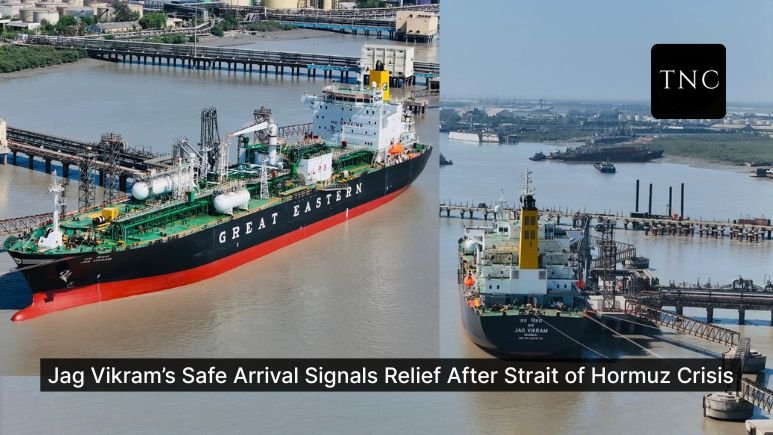

The ship moved slowly under a dim orange sky, its steel hull cutting through uneasy waters that had, just days earlier, gone silent. On the bridge of the LPG carrier Jag Vikram, officers scanned radar screens with unusual intensity. The Strait of Hormuz, one of the world’s most volatile maritime corridors, had become a graveyard of stalled tankers and whispered warnings. Now, cautiously, the vessel pushed forward.
Three days later, under floodlights at Gujarat’s Kandla port, dockworkers watched as the ship finally berthed. Inside its tanks: over 20,000 metric tonnes of cooking gas. For most Indians, it would soon become the quiet blue flame beneath a kitchen stove. For policymakers, it meant something far larger relief.
The journey of Jag Vikram was not just another cargo delivery. It marked the first successful transit by an Indian-flagged vessel through the Strait of Hormuz after a fragile ceasefire between the United States and Iran briefly eased weeks of maritime paralysis.
This narrow waterway carries nearly 20% of the world’s oil and gas supply, making it one of the most critical chokepoints in global energy trade. For India where nearly 90% of LPG imports originate from the Gulf any disruption is not abstract. It shows up in delayed deliveries, rising prices, and anxious households.
The safe arrival of Jag Vikram signals more than operational success. It suggests that the arteries of global energy, briefly constricted by war, are beginning cautiously to reopen.
The backdrop to this voyage is stark. Since late February 2026, the Strait of Hormuz had effectively shut down amid escalating conflict involving Iran, the United States, and its allies. Missile strikes, drone attacks, and naval warnings turned the region into a high-risk zone. At one point, tanker traffic dropped dramatically, and dozens of vessels were stranded.
India was among the worst affected. As the world’s second-largest LPG importer, it faced what officials described as one of its most severe gas supply crunches in decades. Tankers were stuck mid-route. Imports slowed. The government scrambled prioritizing household consumption and even repurposing idle ships to carry fuel.
Against this backdrop, Jag Vikram’s passage becomes a calculated risk. Its transit on April 11, followed by safe docking on April 14, was made possible by a temporary diplomatic thaw. Yet the corridor remains tense. Even as ships resume movement, some vessels are still stranded, and the threat of renewed disruption lingers.
This is the new reality of global trade: geopolitics is no longer a distant variable, it is an operational hazard.
The arrival of Jag Vikram is a quiet victory with loud implications. It shows how quickly global supply chains can fracture and how fragile their recovery can be.For India, the lesson is clear: energy security is no longer just about supply, but about safe passage. For the world, the message is sharper: when a single strait falters, entire economies feel the tremor.











Leave a comment