

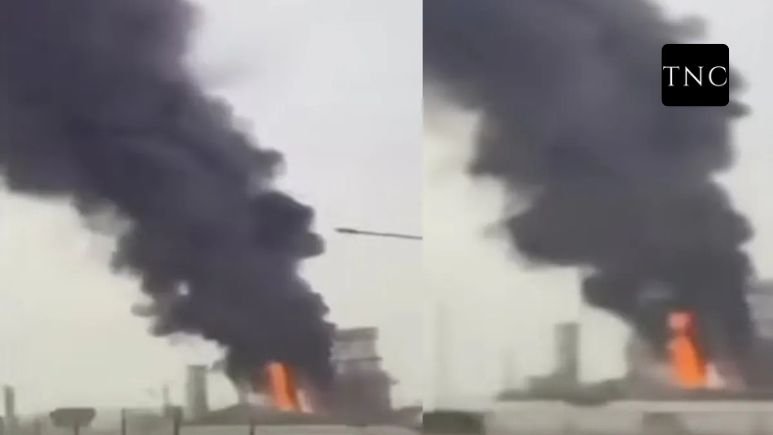

An Iranian strike on a power and water desalination facility in Kuwait on Sunday evening claimed the life of an Indian national, marking another tragic casualty in a conflict whose reverberations are being felt with growing severity across the Gulf’s vast expatriate workforce.
The Attack
Kuwait’s Ministry of Electricity, Water and Renewable Energy confirmed on Monday that a service building at one of the country’s power and water desalination plants had come under attack, resulting in the death of one worker of Indian nationality and significant material damage to the building. The identity of the deceased has not been officially released.
Technical and emergency teams were deployed immediately under the country’s approved response plans, working in close coordination with security agencies to stabilise operations and secure the affected area. Authorities confirmed that nationwide electricity and water operations remained stable following the incident.
Iran denied responsibility for the strike. Tehran’s military operational command, Khatam al-Anbiya, instead attributed the attack to Israel, describing it as a “brutal aggression by the Israeli regime against Kuwait’s desalination plant, carried out under the pretext of accusing the Islamic Republic of Iran.”
Kuwait Under Sustained Assault
The attack did not occur in isolation. Al Jazeera’s correspondent reporting from Kuwait City noted that the country has been subjected to repeated attacks since the start of the U.S.-Israeli war on Iran more than a month ago. Just the previous evening, Kuwait’s Defence Ministry reported that 14 missiles and 12 drones had been detected in Kuwaiti airspace, with several drones targeting a military camp and injuring 10 servicemen.
Kuwait’s Foreign Minister Sheikh Jarrah Jaber Al Sabah described what the region is witnessing as a “systematic pattern of undermining regional stability led by Iran,” adding that Tehran is destabilizing the region by “exploiting chaos and terrorism as tools of influence.”
A Dangerous Vulnerability Exposed
The targeting of water infrastructure has alarmed analysts and governments alike. Kuwait relies on seawater for approximately 90% of its drinking supply, making its desalination plants not merely industrial assets but critical lifelines. The broader Middle East region, home to around 5,000 desalination plants, produces 41.8% of global desalinated water capacity, a resource the region cannot afford to lose.
Iran had previously warned it would target power and desalination facilities across the Gulf and in Israel if its own energy infrastructure came under attack, a threat that followed overnight U.S.-Israeli strikes on Iranian power grids, which triggered outages in Tehran and the Alborz province.
Kuwait Petroleum Corporation’s chief executive Sheikh Nawaf Al Sabah put the stakes in stark terms. “Iran is effectively holding the world economy hostage,” he said, warning that attacks on infrastructure and shipping routes are disrupting supplies and pushing oil prices higher.
Indian Nationals in the Firing Line
The death has deepened concern in India over the safety of its citizens working across the Gulf. The incident raises the reported number of Indian nationals killed in the ongoing West Asia conflict to at least eight, underscoring the acute risks facing the large Indian expatriate workforce in the region.
The Indian Embassy in Kuwait expressed its deepest condolences and confirmed it is closely coordinating with Kuwaiti authorities to render all possible support and assistance to the family of the deceased.
India’s Ministry of External Affairs has also been in contact with Kuwaiti authorities and Indian missions across the region to monitor the safety and welfare of Indian workers, with officials expected to provide further updates on measures to safeguard the wider Indian community.
Regional and Global Fallout
Qatar’s Foreign Ministry condemned the attack in the “strongest terms,” affirmed full solidarity with Kuwait, and expressed support for all measures Kuwait takes to preserve its sovereignty and security.
The conflict, which began when the U.S. and Israel launched an offensive against Iran on February 28, has so far killed more than 1,340 people, including then-Supreme Leader Ali Khamenei. Iran has retaliated with drone and missile strikes targeting Israel, Jordan, Iraq, and Gulf countries hosting U.S. military assets, causing casualties, infrastructure damage, and significant disruption to global markets.
As the conflict enters its second month with no credible diplomatic resolution in view, the attack on Kuwait’s water infrastructure serves as a stark reminder that the human cost is no longer confined to frontline combatants; it is now being borne, fatally, by workers thousands of miles from the decisions that set this war in motion.
Also Read / OIL AT GUNPOINT: TRUMP SIGNALS U.S. SEIZURE OF IRAN’S KHARG ISLAND AS CRUDE SURGES PAST $116.









Leave a comment