

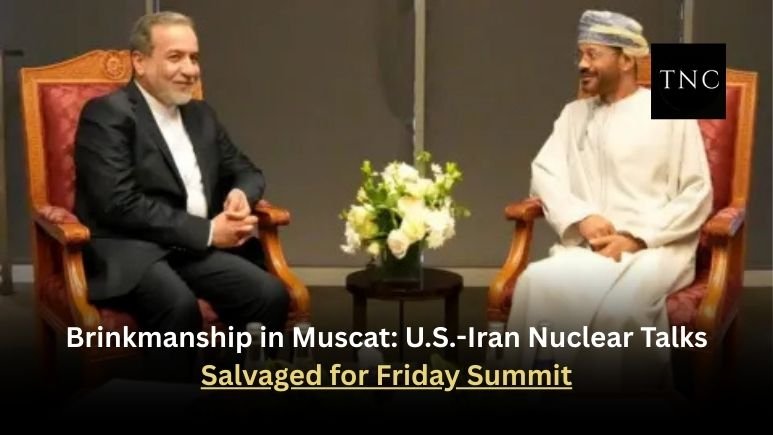

Twenty-four hours ago, these talks were dead. Iran wanted to change venues. Washington was ready to walk away. The diplomatic track appeared to be collapsing just as the USS Abraham Lincoln positioned itself within striking distance of Iranian territory. Then nine regional countries intervened, frantically lobbying the White House not to abandon negotiations. Now, somehow, both sides are heading to Muscat for a 10:00 AM Friday summit that neither side seems to believe will actually work. Trump says Khamenei “should be very worried” about the carrier group offshore. Iran insists its missile program is completely off the table for discussion. And somewhere between those irreconcilable positions, diplomats will sit down and try to prevent a war that could engulf the entire Middle East.
MUSCAT / WASHINGTON High-level nuclear talks between the United States and Iran are back on for Friday (February 6, 2026) at 10:00 AM in the Omani capital, following a chaotic Wednesday that nearly saw the entire diplomatic effort collapse. Iranian Foreign Minister Abbas Araghchi confirmed late Wednesday that both sides would meet in Muscat to discuss the “nuclear file,” with the White House later corroborating despite what officials describe as “deep scepticism” within the Trump administration.
The fact that these talks are happening at all is remarkable given how close they came to falling apart completely just hours ago.
The 24-hour crisis that almost killed diplomacy
Originally planned for Istanbul in a multi-party format proposed by Turkey, the talks appeared to disintegrate Wednesday when Tehran suddenly insisted on changing the venue to Oman and narrowing the agenda to just nuclear issues, excluding the broader regional and domestic concerns the U.S. wanted to address.
Iran’s venue demand: Muscat has historically served as neutral ground for U.S.-Iran negotiations, most notably during the secret talks that led to the 2015 nuclear deal. Iran trusts Oman in ways it doesn’t trust Turkey, which maintains complex relationships with both Washington and regional players. The insistence on Muscat signalled Iran wanted direct bilateral talks, not the multilateral framework Turkey was proposing.
Washington’s initial response: The White House was prepared to walk away. From their perspective, Iran was dictating terms, narrowing the agenda to avoid addressing missile programs and regional activities, and generally acting like the party with leverage when they’re the ones facing a carrier strike group offshore.
Regional intervention saves the talks: Then at least nine regional countries, including Arab and Muslim allies, intervened with urgent appeals to the White House not to abandon negotiations. These countries understand what Washington sometimes forgets: if diplomacy fails and military action begins, they’re the ones whose cities might get hit by retaliatory Iranian missiles, whose economies would be devastated by spiking oil prices, whose populations would be displaced by regional conflict.
U.S. participation with reservations: A White House official stated the U.S. is participating “out of respect for regional allies” but remains “very sceptical” that meaningful breakthrough is possible. That’s diplomatic language for “we don’t think this will work, but our allies begged us not to walk away, so we’re going through the motions.”
The positions that guarantee failure (probably)
Both sides are heading to Muscat, but their definitions of what constitutes a “successful” summit remain fundamentally incompatible:
| Who | What They Want | What They Absolutely Won’t Discuss |
| United States | Total nuclear freeze, end to proxy support in Lebanon/Syria/Iraq/Yemen, limits on ballistic missiles | Missile program and regional proxies must be part of any deal |
| Iran | Complete sanctions removal, recognition of peaceful nuclear enrichment rights | The “Missile Belt” and regional defense strategy are completely off the table |
Look at those positions. The U.S. demands discussion of exactly the things Iran refuses to discuss. Iran wants sanctions relief before making concessions the U.S. says are preconditions for sanctions relief.
These aren’t negotiating positions with room for compromise. These are statements of mutually exclusive requirements designed to protect each side’s core interests while demanding the other side surrender theirs.
The military pressure nobody can ignore
The talks are happening against the backdrop of the most significant U.S. military buildup in the region since the June 2025 “Operation Midnight Hammer” strikes that crippled Iran’s nuclear facilities.
An American carrier strike group and substantial airpower assets are currently positioned in the Indian Ocean within striking distance of Iranian leadership compounds and nuclear facilities. This isn’t subtle. It’s overwhelming force deliberately positioned to concentrate Iranian minds on what happens if talks fail.
When asked if Supreme Leader Ayatollah Ali Khamenei should be concerned about this military posture, Trump didn’t equivocate: “I would say he should be very worried, yeah, he should be.”
That’s not diplomatic ambiguity. That’s a direct threat: make a deal or face attack. The carrier group isn’t just background pressure. It’s the alternative to negotiation, sitting offshore with orders presumably already drafted, just waiting for Trump to give the word.
Iran’s domestic crisis complicates everything
Inside Iran, the regime is still reeling from what they’re calling a “bloody crackdown” on protesters last month. Rights groups report over 6,159 killed since December 2025, with 42,000 detained. The Supreme Leader has characterized the protests as a foreign-backed “coup,” framing domestic dissent as external aggression.
This creates impossible dynamics for negotiation. The U.S. is explicitly citing domestic repression as justification for potential military action, making internal security a legitimate topic for discussion from Washington’s perspective. Iran views domestic security as completely sovereign territory, rejecting any external interference as violation of basic sovereignty.
How do you negotiate when one side considers the other side’s internal affairs a legitimate subject for international pressure, while that other side considers such pressure an act of aggression? You don’t, really. You talk past each other while pretending to negotiate.
Who’s actually sitting at the table?
The negotiations will be conducted through Omani mediation, with experienced diplomats who understand exactly how far apart these positions are:
For the United States: Steve Witkoff, White House Special Envoy, who’s been claiming for weeks that a deal is “very close” despite no visible evidence of actual progress.
For Iran: Foreign Minister Abbas Araghchi, who just told the world Iran is “ready for war,” plus senior diplomats Majid Takht-Ravanchi and Kazem Gharibabadi, both veterans of previous nuclear negotiations who know precisely what Washington wants and why Tehran can’t give it.
These aren’t novices who might stumble into compromise through inexperience. These are professionals who understand the constraints each side operates under and the minimal space for actual agreement.
What Friday might produce
As Muscat prepares for the 10:00 AM session, several outcomes seem possible, none of them particularly hopeful:
Narrow technical progress: Maybe they agree on some preliminary nuclear monitoring arrangements or discuss timelines for IAEA inspector access. Enough to justify continued talks without addressing fundamental incompatibilities.
Framework without substance: Produce a document outlining principles for future negotiations, allowing both sides to claim diplomatic progress while committing to nothing concrete. The kind of agreement that sounds meaningful in press releases but changes nothing operationally.
Complete stalemate: Both sides restate their positions, discover they remain irreconcilable, and end the meeting with vague commitments to “continue dialogue” while the military pressure continues building.
Breakdown and escalation: Talks collapse entirely, one side or both walks away publicly, and the carrier group transitions from diplomatic pressure to operational preparation for strikes.
The test of Maximum Pressure 2.0
For Washington, this summit tests whether “Maximum Pressure 2.0” actually works. The theory is that sanctions plus military threat plus domestic unrest forces Iran to choose between economic collapse/potential regime change and making a deal that surrenders nuclear ambitions and regional influence.
The problem with that theory is it assumes Iran views those options the same way Washington does. From Tehran’s perspective, surrendering nuclear capability and regional strategic depth makes the regime more vulnerable to the very regime change Washington has openly pursued for decades. The nuclear program and regional proxies aren’t obstacles to security. They are security, deterrents against American or Israeli aggression.
So maximum pressure might not produce the deal Washington wants. It might just produce the “regional war” Khamenei has threatened, because Iran calculates that fighting is better than surrendering the capabilities that prevent attacks in the first place.
Tehran’s slim chance
For Iran, these talks offer a slim opportunity to lift crushing sanctions and forestall potential strikes. The economic pain is real. Hyperinflation, currency collapse, inability to access international banking, critical shortages of goods and medicines. The sanctions are working in the sense that they’re devastating the Iranian economy.
But devastating an economy doesn’t automatically produce political concessions when the regime believes those concessions threaten its survival. It might just produce desperation, which can lead to either capitulation or lashing out.
The stakes nobody’s discussing
What happens if these talks fail? If both sides walk away Friday afternoon having made no progress, what comes next?
Does Trump authorize strikes, gambling that Iran won’t or can’t effectively retaliate? Do Iranian hardliners convince Khamenei that negotiation is pointless and military confrontation inevitable? Do Gulf States get dragged into a conflict they desperately want to avoid? Does oil hit $150 per barrel as the Strait of Hormuz becomes a war zone?
The regional countries that lobbied Washington to participate in these talks understand those stakes viscerally. They’re not abstract geopolitical calculations. They’re the difference between continued prosperity and economic devastation, between peace and their cities becoming missile targets.
The narrow window keeps narrowing
Friday at 10:00 AM in Muscat, diplomats will sit down knowing they’re probably not going to reach a meaningful agreement. The positions are too far apart. The mistrust is too deep. The domestic political constraints on both sides are too severe.
But they’ll try anyway, because the alternative is regional war that nobody actually wants but that keeps becoming more likely with each failed diplomatic attempt.
Trump wants a deal that ensures “no nuclear weapons” and addresses missiles and proxies. Iran wants sanctions relief while preserving capabilities it considers essential for regime survival. Those objectives are fundamentally incompatible.
So Friday’s talks will probably produce carefully worded statements about “constructive dialogue” and “continued engagement” while changing nothing substantive. Both sides will claim they showed good faith. The carrier group will stay in position. And the world will continue waiting to see if this ends in compromise or catastrophe.
Ten o’clock Friday morning in Muscat. That’s when we find out if diplomacy has any chance at all, or if we’re just watching the final performance before the missiles start flying.
Also Read / “He Means Business”: Hegseth Issues Chilling Nuclear Warning to Tehran.











Leave a comment