

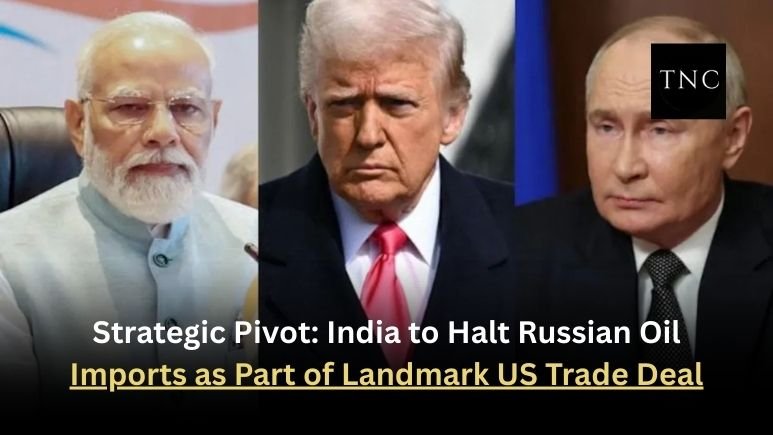

Thirty-five percent of India’s oil supply. Gone overnight. Russian crude that kept fuel prices manageable for 1.4 billion people, bought at deep discounts while the West imposed sanctions. Now being replaced with American oil that costs more and Venezuelan crude from a country whose government the U.S. just overthrew. And in exchange? An 18% tariff instead of 50%, access to American markets, and a commitment to spend $500 billion on “Buy American” purchases over the next decade. This isn’t just a trade deal. This is India fundamentally reordering its strategic relationships, choosing alignment with Washington over energy security independence, and betting that American partnership is worth more than cheap Russian oil.
WASHINGTON / NEW DELHI — The White House officially confirmed Tuesday (February 3, 2026) that India has committed to “no longer” purchasing Russian oil, formalizing the most significant element of Monday’s breakthrough trade agreement between President Donald Trump and Prime Minister Narendra Modi. The announcement represents a complete reversal of India’s energy policy and removes one of the biggest irritants in U.S.-India relations since Russia invaded Ukraine.
As part of this strategic realignment, Washington immediately dropped the 25% “punitive” tariffs specifically imposed because of India’s Russian energy purchases, while also lowering the reciprocal tariff on all Indian goods from 25% to 18%. For Indian exporters who’ve been strangled by combined 50% tariffs, this is transformative. For India’s energy security, it’s a massive gamble.
The Russian oil relationship that’s ending
For over a year, India’s status as a top buyer of Russian crude was a major friction point with the Trump administration. While Western countries imposed sanctions and pledged to isolate Russia economically, India dramatically increased its Russian oil imports, taking advantage of steep discounts as Russian crude got shut out of European markets.
At its peak, Russian oil accounted for approximately 35% of India’s total supply. That’s not a marginal energy source. That’s a fundamental pillar of India’s energy security, keeping fuel prices manageable for consumers and industry in a country of 1.4 billion people where energy costs directly impact poverty and economic growth.
India defended these purchases by invoking strategic autonomy and the practical reality that its citizens needed affordable energy. The moral argument about funding Russia’s war machine ran headlong into the economic argument about protecting Indian consumers from energy price shocks. For months, New Delhi held firm: we’ll buy energy wherever it makes economic sense, and Western countries lecturing India about values while having built their own development on cheap energy can mind their own business.
Now that position has completely reversed. PM Modi reportedly assured President Trump that India will phase out Russian oil imports to help “END THE WAR” in Ukraine, adopting Washington’s framing of the issue wholesale.
What replaces Russian Crude?
Here’s where the deal gets interesting and potentially problematic for India’s long-term interests.
To fill the void left by stopping Russian purchases, India will significantly increase its intake of American crude. American oil costs more than the discounted Russian crude India has been buying. That price difference will be passed on to Indian consumers and industry, making energy more expensive across the economy.
The deal also includes a potential pivot to Venezuelan oil. This is particularly ironic given recent events. The U.S. “now largely dictates” Venezuelan oil policy following the capture of Nicolás Maduro and the installation of a transitional government in Caracas. So India is replacing oil from Russia (a country the U.S. opposes) with oil from Venezuela (a country whose government the U.S. just overthrew and now controls by proxy).
India’s energy security, previously based on diversified sources and market competition, now depends heavily on countries aligned with or controlled by Washington. That’s a significant surrender of strategic autonomy in exchange for trade benefits.
The $500 billion “Buy American” commitment
The energy pivot is just one element of a much broader economic realignment. PM Modi committed to $500 billion in investments and purchases over the coming years, including:
- High-tech military hardware (replacing some Russian defense equipment India has relied on for decades)
- Agricultural products (potentially undercutting Indian farmers with subsidized American agriculture)
- Coal (ironic given India’s climate commitments)
- Transportation technology
India has also agreed to move toward reducing its own tariffs and non-tariff barriers against U.S. goods to ZERO, a primary goal of Trump’s “reciprocal trade” philosophy.
| What Changed | Before the Deal | After the Deal |
| U.S. tariff on Indian goods | 50% (25% base + 25% punitive) | 18% flat reciprocal rate |
| Russian oil as % of supply | ~35% of total imports | Commitment to zero |
| “Buy American” commitment | No formal framework | $500 billion over 10 years |
| Indian tariffs on U.S. goods | 13.5% average on industrial goods | Path to 0% reciprocal |
The market reaction was immediate and enthusiastic. Indian equity markets soared, with the GIFT Nifty jumping nearly 800 points as exporters in textiles, gems, and engineering anticipated surging demand from the U.S. market. Lower tariffs mean Indian products become more competitive in America, potentially creating jobs and boosting manufacturing.
Strategic autonomy vs. economic incentive
For decades, India maintained strategic autonomy as a core principle of its foreign policy. It refused to fully align with any major power bloc, maintaining relationships with Russia, the U.S., Europe, and others simultaneously. This flexibility allowed India to play different partners against each other, extracting benefits from multiple relationships without becoming dependent on any single one.
This deal fundamentally undermines that approach. By committing to end Russian oil purchases, spend $500 billion on American products, and move toward zero tariffs on U.S. goods, India is choosing clear alignment with Washington over maintaining equidistant relationships.
The economic incentive is obvious. The 18% tariff gives Indian exporters a massive competitive advantage over regional rivals, particularly China (facing 34% tariffs) and Southeast Asian competitors. Access to American markets on favourable terms could drive significant economic growth.
But the strategic cost is also clear. India is surrendering leverage, accepting dependence on American-aligned energy sources, and committing to purchase levels that could distort its domestic industries. The $500 billion commitment over 10 years means $50 billion annually in “Buy American” obligations, which limits India’s ability to support domestic production or diversify international partnerships.
The Trump-Modi relationship
The deal is being presented as a personal triumph for the relationship between the two leaders. White House Press Secretary Karoline Leavitt noted that President Trump “particularly enjoys” his relationship with Modi, describing them as “two people that GET THINGS DONE.”
This framing is both accurate and concerning. Yes, the personal rapport between Trump and Modi clearly facilitated this agreement in ways that wouldn’t have been possible with leaders who disliked each other. But basing major strategic realignments on personal relationships between leaders is inherently unstable. Trump won’t be president forever. Modi won’t be prime minister forever. What happens to these commitments when their successors don’t have the same chemistry?
The deal’s structure also reveals Trump’s transactional approach to international relations. He doesn’t care about values, democracy promotion, or long-term alliance building. He cares about deals that he can claim as wins: lower U.S. trade deficits, commitments to buy American products, and visible concessions from other countries that he can tout as evidence of his negotiating prowess.
Modi clearly calculated that giving Trump the visible wins he craves (ending Russian oil purchases, massive “Buy American” commitments, tariff reductions) was worth the strategic costs because the economic benefits outweigh them.
The domestic criticism
Some domestic critics in India have expressed concern, particularly over the “0% tariff” goal for U.S. agricultural products. Indian farmers are already struggling with competition from subsidized agriculture. Opening the market completely to American agricultural imports could devastate rural communities that depend on farming for livelihood.
The government maintains the deal is vital for securing India’s place in global supply chains, especially as Ambassador Sergio Gor pushes for India to join the U.S.-led “Pax Silica” semiconductor initiative. That’s the broader strategic play: positioning India as a key partner in American efforts to build technology supply chains independent of China.
But the semiconductor benefits are prospective and uncertain, while the agricultural impact will be immediate and concrete. The political risk of rural unrest over agricultural competition is real, and Modi’s government will need to carefully manage the implementation to avoid backlash.
What this means for Russia
For Moscow, losing India as a major oil customer is a significant blow. After European sanctions cut off traditional markets, countries like India and China became crucial outlets for Russian crude. India’s exit removes billions in annual revenue and further isolates Russia economically.
The timing is particularly damaging given ongoing Ukraine peace talks in Abu Dhabi. Russia is trying to negotiate from a position of strength, but watching major customers like India formally commit to ending purchases undermines that position. It demonstrates that countries are willing to pay premium prices to align with the U.S. rather than continue buying cheap Russian resources.
The bet India is making
Ultimately, this deal represents India betting that alignment with the United States provides more value than strategic autonomy and cheap Russian oil. It’s a bet that American markets, technology partnerships, and security cooperation are worth more than the flexibility of playing multiple powers against each other.
It’s also a bet that the short-term economic costs (higher energy prices, agricultural competition, “Buy American” obligations) will be offset by long-term gains from preferential market access, technology transfers, and integration into U.S.-led supply chains.
Whether that bet pays off depends on factors largely outside India’s control: whether the U.S. actually follows through on promised partnerships, whether American markets remain open to Indian exports, whether future U.S. administrations honour commitments made by Trump, and whether the global strategic environment continues favouring U.S. alignment over diversified relationships.
For now, the market is celebrating. Indian exporters see opportunity. The government sees strategic partnership. And somewhere, Indian energy consumers are about to discover that American crude costs more than the Russian oil they’ve been buying for the past two years.
The relationship between the world’s oldest democracy and the world’s largest democracy just got a lot closer. Whether it’s actually more equal, or whether India just traded one form of dependence for another, time will tell.












Leave a comment