

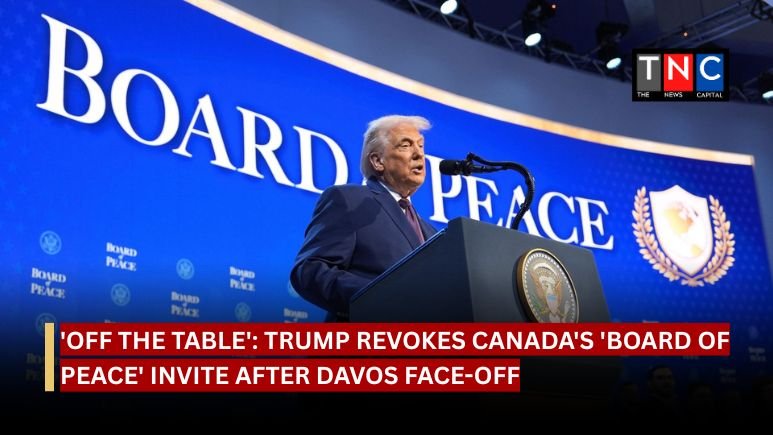

In a swift and public escalation of the feud between North American neighbors, President Donald Trump has rescinded Canada’s invitation to his newly formed “Board of Peace” following a defiant speech by Prime Minister Mark Carney that challenged American economic hegemony and declared the old world order “dead.” The announcement, made late Thursday, January 22, 2026, came just hours after the board’s official launch in Davos and follows a week of increasingly hostile rhetoric between the two leaders over trade, sovereignty, and the “right to be grateful.”
The President utilized his Truth Social platform to issue a formal, if unconventional, letter of withdrawal directed at Prime Minister Mark Carney in characteristically blunt language.
- The Letter: “Please let this Letter serve to represent that the Board of Peace is withdrawing its invitation to you regarding Canada’s joining, what will be, the most prestigious Board of Leaders ever assembled, at any time,” Trump wrote in his distinctive capitalization style.
- Historic Exclusion: The revocation makes Canada the first major Western ally to be explicitly barred from the founding executive circle, which was initially designed to oversee the post-war reconstruction of Gaza but has since expanded into a broader global conflict-mediation forum.
- The Stated Reason: While the White House did not offer a formal policy statement, Trump told listeners in Davos that Carney “wasn’t so grateful” and that Canada “lives because of the United States,” framing the exclusion as punishment for insufficient deference.
- Diplomatic Norm Violation: The public nature of the withdrawal via social media rather than diplomatic channels represents an extraordinary breach of protocol between allied nations sharing the world’s longest undefended border.
The diplomatic fallout was triggered by Carney’s keynote address at the World Economic Forum on Tuesday, where he received a rare standing ovation for urging “middle powers” to resist economic coercion from hegemons.
- The ‘Rupture’ Thesis: Carney argued that the U.S.-led rules-based order is experiencing not a temporary transition but a permanent “rupture,” with the multilateral system that governed post-WWII relations irretrievably broken.
- Trade as Weapon: He decried great powers for using “economic integration as weapons and tariffs as leverage,” a barely veiled criticism of Trump’s approach to alliance management and trade policy.
- Third Path Vision: Carney advocated for middle powers forming coalitions independent of both American and Chinese hegemony, presenting a strategic vision fundamentally at odds with Trump’s demand for allied subordination.
- Standing Ovation: The enthusiastic Davos audience response demonstrated how Carney’s message resonated with European and other leaders frustrated by Trump’s transactional approach to alliances.
Responding from the Citadelle of Quebec on Thursday, Carney pushed back forcefully against Trump’s characterization of Canadian dependence on American benevolence.
- Sovereignty Assertion: “Canada and the United States have built a remarkable partnership… but Canada doesn’t live because of the United States. Canada thrives because we are Canadian,” Carney said, directly rebutting Trump’s claim.
- Partnership vs. Subordination: The statement framed the bilateral relationship as one between equals who choose cooperation rather than a patron-client dynamic where Canada survives only through American generosity.
- Domestic Audience: The Quebec City setting and defiant tone played well to Canadian domestic audiences increasingly frustrated by Trump’s “51st state” rhetoric and economic threats.
- No Apology: Carney made no effort to walk back his Davos remarks or seek reconciliation, signalling his willingness to accept consequences rather than subordinate Canadian sovereignty to American demands.
Canadian Finance Minister François-Philippe Champagne had previously hinted at friction over the Board of Peace structure, particularly its controversial membership fee.
- Permanent Seat Cost: The Board requires a $1 billion contribution to secure permanent membership with indefinite influence over Gaza reconstruction and future conflict resolution initiatives.
- Canadian Refusal: Champagne stated earlier this week that Canada had no intention of paying the billion-dollar fee, viewing it as purchasing influence rather than contributing to legitimate multilateral institutions.
- Principled Opposition: The fee rejection reflected broader Canadian concerns about the Board’s legitimacy, its bypass of UN structures, and whether it serves Palestinian interests or donor priorities.
- Trump’s Revenge: The public withdrawal of Canada’s invitation may represent retaliation for the fee refusal as much as for Carney’s Davos speech, punishing a nation that refused to pay for access.
The Escalating Rift: Context and Consequences
The revocation of the Board of Peace invite is the latest in a series of economic and diplomatic clashes between Ottawa and Washington that have transformed the bilateral relationship.
| Strategic Context | Status / Impact |
| Trade Policy | Trump maintains 25% tariffs on Canadian steel, aluminum, and autos |
| China Pivot | Carney recently signed a “New Strategic Partnership” with Beijing to hedge against U.S. volatility |
| Greenland Standoff | Canada has voiced strong support for Denmark’s sovereignty, further irritating the White House |
| Gaza Mandate | UN engagement with the Board of Peace remains limited to Gaza reconstruction oversight |
| “51st State” Rhetoric | Trump continues joking about Canadian annexation, which Ottawa takes seriously |
| USMCA Uncertainty | Questions about whether Trump will honor the trade agreement or impose new conditions |
As of Friday morning, the Board of Peace officially moves forward with its founding members, revealing a composition that favours nations with less complicated relationships with Washington.
- Founding Members Include: Argentina, Bahrain, Morocco, Pakistan, Turkey, Hungary, UAE, Vietnam, Paraguay, Kazakhstan, and Armenia a mix of authoritarian-leaning governments and smaller democracies willing to align with Trump.
- Western Absence: Beyond Canada’s explicit exclusion, traditional Western allies like France, Germany, and the UK have not joined, limiting the board’s claim to represent global consensus.
- Regional Players: The inclusion of Middle Eastern states like Bahrain, Morocco, and UAE reflects their direct interests in Gaza reconstruction and existing relationships with both Israel and the Trump administration.
- Trump as Chairman: President Trump, serving as lifetime Chairman, has vowed that the board will “do pretty much whatever we want to do” in conjunction with its UN-endorsed mandate for Gaza stabilization.
Canada’s exclusion and the broader absence of major Western democracies raises questions about the Board of Peace’s effectiveness in coordinating Gaza reconstruction.
- Funding Questions: Without Canadian, European, or other major Western participation, the board may struggle to mobilize the billions needed for meaningful reconstruction despite the $1 billion membership fees.
- Legitimacy Concerns: The composition dominated by nations aligned with Trump or regional actors with direct interests limits the board’s claim to serve as an impartial reconstruction authority.
- UN Relationship: The board’s assertion that it will “do pretty much whatever we want to do” while claiming UN endorsement creates tension with multilateral norms and Palestinian self-determination.
- Alternative Approaches: Excluded nations like Canada may channel Gaza assistance through traditional UN mechanisms, creating competing reconstruction frameworks.
The public exclusion of Canada from the Board of Peace represents an unprecedented breach in a relationship that has been foundational to both nations’ security and prosperity.
- Longest Undefended Border: The U.S.-Canada border stretches 5,525 miles without militarization, a testament to trust and cooperation that Trump’s rhetoric and actions are undermining.
- Deep Economic Integration: Bilateral trade exceeds $700 billion annually, with supply chains crossing the border multiple times for many products, making economic warfare mutually destructive.
- Security Cooperation: Canada and the U.S. are partners in NORAD, NATO, Five Eyes intelligence sharing, and countless defence arrangements that require trust Trump’s actions erode.
- Cultural Ties: Millions of Americans and Canadians have family across the border, making the diplomatic rupture personally painful beyond its policy implications.
The Board of Peace exclusion forces both nations to confront how far their relationship has deteriorated and whether reconciliation remains possible.
- Carney’s Choice: The Prime Minister can either seek reconciliation through concessions Trump would view as appropriate deference, or continue the independent “third path” strategy regardless of American retaliation.
- Trump’s Leverage: The President holds significant economic leverage through tariffs and USMCA renegotiation threats, but Canada’s China pivot demonstrates limits to coercive effectiveness.
- Domestic Politics: Both leaders face domestic audiences Carney’s Canadians increasingly frustrated by American bullying, Trump’s base appreciating the “tough” stance that reward confrontation over compromise.
- Alternative Partnerships: Canada’s exclusion from the Board of Peace may accelerate Carney’s diversification strategy, deepening ties with China, the EU (currently negotiating a major FTA), and other partners.
Trump’s public revocation of Canada’s Board of Peace invitation punishes Carney for delivering the Davos speech that said aloud what many allies think privately that the U.S.-led order is dead and middle powers must chart independent paths transforming a North American relationship defined by partnership into a hegemon-subordinate dynamic where gratitude is currency and sovereignty is conditional on deference.
Also Read / Gaza Reconstruction: Trump Invites India to Join ‘Most Consequential’ Board of Peace.












Leave a comment