

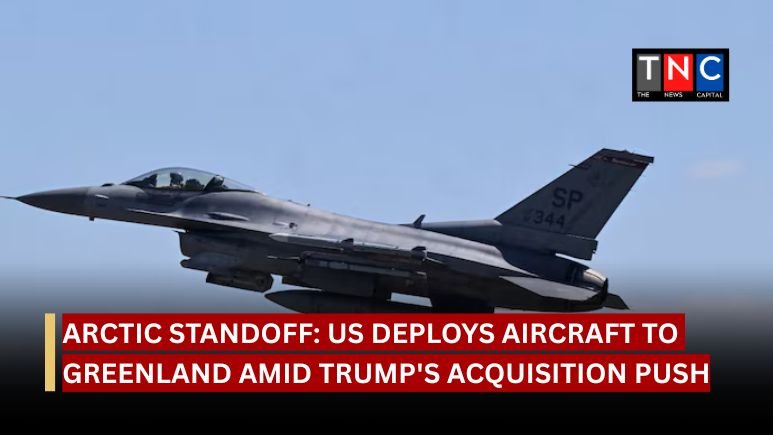

In a move that the U.S. military describes as “long-planned” but critics view as a strategic flexing of muscle, NORAD announced Tuesday the deployment of aircraft to Greenland’s Pituffik Space Base just as President Donald Trump intensifies economic and diplomatic pressure on Denmark to relinquish the Arctic territory. The arrival of American airpower on January 20, 2026, coincides with a deepening geopolitical crisis triggered by Trump’s recent threat to impose a 25% tariff on European allies unless they facilitate a deal for the “Complete and Total purchase” of the island, sparking international alarm about whether the deployment represents routine defense cooperation or a preamble to annexation.
The North American Aerospace Defense Command announced that U.S. military aircraft are being deployed to Pituffik Space Base in northwestern Greenland, emphasizing the mission is part of “routine dispersed operations” coordinated with the Kingdom of Denmark.
- Strategic Assets: The aircraft will arrive at Pituffik (formerly Thule Air Force Base), which serves as a vital missile warning hub for North America. They will join other assets operating from the continental U.S. and Canada as part of integrated air defense operations.
- Diplomatic Cover: Officials stressed that the Government of Greenland was informed in advance and that all forces are operating with the “requisite diplomatic clearances,” attempting to frame the deployment as consensual cooperation rather than unilateral action.
- Timing Questions: However, the announcement comes just days after the White House reiterated that the acquisition of Greenland remains a “top priority” regardless of European military movements, making the “routine” characterization difficult to accept at face value.
- Base Upgrades: Parallel to the deployment, the U.S. military has issued a $25 million solicitation for upgrades to Pituffik’s airfield, including new runway lighting and river crossing bridges, signaling a long-term intention to expand the Arctic hub beyond current capabilities.
As the U.S. boosts its presence at Pituffik, European allies have launched their own “Arctic Endurance” exercise in a move many see as a symbolic shield for Danish sovereignty over Greenland.
- Multinational Force: Approximately 200 combat soldiers from France, Germany, the UK, Norway, Sweden, and Finland have arrived in Nuuk and Kangerlussuaq, marking the largest European military deployment to Greenland in recent history.
- Russian Pretext: Danish Maj. Gen. Søren Andersen stated that the deployment is a response to “Russian threats” in the Arctic, though analysts note the acceleration of the drill followed Trump’s “no comment” when asked if he would seize the island by force.
- Danish Reinforcement: Denmark is boosting its own troop numbers in Kangerlussuaq and Nuuk beyond the European contingent, demonstrating commitment to defending its sovereign territory.
- Symbolic Significance: The exercise sends a message that European NATO members will not stand aside if the United States attempts to forcibly acquire Greenland from a fellow alliance member.
Danish Foreign Minister Lars Løkke Rasmussen has attempted to balance security cooperation with firm limits on sovereignty concessions, while the EU prepares powerful economic countermeasures.
- Danish Position: Rasmussen stated that while Denmark is meeting U.S. security concerns through enhanced cooperation, there are “red lines that cannot be crossed,” specifically regarding Greenland’s territorial sovereignty.
- Anti-Coercion Instrument: In Brussels, EU leaders are holding emergency meetings to discuss activating the Anti-Coercion Instrument (ACI), which could restrict U.S. banking activity and digital services in retaliation for the Greenland tariffs.
- Trade War Escalation: The ACI represents the EU’s most powerful economic weapon, potentially targeting American financial institutions, technology companies, and strategic exports if Trump follows through on tariff threats.
- Alliance Fracture Risk: The crisis has pushed NATO to the brink, with the alliance’s leading member threatening economic warfare against European partners over territorial acquisition.
The Arctic Standoff: Current Positions
| Country/Org | Current Action (Jan 20, 2026) |
| United States | Deploying aircraft to Pituffik; $25M base upgrade planned |
| Denmark | Boosting troop numbers in Kangerlussuaq and Nuuk |
| NATO Allies | Sending 200 soldiers for “Arctic Endurance” drills |
| European Union | Threatening counter-tariffs and banking restrictions |
| Greenland | 85% of population opposes U.S. acquisition (2025 poll) |
| Russia/China | Watching closely; potential beneficiaries of NATO division |
President Trump has framed the Greenland takeover as essential to American security, claiming Denmark cannot defend the mineral-rich island against adversarial powers seeking Arctic footholds.
- Russia-China Narrative: Trump argues the takeover is a shield against the “neighboring” threat of Russia and China, claiming Denmark cannot defend the mineral-rich island on its own against great power competition.
- Existing Access: Critics counter that the U.S. already has sufficient access through the 1951 Defense of Greenland Agreement, which grants America extensive rights to maintain military installations and conduct operations without requiring sovereignty transfer.
- Mineral Resources: Beyond security, Greenland holds vast reserves of rare earth elements, uranium, oil, and other strategic minerals that are becoming accessible as Arctic ice melts due to climate change.
- Golden Dome Defense: Trump has referenced his proposed “Golden Dome” missile defense system as requiring Greenland’s geography for complete North American coverage, though experts question whether this necessitates sovereignty rather than continued basing rights.
The crisis evokes historical precedents while operating in a modern legal framework that makes territorial acquisition through coercion problematic.
- 1917 Virgin Islands Purchase: The last time the U.S. purchased territory from Denmark was in 1917, when it acquired the Virgin Islands for $25 million in gold but that was a consensual transaction during World War I, not coerced through tariff threats.
- International Law: Modern international law, particularly the UN Charter, prohibits territorial acquisition through force or coercion, making Trump’s tariff-backed demands legally questionable regardless of strategic justifications.
- Greenlandic Self-Determination: Greenland enjoys home rule under Danish sovereignty, with rights to self-determination under international law. The 85% of Greenlanders opposing U.S. acquisition have legal standing that cannot simply be overridden by Washington or Copenhagen.
- NATO Precedent: No NATO member has ever attempted to acquire territory from another member state, making this crisis unprecedented in the alliance’s 75-year history.
The NORAD deployment serves multiple potential purposes, from genuine defense cooperation to demonstrating American capability to project power in the Arctic.
- Defense Legitimacy: Pituffik genuinely serves critical missile warning and space tracking functions, and regular deployments of additional aircraft for training and readiness are defensible from a military perspective.
- Show of Force: The timing transforms what might otherwise be routine military activity into a demonstration of American capability to expand presence in Greenland with or without Danish consent.
- Negotiating Leverage: The deployment, combined with base upgrade solicitations, may be designed to strengthen Trump’s negotiating position by showing the U.S. can expand its Greenland footprint through existing agreements even without sovereignty transfer.
- Annexation Infrastructure: The $25 million in airfield upgrades could represent preparation for expanded operations that would support territorial control rather than just defense cooperation.
As aircraft land at Pituffik and European troops deploy to Nuuk, the Arctic standoff approaches potential flashpoints with multiple possible trajectories.
- De-escalation Through NATO: Italian PM Giorgia Meloni and others are attempting to broker a compromise where enhanced Arctic security cooperation through NATO satisfies American concerns without sovereignty transfer.
- Economic War: If Trump implements the 25% tariffs on February 1 as threatened, and the EU activates the Anti-Coercion Instrument, the transatlantic alliance enters uncharted territory of economic warfare between members.
- Military Incidents: With U.S. aircraft at Pituffik and European troops deploying to other Greenlandic locations, the potential for incidents or miscalculations increases, particularly if Trump attempts to expand American military presence beyond agreed areas.
- Greenlandic Agency: Lost in the great power competition are the 57,000 Greenlanders whose voices and rights to self-determination are being overshadowed by American territorial ambitions and European sovereignty defense.
As the first batch of NORAD aircraft touches down at Pituffik Space Base, the central question remains whether this is a mission of defence or a preamble to annexation. The U.S. military’s characterization of “routine dispersed operations” is technically accurate such deployments have occurred before but the context transforms routine into ominous. The timing, immediately following Trump’s tariff ultimatum and European “red line” declarations, makes it impossible to separate the military deployment from the political crisis. Denmark finds itself in an impossible position: cooperating with American security operations at Pituffik while simultaneously reinforcing Greenlandic defences against potential American annexation. European allies deploy troops ostensibly against Russian threats while actually creating a tripwire against American unilateral action. And Greenland itself, with 85% of its population opposing U.S. acquisition, watches foreign militaries manoeuvre across its territory in a sovereignty dispute where the people most affected have the least agency. The $25 million in airfield upgrades at Pituffik will proceed regardless of the diplomatic outcome, representing either prudent infrastructure investment for mutual defence or preparation for territorial control depending entirely on whether Trump’s “Complete and Total purchase” demand is negotiating bluster or a genuine blueprint for Arctic annexation that has already begun.
Also Read / Economic Warfare: China Bans Dual-Use Exports to Japan as Taiwan Row Boils Over.










Leave a comment