

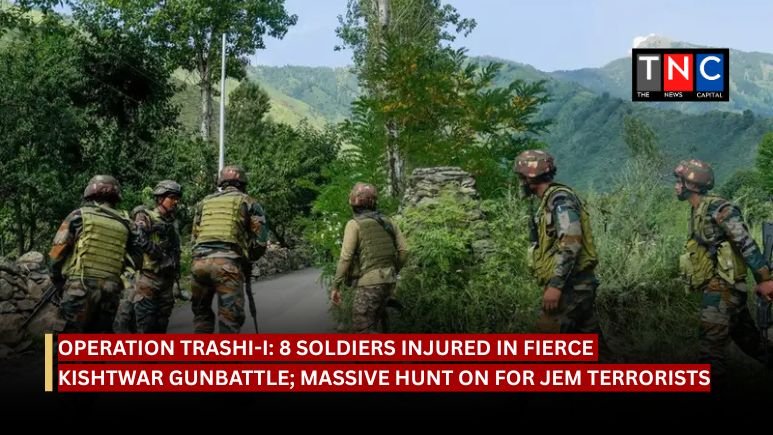

Following a night-long halt due to treacherous terrain, security forces have resumed a high-stakes search operation in Jammu and Kashmir’s Kishtwar district today, Monday, January 19, 2026, as they hunt for a group of trapped terrorists in the upper reaches of the district. The operation, launched to flush out foreign terrorists, saw a violent escalation on Sunday that left eight Indian Army soldiers wounded, primarily from splinter wounds caused by a sudden grenade attack from hiding militants in the Sonnar forest area.
The encounter broke out around noon on Sunday in the Sonnar forest area (northeast of Chatroo) when a joint team of the Army’s White Knight Corps and the J&K Police were conducting a deliberate search operation to locate and neutralize terrorists hiding in the dense forests.
- Ambush and Retaliation: As the search party approached a suspected hideout, a group of 2-3 foreign terrorists, believed to be affiliated with the Pakistan-based Jaish-e-Mohammad (JeM), opened indiscriminate fire and lobbed grenades to break the security cordon.
- The Casualties: Eight soldiers sustained injuries in the initial volleys and grenade blasts. Three of the more seriously wounded personnel were evacuated via helicopter to a military hospital, where they are reportedly in stable condition.
- Nature of Injuries: Most injuries were caused by splinter wounds from grenades and shrapnel, rather than direct gunfire, suggesting the terrorists relied on explosive devices to compensate for being outnumbered.
- Tactical Suspension: Due to the dense vegetation, steep slopes, and fading light, the active firefight was suspended late Sunday night, though a tight cordon was maintained around the suspected terrorist position to prevent any escape during darkness.
With daybreak on Monday, additional reinforcements from the CRPF and the Special Operations Group (SOG) were inducted to reinforce the perimeter and intensify the search for the trapped terrorists.
- Advanced Technology Deployment: Surveillance is being spearheaded by high-definition drones and thermal imaging equipment to locate terrorists hiding in the dense forest cover, while sniffer dog units are combing the thick undergrowth for tracks and scent trails.
- Terrain Challenges: The Chatroo belt is characterized by high-altitude peaks and thick forests, which the terrorists have been using as natural bunkers, making direct assault difficult and favoring defenders who know the terrain.
- Cordon Strategy: Security forces have established multiple layers of cordons to prevent escape routes, with blocking positions placed on likely exfiltration paths toward the Line of Control.
- Deliberate Approach: Rather than rushing the operation, commanders are taking a methodical approach to minimize casualties while ensuring the terrorists cannot slip through the cordon under cover of difficult terrain.
| Feature | Details of Operation Trashi-I |
| Location | Sonnar/Mandral-Singhpora, Kishtwar |
| Enemy Strength | 2-3 Foreign Terrorists (JeM) |
| Casualties (SF) | 8 Injured (Splinter injuries) |
| Status | Ongoing Search & Cordon |
| Strategic Goal | Flush out nearly 35 terrorists hiding in Jammu forest belts |
| Forces Deployed | Army (White Knight Corps), J&K Police, CRPF, SOG |
| Duration | Launched Sunday; Resumed Monday morning |
The recent surge in activity in the Kishtwar and Doda districts is part of a broader trend where foreign infiltrators are attempting to revive terrorism in the traditionally quieter Jammu province, shifting focus away from the Kashmir valley.
- Third Major Encounter: This is the third major encounter in the Jammu region this year, following gunfights in Kathua on January 7 and 13, indicating sustained terrorist presence in the area.
- Strategic Shift: Intelligence assessments suggest Pakistan-based terror groups are deliberately pushing infiltrators into the Jammu region’s forested belts to open a new front and stretch security forces.
- Forest Belt Hideouts: Approximately 35 terrorists are believed to be hiding in the dense forest belts of the Jammu region, using the difficult terrain as sanctuary while planning attacks.
- Foreign Terrorist Focus: The emphasis on “foreign terrorists” indicates these are likely Pakistani nationals or militants who have crossed the Line of Control, rather than local recruits.
“Operations remain underway with additional forces inducted to reinforce the cordon. Our troops continue to display exceptional professionalism and resolve in this challenging terrain.” White Knight Corps, Indian Army
The operation takes on added urgency as India prepares for Republic Day celebrations on January 26, with intelligence agencies warning of potential attack attempts.
- Enhanced Security: Security has been beefed up across the Union Territory ahead of Republic Day celebrations, following intelligence reports of potential “fidayeen” (suicide) strike attempts.
- Symbolic Timing: Terrorist groups often attempt high-profile attacks around national holidays to maximize psychological impact and media coverage.
- Preventive Operations: Operations like Trashi-I are partly designed to disrupt terrorist capabilities and prevent them from executing planned attacks during the Republic Day period.
- Multi-Layered Defense: Security agencies have implemented multiple security layers around potential targets, including government installations, military facilities, and public gathering sites.
The Kishtwar operation highlights the unique challenges of counter-terrorism operations in the rugged terrain of the Jammu region’s upper reaches.
- Altitude and Weather: High-altitude operations in winter conditions create additional challenges for troops, including cold weather injuries, reduced visibility, and difficult helicopter operations.
- Dense Forest Cover: The thick vegetation provides concealment for small terrorist groups and makes aerial surveillance less effective, requiring boots-on-ground search operations.
- Local Knowledge: Foreign terrorists often rely on guides with local knowledge to navigate the complex terrain, giving them advantages over security forces unfamiliar with specific areas.
- Evacuation Difficulties: The terrain makes medical evacuation challenging, requiring helicopter operations that may not be possible in poor weather or under fire.
As of Monday afternoon, no fresh contact has been established with the terrorists, but the area remains under total lockdown with security forces maintaining their cordon.
- Patient Approach: Military commanders appear committed to maintaining the cordon indefinitely rather than rushing operations that could result in additional casualties.
- Technology Advantage: The use of drones and thermal imaging should give security forces significant advantages as night falls and temperatures drop, making heat signatures more visible.
- Exhaustion Factor: The longer the cordon holds, the more challenging conditions become for trapped terrorists lacking food, water, and shelter in winter conditions.
- Neutralization Goal: The operation’s success will be measured not just by neutralizing the immediate terrorist threat, but by preventing these militants from executing any planned Republic Day attacks.
Operation Trashi-I represents both the ongoing challenge of terrorism in Jammu and Kashmir and the methodical approach security forces are taking to neutralize threats while minimizing their own casualties. The eight injured soldiers on Sunday demonstrate the continuing risks faced by troops conducting operations in difficult terrain against determined adversaries, while the reinforcement and resumption of operations on Monday shows the military’s commitment to completing the mission despite these challenges. As Republic Day approaches and intelligence warns of potential fidayeen attacks, the pressure intensifies to neutralize not just the 2-3 terrorists currently trapped in Kishtwar’s forests, but the estimated 35 militants believed to be hiding in Jammu’s forest belts, waiting for opportunities to strike. The coming days will reveal whether the cordon holds, whether the trapped terrorists are neutralized, and whether Operation Trashi-I succeeds in its broader strategic goal of disrupting terrorist capabilities before they can execute planned attacks during India’s national celebrations.












Leave a comment