

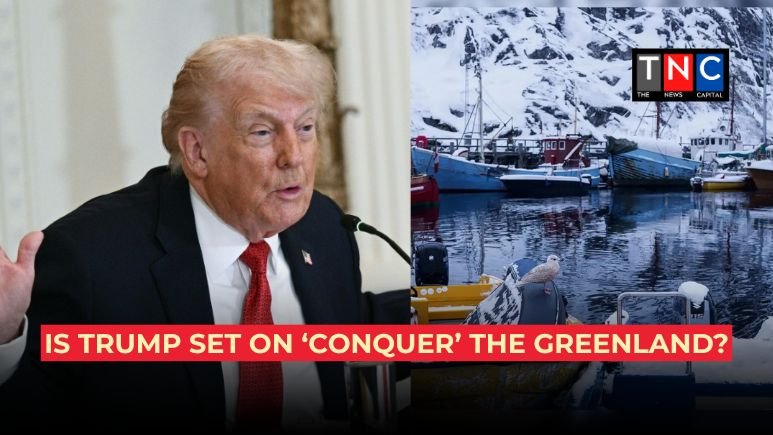

In a significant escalation of his administration’s Arctic ambitions, President Donald Trump threatened Friday to impose punitive tariffs on countries that do not support his plan to acquire Greenland, citing a “national security hole” that would leave a vacuum for Russia or China to exploit. Speaking at a White House roundtable, Trump declared that acquiring the Arctic territory is a “national security imperative” necessary to complete his proposed “Golden Dome” missile defense system, pivoting from suggestive rhetoric to explicit economic coercion against allies who oppose the takeover.
The President’s latest remarks represent a fundamental shift from diplomatic overtures to using America’s economic leverage as a bludgeon against allies on a territorial acquisition that has no basis in international law.
- The Direct Threat: “I may put a tariff on countries if they don’t go along with Greenland, because we need Greenland for national security,” Trump stated Friday, linking the tactic to his recent 25% tariff threats against nations trading with Iran and his efforts to pressure pharmaceutical pricing.
- Unprecedented NATO Pressure: The threat to economically punish NATO allies for not supporting the acquisition of another NATO member’s territory represents an unprecedented use of tariffs as a tool of territorial expansion rather than trade policy.
- Pattern of Weaponization: The Greenland tariff threat follows Trump’s established pattern of using economic coercion to achieve non-economic goals, from immigration enforcement to now territorial acquisition.
- Alliance Implications: The willingness to threaten tariffs against European allies over Greenland raises questions about whether any issue is off-limits for Trump’s economic warfare approach to foreign policy.
Trump framed the Greenland acquisition as essential to American defense, arguing that without control of the territory, the United States faces unacceptable strategic vulnerabilities in the Arctic region.
- The “Big Hole” Claim: Trump argued that without Greenland, the U.S. has a “big hole” in its defense architecture. He insisted that Denmark is “not going to be able to” defend the territory against Russian and Chinese interests attempting to establish Arctic presence.
- Golden Dome Integration: The President cited his proposed “Golden Dome” missile defense system as requiring Greenland’s geography for complete coverage, suggesting the acquisition is necessary for homeland defense infrastructure.
- The Neighbor Threat: “If we don’t do it, Russia or China will take over Greenland,” Trump told reporters. “We’re not going to have Russia or China as a neighbor.” He claimed the region is currently “covered with Russian and Chinese ships.”
- Strategic Minerals: Beyond defense, Greenland holds vast reserves of rare earth elements and critical minerals essential for advanced technology and military applications, adding economic dimensions to the security rationale.
🌐 NATO Crisis: Alliance on the Brink
The Greenland push has created the most serious crisis within NATO since its founding, with European leaders warning that forcing acquisition of a member’s territory would fundamentally destroy the alliance’s foundation.
- EU Defense Warning: The European Union’s defense commissioner warned that a forced U.S. acquisition would effectively mark the “end of NATO,” as it would demonstrate that alliance membership provides no protection against American territorial ambitions.
- NATO Leadership Paradox: While Trump suggested NATO should lead the support for a U.S. takeover, the proposal asks the alliance to support one member annexing territory from another an absurdity that undermines NATO’s collective defense premise.
- Article 5 Implications: The crisis raises uncomfortable questions about NATO’s Article 5 mutual defense commitment if the United States threatens a member state, would other members be obligated to defend against America?
- European Unity Test: The incident is forcing European NATO members to choose between maintaining transatlantic ties and defending the principle that alliance membership protects territorial integrity.
As the White House ramps up pressure, legal and diplomatic battle lines are being drawn on both sides of the Atlantic, with congressional action contradicting executive branch threats.
- The Annexation Bill: On January 12, 2026, Representative Randy Fine (R-FL) introduced the Greenland Annexation and Statehood Act, which seeks to authorize the President to pursue “all necessary means” to acquire the territory and eventually admit it as the 51st U.S. state.
- Bipartisan Pushback: In stark contrast to the White House’s tone, a bipartisan delegation of 11 U.S. lawmakers visited Copenhagen this week to reassure Danish Prime Minister Mette Frederiksen that “Greenland is an ally, not an asset,” attempting to contain diplomatic damage.
- Danish Defiance: PM Frederiksen has called the situation a “fateful moment,” accusing the U.S. of turning its back on the Western alliance by threatening a fellow NATO member. She has flatly stated that Greenland is not for sale at any price.
- Greenlandic Self-Determination: Greenland’s government, which has home rule under Danish sovereignty, has its own voice in the matter, with leaders emphasizing that Greenlanders will determine their own future without external pressure.
| Metric | Details / Status |
| Proposed US Action | Annexation via “Greenland Annexation and Statehood Act” |
| New Economic Threat | Punitive tariffs on non-supporting nations |
| Local Opposition | 85% of Greenlanders reject the idea (2025 Poll) |
| Strategic Goal | Secure critical minerals and “Golden Dome” defense |
| Population | ~57,000 Greenlanders (largely Inuit indigenous) |
| Territory Size | 836,000 sq mi (world’s largest island) |
| Current Status | Autonomous territory of Denmark since 1979 |
| NATO Membership | Part of Denmark (founding NATO member 1949) |
Reaffirming his stance from earlier in the month, Trump made clear that he views Greenland’s acquisition as inevitable, with only the method remaining in question.
- Preferred Path: Trump stated he would prefer to make a deal “the easy way,” suggesting negotiations with Denmark and potentially Greenland’s government for a consensual transfer of sovereignty.
- Coercive Alternative: However, he warned he is prepared to pursue the acquisition “the hard way” if resistance continues, though he has not specified what this would entail beyond tariff threats.
- Military Option Speculation: While Trump has not explicitly threatened military action, his history of using force in Venezuela and his “all necessary means” language in the annexation bill raise questions about whether military coercion remains an option.
- Economic Strangulation: The tariff threats suggest the “hard way” may involve economic pressure designed to make Denmark’s continued control of Greenland unsustainably expensive for Copenhagen and its European allies.
The Greenland acquisition push raises fundamental questions about international law, territorial sovereignty, and the post-World War II order that has generally prohibited territorial conquest.
- UN Charter Violations: Forced acquisition of territory, even through economic coercion rather than military force, would violate fundamental UN Charter principles of territorial integrity and sovereign equality.
- Decolonization Reversal: Greenland’s path toward greater autonomy from Denmark represents a decolonization process; U.S. acquisition would reverse this trajectory by imposing a new colonial relationship.
- Indigenous Rights: The 85% of Greenlanders opposing U.S. acquisition include the island’s indigenous Inuit majority, whose rights to self-determination are protected under international human rights law.
- Dangerous Precedent: Success in acquiring Greenland through economic coercion would establish a precedent that could encourage territorial revisionism globally, potentially destabilizing the international system.
Trump’s shift from rhetorical interest to explicit tariff threats marks a dangerous escalation in what began as seemingly quixotic commentary about purchasing Greenland, transforming it into a genuine crisis with profound implications for the Western alliance.
- Point of No Return: The public tariff threats and legislative action make it difficult for Trump to back down without appearing weak, potentially locking the administration into an escalatory path.
- Alliance Fracture: European leaders face their own domestic pressures not to appear weak in the face of American bullying, creating a dynamic where both sides may find compromise politically impossible.
- Greenlandic Agency: The voices least heard in the debate are Greenlanders themselves, 85% of whom oppose U.S. acquisition, yet whose territory has become a bargaining chip in great power competition.
- Arctic Militarization: Regardless of the acquisition outcome, the crisis is accelerating Arctic militarization as Russia and China exploit NATO divisions and Greenland becomes a flashpoint for great power competition.
The Greenland crisis reveals how Trump’s transactional approach to international relations collides with foundational principles of the post-war order—that territory cannot be acquired through force or coercion, that alliances are based on mutual respect rather than domination, and that sovereignty belongs to peoples rather than being a commodity for great powers to trade. Whether the tariff threats represent serious policy or negotiating bluster, they have already damaged NATO cohesion, empowered adversaries who benefit from Western division, and transformed Greenland from a quiet Arctic territory into a symbol of whether American power still operates within international law or has moved beyond it entirely.
Also Read / Arctic Ambitions: US Lawmakers Clash Over Greenland ‘Annexation’ Bill.












Leave a comment