

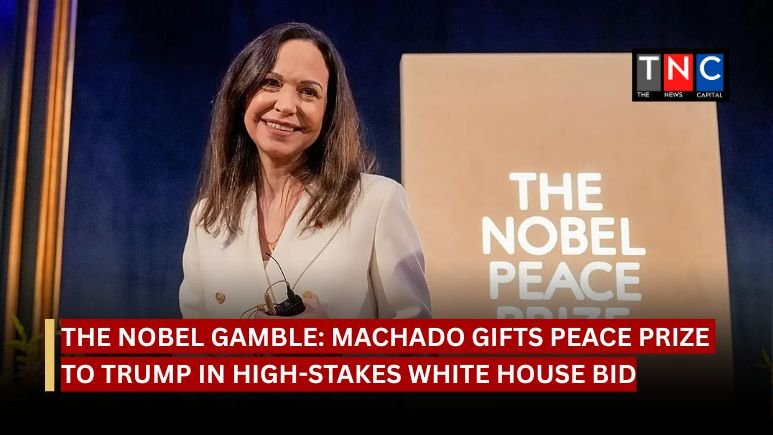

In a move described as both “extraordinary” and “extra-legal,” Venezuelan opposition leader María Corina Machado presented her 2025 Nobel Peace Prize medal to President Donald Trump during their first face-to-face encounter at the White House on Thursday. The gesture, aimed at reclaiming her role in Venezuela’s transition, comes as Washington maintains its surprising recognition of former Maduro regime deputy Delcy Rodríguez as the country’s acting leader, leaving Machado sidelined despite her status as the internationally recognized democratic opposition leader.
María Corina Machado met with President Donald Trump at the White House on Thursday, January 15, 2026, marking their first face-to-face encounter since the U.S. military operation that toppled Nicolás Maduro. In a move that stunned diplomatic observers, Machado presented her 18-carat gold Nobel medal to Trump, calling it a “recognition of his unique commitment to our freedom.”
- The Historical Comparison: Machado framed her gift through a lens of historical symbolism, drawing a direct line between the 19th-century liberation of South America and the current U.S. intervention. She told reporters she compared her gesture to the Marquis de Lafayette’s gift of a medal to Simón Bolívar 200 years ago, describing Trump as the “heir of Washington” receiving a token from the “people of Bolívar.”
- Trump’s Reaction: The President took to Truth Social later that evening to praise Machado as a “wonderful woman who has been through so much.” He confirmed he intended to keep the medal, calling it a “wonderful gesture of mutual respect.”
- The Nobel Rebuttal: The Norwegian Nobel Institute issued a swift clarification, stating that while a physical medal can change hands, the title of laureate is strictly non-transferable and cannot be “shared or gifted.”
- Strategic Calculation: The unprecedented gift represents Machado’s attempt to leverage her international prestige and moral authority to influence Trump’s decision-making on Venezuela’s political future.
Despite the personal warmth of the meeting and the dramatic gesture, the fundamental power dynamic in Caracas remains unchanged, with Machado still on the outside looking in.
- The Sidelining: Since the January 3rd raid (Operation Absolute Resolve) that captured Maduro, Trump has been dismissive of Machado’s ability to govern, claiming she lacks the “support or respect” within the country to maintain order.
- The Rodríguez Shift: Trump has instead fostered a working relationship with Delcy Rodríguez, Maduro’s former vice-president, who has pivoted to meet U.S. demands. Last week, Trump announced a deal with the Rodríguez administration to provide 50 million barrels of crude oil to the U.S., signaling that economic stability and oil access currently outweigh democratic transition timelines.
- Voter Trust Disconnect: Supporters of Machado, gathered outside the White House, expressed hope that the meeting would “make President Trump understand” that Rodríguez is not the person Venezuela deserves, highlighting the gap between popular will and U.S. strategic calculations.
- The Democracy Dilemma: The situation creates a paradox where the U.S. removed an authoritarian leader but installed his deputy rather than the democratically-elected opposition, raising questions about American commitment to democratic principles versus strategic interests.
The meeting occurs in the shadow of the most aggressive U.S. military action in the Western Hemisphere in decades, which fundamentally reshaped Venezuelan politics overnight.
- The Raid: On January 3, 2026, U.S. Special Forces captured Nicolás Maduro and his wife in a pre-dawn raid in Caracas. They are currently being held in a federal facility in New York on narco-terrorism charges.
- The Immediate Aftermath: While the raid initially fueled hopes among Machado’s supporters for an immediate transition to her presidency, the White House quickly moved toward a “fix the country first” approach, emphasizing security and oil production over immediate democratic elections.
- Military Presence: The U.S. maintains a significant military presence in Venezuela, with naval forces positioned off the coast and advisors embedded with interim government security forces.
- International Reactions: The raid drew condemnation from Russia and China, praise from some Latin American democracies, and careful silence from many others concerned about the precedent of direct U.S. military intervention.
As she left the White House for meetings on Capitol Hill, Machado was greeted by jubilant supporters. Though she provided few specifics on whether Trump gave her a timeline for democratic elections, her message was one of carefully calibrated optimism.
“We can count on President Trump. He truly understands the reality… we want our children back home, and for that to happen, there has to be democracy.” — María Corina Machado
- Congressional Outreach: Machado’s meetings on Capitol Hill suggest she’s building pressure from multiple angles, leveraging Congressional support for democratic transition to influence White House policy.
- The Diaspora Factor: Millions of Venezuelans who fled during the Maduro years represent both a humanitarian crisis and a potential political force if democratic elections are held.
- Timeline Ambiguity: The lack of concrete commitments on election timelines suggests Trump remains focused on oil deals and stability over democratic processes.
The coming weeks will determine if Machado’s “Nobel gamble” pays off, but early signals suggest Trump’s priorities lie elsewhere.
- The MIGA Doctrine: Trump’s administration remains focused on the “Make Venezuela Great Again” doctrine and the integration of Venezuelan oil into the U.S. energy sector as a replacement for sanctioned sources.
- Economic Reconstruction: The White House has emphasized rebuilding Venezuela’s oil infrastructure before addressing political transitions, potentially delaying elections indefinitely.
- The $100 Billion Promise: Trump has touted plans for U.S. oil companies to invest at least $100 billion in modernizing Venezuela’s energy sector, a timeline that could stretch years.
- Moral vs. Executive Authority: For now, Machado remains the “moral leader” of Venezuela with international legitimacy, but executive power rests firmly in the hands of those willing to trade oil for political survival under the watchful eye of the White House.
Machado’s decision to gift her Nobel medal to Trump represents an extraordinary bet that personal diplomacy and symbolic gestures can overcome the cold calculus of energy politics and strategic interests. The gesture acknowledges Trump’s role in removing Maduro while attempting to leverage his ego and desire for historical legacy toward supporting democratic transition. Whether the gamble succeeds depends on whether Trump values being remembered as a liberator or an oil broker, and whether Machado’s moral authority can compete with Delcy Rodríguez’s willingness to deliver the crude oil that currently defines U.S. policy toward Venezuela. The medal now sits in the White House, but the question of who will sit in Miraflores Palace remains unanswered.
Also Read / ‘A Slaughter in Silence’: Trump Condemns Iran’s Resumed Executions Amid Total Blackout.








Leave a comment