

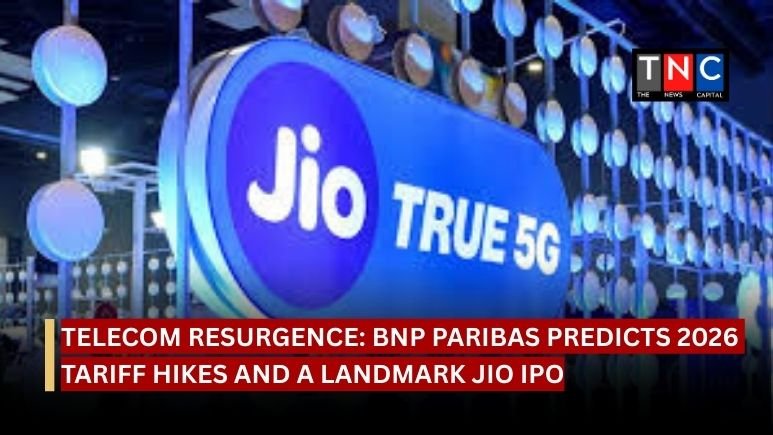

As the Indian telecom sector shifts from a “capex-heavy” 5G rollout to a “monetization phase,” global brokerage BNP Paribas has labeled the industry a top pick for 2026, citing a perfect storm of tariff hikes, a record-shattering Jio IPO, and crucial capital raising for Vodafone Idea. The Indian telecom sector is poised for a transformative year, with revenue growth set to accelerate on the back of a predicted 15–20% mobile tariff hike mid-year and the imminent public listing of Reliance Jio Platforms, which could crown it as India’s largest-ever IPO.
📈 The Tariff Hike Catalyst
BNP Paribas expects the next major industry-wide tariff adjustment to hit in June or July 2026, following the established biennial pattern of 2021 and 2024 that has characterized the sector’s recovery from its brutal price war years.
- Revenue Boost: A 15% headline tariff hike is modeled to drive a healthy 14% year-on-year ARPU (Average Revenue Per User) growth by the 2027 fiscal year, translating into significant revenue expansion for the top operators.
- Market Share Stability: Despite recent regulatory relief for Vodafone Idea (VIL) regarding its Adjusted Gross Revenue (AGR) dues, BNP Paribas does not expect a meaningful shift in market share trends. The report suggests the competitive landscape will remain a “two-plus-one” player market dominated by Jio and Airtel.
- Moderating Capex: With 5G networks largely complete, “capex-to-sales” ratios are expected to decline further in 2026, allowing telcos to focus on free cash flow generation and dividends rather than network infrastructure investments.
- Consumer Acceptance: The report notes that previous tariff hikes have been absorbed without significant subscriber churn, suggesting pricing power has returned to the industry after years of unsustainable competition.
🚀 The Jio IPO: India’s Largest Public Listing?
The long-anticipated IPO of Reliance Jio Platforms is slated for the first half of 2026, with preparations reportedly in advanced stages and analysts divided only on the scale of the valuation.
| Parameter | Estimated Value / Details |
| IPO Size | ~$4 billion to $4.5 billion |
| Proposed Stake Sale | 2.5% (Awaiting 2.5% float rule approval) |
| Enterprise Valuation | $180 billion to $240 billion |
| Target Date | By June 2026 |
| Lead Bankers | Kotak Mahindra Capital, Morgan Stanley |
- Strategic Float: A 2.5% float is the preferred strategy to create “pricing tension” and avoid flooding the market with shares, while still meeting regulatory requirements for minimum public shareholding.
- Index Impact: The listing could significantly increase the telecom sector’s weightage in key stock indices like the Nifty 50 and Sensex, given Jio’s massive valuation and market dominance.
- Investor Appetite: The IPO is expected to attract massive domestic and international investor interest, potentially setting new records for subscription levels and first-day trading volumes.
- Valuation Debate: The $180-240 billion enterprise valuation range reflects differing assumptions about Jio’s growth trajectory in digital services, broadband, and emerging businesses like AI infrastructure.
⚠️ Vodafone Idea: The Survival Story
While Jio and Airtel pivot toward AI and data centers, the narrative for Vodafone Idea (VIL) remains focused on survival and balance sheet strengthening in what has become a tale of two very different telecom industries.
- The Funding Gap: VIL is expected to launch a significant capital raise in 2026. BNP Paribas emphasized that this is a critical “watch out” for investors, as the firm needs to restart spectrum and AGR installments of approximately ₹18,000 crore per year after March 2026.
- Drastic Measures Required: Analysts warn that VIL may eventually require a cumulative 45% tariff hike by 2030 to meet its statutory obligations, even with a potential five-year government moratorium on AGR payments a level that could test subscriber retention.
- Government Support: The company’s survival remains partly dependent on continued government support through payment deferrals and potential equity conversion of dues, making it as much a policy story as a business one.
- Market Share Erosion: Despite regulatory relief, VIL continues to lose subscribers to better-capitalized rivals, raising questions about its long-term viability as India’s third major telecom operator.
🔮 Beyond Connectivity: The Tech Transformation
The report notes that Indian telcos are no longer just “pipelayers” for data but are evolving into tech-focused entities with diversified revenue streams beyond traditional voice and data services.
- Digital Bundling: Operators have ramped up offerings by bundling AI, cloud storage, and content, creating new monetization streams that increase ARPU while improving customer stickiness.
- Infrastructure Arms Race: Investment is shifting from 5G towers to data centers and home broadband, with Jio and Airtel leading the charge in building India’s sovereign AI infrastructure to support the country’s digital economy ambitions.
- Enterprise Pivot: Both major operators are aggressively pursuing enterprise customers with cloud services, IoT solutions, and dedicated network slices, moving beyond consumer-focused revenue models.
- Content Integration: Strategic partnerships and acquisitions in digital content, streaming, and gaming are positioning telecom operators as integrated digital service providers rather than pure connectivity businesses.
💼 Investment Outlook
BNP Paribas’s bullish stance on the sector reflects a fundamental shift from survival mode to growth and profitability.
- Top Sector Pick: The brokerage has labeled Indian telecom as a top pick for 2026, citing multiple catalysts including tariff hikes, the Jio IPO, improving cash flows, and sector consolidation benefits.
- Risk Factors: Key risks include regulatory interventions on tariff increases, slower-than-expected 5G monetization, and the potential for VIL’s difficulties to trigger regulatory changes that affect the entire sector.
- Long-Term Trajectory: The sector is transitioning from a decade of destructive competition and heavy capital expenditure to a period of rational pricing, cash generation, and shareholder returns a transformation that positions it for sustained outperformance.
The convergence of tariff hikes, the landmark Jio IPO, and the evolution toward tech-focused business models marks 2026 as a potential inflection point for Indian telecom, transforming it from an industry focused on survival and network buildout to one positioned for sustained profitability and growth in India’s rapidly digitalizing economy.
Also Read / Mega-Listing in the Making: Reliance Jio Eyes Record-Shattering $4.5B IPO for 2026.












Leave a comment