

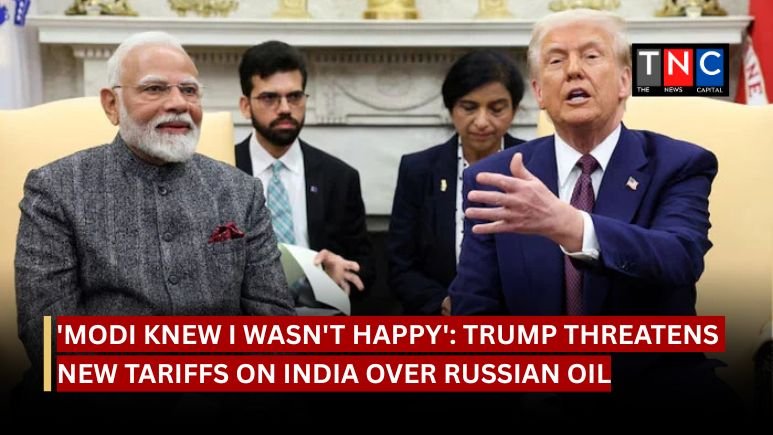

In a blunt warning from 30,000 feet, U.S. President Donald Trump has signaled a potential hike in existing 50% tariffs on Indian goods, claiming that Prime Minister Narendra Modi is aware of Washington’s deep dissatisfaction regarding New Delhi’s energy ties with Moscow.
Speaking to reporters aboard Air Force One on Sunday (January 4, 2026), President Donald Trump warned the United States could raise tariffs on India “very quickly” if the country doesn’t further cut its imports of Russian crude. The President praised Prime Minister Narendra Modi as a “good guy” but stressed that personal rapport won’t shield India from economic penalties if it continues to provide a financial lifeline to the Kremlin during the ongoing Ukraine conflict.
The remarks highlight a period of intense trade friction that began in August 2025, when the Trump administration doubled tariffs on Indian imports to 50%, a move specifically labeled as “punishment” for India’s refusal to halt Russian oil purchases.
- The “Happiness” Ultimatum: “Modi is a very good man; he is a good guy. He knew I was not happy, and it was important to make me happy,” Trump said. He added that because India relies on trade with the U.S., Washington holds the ultimate leverage.
- The Lindsey Graham Factor: Accompanied by Senator Lindsey Graham, Trump highlighted a proposed bill that could authorize tariffs of up to 500% on countries that don’t support a ceasefire in Ukraine by cutting off Russian energy revenues. Graham claimed the current 50% duty is the “chief reason” India has started buying less Russian oil in recent months.
- New Transparency Mandates: In an apparent effort to appease Washington, the Indian government on January 2, 2026, mandated that all domestic refiners submit weekly reports on their purchases of Russian and American crude. This data is meant to provide “verified figures” to U.S. negotiators as both nations try to finalize a Bilateral Trade Agreement.
The trade war has already taken a heavy toll on Indian exports, which dropped 37.5% between May and September 2025. Sectors like textiles, gems and jewelry, and furniture have been hit hardest by the 50% duties, leading to concerns that further hikes could result in an export collapse of up to 45% by the end of the 2025-26 fiscal year.
“India wanted to make me happy. Modi is a very good guy and he knew I was not happy… We can raise tariffs on them very quickly. It would be very bad for them.” President Donald Trump, aboard Air Force One.
“I was at the Indian Ambassador’s house about a month ago and all he wanted to talk about is how they are buying less Russian oil. ‘Would you tell the President to relieve the tariff?’ This stuff works.” Senator Lindsey Graham.
Despite the rhetoric, India remains one of the largest buyers of Russian seaborne crude. While imports are expected to dip below 1 million barrels per day this month for the first time in years, New Delhi has consistently said its energy policy is governed by domestic consumer needs and market availability. However, the Trump administration’s recent success in Venezuela, where it captured Nicolás Maduro on January 4, appears to have emboldened the President to use similar “maximum pressure” tactics against other global energy players.
With the first phase of a new India-U.S. trade deal expected to be announced soon, the threat of new tariffs serves as a powerful negotiating tool. While Indian markets reacted sharply Monday with the IT stock index falling 2.5%, all eyes are now on New Delhi’s upcoming weekly oil disclosures to see if they meet Trump’s definition of “making him happy.”
Also Read / Trump threatens fresh tariffs on Indian rice over ‘dumping’ claims.










Leave a comment