

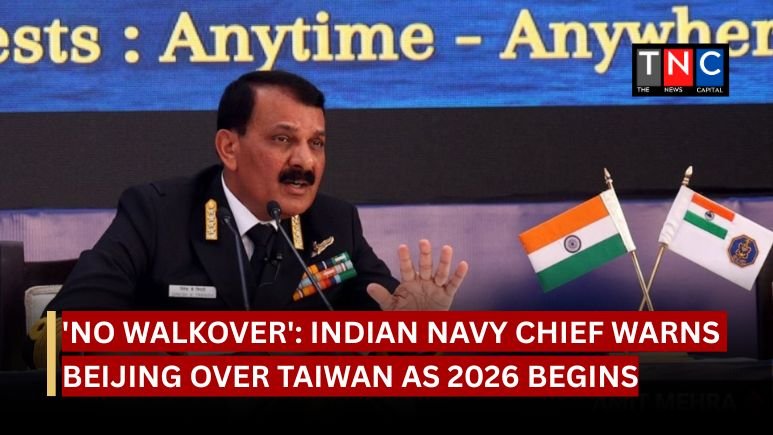

The new year arrived with the same old tensions, but this time with a pointed reminder from New Delhi: if Beijing thinks taking Taiwan will be easy, they haven’t been paying attention. India’s top naval commander just made clear that China’s massive fleet doesn’t guarantee success—and that India is watching every move in waters far closer to home.
As 2026 begins under gathering storm clouds of regional tension, Admiral Dinesh K. Tripathi, Chief of Naval Staff, delivered a blunt assessment that Taiwan would be “no walkover” for China’s People’s Liberation Army (PLA), despite Beijing’s relentless military buildup and intimidation campaign. Even as China concluded its massive “Justice Mission 2025” blockade simulation on December 31 a theatrical display of force meant to demonstrate the PLA’s ability to choke Taiwan into submission Indian military leadership is downplaying Beijing’s naval expansion as more show than substance, while asserting that India maintains comprehensive “maritime domain awareness” across the strategic waterways of the Indian Ocean Region (IOR).
The Admiral’s pointed comments follow a year of record-breaking military activity in the Taiwan Strait and a significant acceleration of India’s own maritime buildup, signaling that New Delhi sees China’s ambitions as a direct threat to regional stability and possibly to India itself.
The military realities challenging Beijing’s Taiwan ambitions:
- PLA’s Capability Gap: While the People’s Liberation Army Navy boasts the world’s largest fleet by sheer number of hulls, military analysts and commanders note it faces a “steep learning curve” in executing the kind of complex amphibious invasion that taking Taiwan would require. Storming a well-defended island across 100 miles of contested water isn’t the same as sailing around in peacetime. Taiwan’s recent $8 billion “Sea-Air Combat Power Improvement Plan” has equipped the island with supersonic Hsiung Feng III anti-ship missiles capable of turning the Taiwan Strait into a killing field creating a formidable “area denial” shield that would exact a devastating toll on any invasion fleet.
- India’s Watchful Eye: Admiral Tripathi made clear that the Indian Navy is tracking “each and every” Chinese vessel entering the Indian Ocean Region. India currently maintains a constant presence of warships specifically positioned to counter China’s “String of Pearls” strategy—Beijing’s attempt to encircle India through a network of strategic ports in Pakistan, Sri Lanka, Bangladesh, and Djibouti. Every Chinese submarine, every supply ship, every naval vessel that enters these waters is being monitored, tracked, and assessed.
- Operation Sindoor: India’s ongoing maritime readiness initiative, Operation Sindoor, remains at heightened alert status as the Navy prepares to commission 19 new vessels in 2026. The expansion is designed to bolster India’s defensive posture against the nightmare scenario defense planners have been gaming out: a coordinated two-front challenge from China in the east and Pakistan in the west.
India finds itself walking an increasingly narrow diplomatic tightrope, trying to maintain economic pragmatism with China while quietly preparing for potential conflict and deepening ties with Taiwan in ways that infuriate Beijing.
India’s delicate balancing act:
- The Vanishing “One China” Policy: While New Delhi hasn’t officially abandoned its “One China” policy which recognizes Beijing’s claim that Taiwan is part of China the language has been conspicuously absent from bilateral documents since 2011, a diplomatic signal that didn’t happen by accident.
- Economic Pivot to Taiwan: India-Taiwan trade surged past $10 billion in the last fiscal year, with heavy emphasis on high-technology sectors and semiconductor cooperation critical industries where Taiwan leads the world and India desperately needs partnerships.
- Strategic Provocation: India recently established a new Taipei Economic and Cultural Centre (TECC) in Mumbai, a move that functions as a quasi-diplomatic outpost and drew sharp protests from Beijing. The Ministry of External Affairs (MEA) brushed aside Chinese objections, framing the move as simply promoting “economic and cultural cooperation” diplomatic language everyone understands means much more.
“The Indian Navy is fully aware of all activities… There is no need for concern. We have not allowed them [China] to come anywhere where we don’t want them to come,” Admiral Dinesh K. Tripathi stated during a recent briefing, his words carefully calibrated to project both confidence and vigilance.
“Taiwan’s capacity to identify, target, and strike PLA Navy vessels could be the decisive measurement of their ability to defeat a blockade or invasion,” observed defense analyst Ben Lewis, echoing the growing consensus that in this modern “David vs. Goliath” scenario, the defender’s asymmetric capabilities missiles, mines, and the geographical advantage of fighting from prepared positions might prove decisive.
“Every day China waits, Taiwan gets stronger. Every missile they deploy, every exercise they conduct, we learn more about how to defeat them,” a Taiwanese defense official said in a background briefing, speaking on condition of anonymity.
The year 2026 is increasingly viewed as a “preparatory window” for the much-discussed 2027 timeline the date by which U.S. intelligence assessments suggest Chinese President Xi Jinping wants the PLA to be fully capable of executing a successful invasion of Taiwan. But the convergence of military coordination between the United States, India, Japan, and Australia the so-called “Quad” has created a new security architecture specifically designed to ensure that any Chinese move on Taiwan would trigger a prolonged, multi-front conflict that Beijing might not win, even if it could initially succeed.
The message from this unprecedented level of cooperation is clear: Taiwan doesn’t stand alone, and an attack on the island wouldn’t remain a bilateral conflict between Beijing and Taipei for long.
With the Milan 2026 naval exercises scheduled for February, India is preparing to host over 50 nations in a massive demonstration of maritime cooperation and interoperability. The exercise, held in Indian waters, will serve as a subtle but unmistakable reminder to Beijing that the Indian Ocean and the wider Indo-Pacific region remains contested space where military might doesn’t automatically translate to strategic success, and where “right does not flow from the barrel of a gun,” to invert Mao’s famous phrase.
As the calendar turns to 2026, the pieces are moving into position for what could be the defining geopolitical confrontation of the decade. China continues building its military power, convinced that overwhelming force will eventually achieve its goals. Taiwan continues fortifying its defenses, betting that it can make invasion prohibitively costly. And India continues watching from the sidelines not neutral, but not yet committed to open confrontation, monitoring every move and preparing for the possibility that what happens in the Taiwan Strait might ultimately determine what happens in the Indian Ocean.
Admiral Tripathi’s message was aimed at multiple audiences: reassuring India’s public that their navy is capable and vigilant, warning Beijing that India won’t stand aside if regional stability collapses, and signaling to Taiwan that it has friends who understand the stakes.
The question hanging over 2026 isn’t whether tensions will ease they won’t. It’s whether the carefully balanced deterrence holding everything together can survive another year of escalation, or whether someone miscalculates and the theoretical war everyone’s been planning for suddenly becomes terrifyingly real.
Also Read / ‘No Third-Party Role’: India rejects China’s claim of mediating May 2025 ceasefire.











Leave a comment