


The explosions have stopped. The mortars are quiet. And for the first time in weeks, families huddled in makeshift shelters along one of Southeast Asia’s most contested borders can finally hear something other than the sound of war.
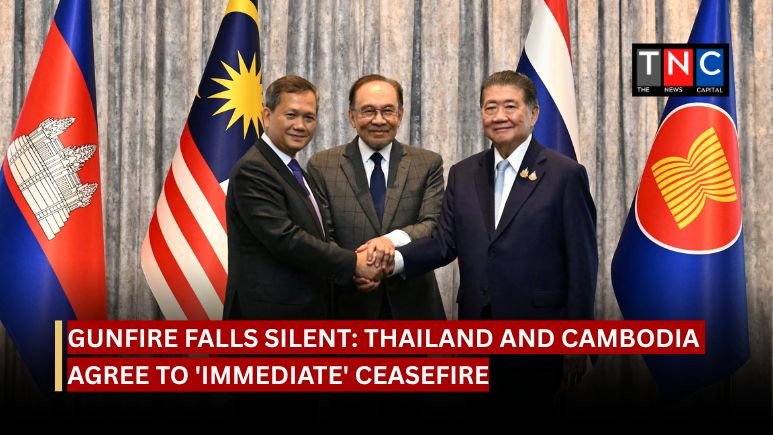
Thailand and Cambodia reached a breakthrough “immediate ceasefire” on Saturday (December 27), taking effect at noon local time and bringing a sudden halt to the most ferocious border fighting the region has seen in over a decade. The agreement was signed by Cambodian Defence Minister Tea Seiha and his Thai counterpart, Natthaphon Narkphanit, during an emergency session of the Special General Border Committee (GBC) at the Prum-Ban Pak Kard international crossing neutral ground where enemies became, at least temporarily, partners in peace.
The deal aims to end a bloody escalation that has claimed over 100 lives and turned nearly a million people into refugees in their own countries, forced to flee villages that have stood for generations along the disputed 817-kilometer frontier.
The joint ceasefire agreement establishes strict de-escalation measures:
- Military Freeze: Both armies have committed to an immediate halt on all troop movements. No reinforcements, no repositioning, no creeping forward toward enemy lines. Soldiers will stay exactly where they are, holding positions frozen in time like a deadly game of freeze tag.
- Complete Weapons Ban: The truce covers everything from small arms to the artillery barrages and F-16 airstrikes that Thailand deployed, to the rocket fire that Cambodia launched in retaliation. Both sides have pledged to respect each other’s airspace, ending the terrifying sound of jets screaming overhead.
- Humanitarian Corridor Opens: Nearly one million displaced people farmers, shopkeepers, schoolchildren, grandparents are now permitted to return to their villages. Thailand has also agreed to release 18 Cambodian soldiers currently held as prisoners of war, provided the ceasefire holds for a critical 72-hour confidence-building period.
- Long-Term Cooperation: Looking beyond the immediate crisis, both nations have committed to joint humanitarian demining efforts along the border clearing the deadly legacy of past conflicts and to working together to dismantle transnational cyber-scam operations that have flourished in the lawless border regions.
The agreement didn’t emerge from goodwill alone. International pressure had been mounting for weeks. U.S. President Donald Trump reportedly got directly involved, claiming to be in contact with both governments and threatening to withhold valuable trade privileges unless a “peace deal” materialized. Meanwhile, regional neighbors under the ASEAN umbrella, currently chaired by Malaysia, held emergency crisis meetings in Kuala Lumpur last week, desperate to prevent the conflict from destabilizing the entire Mekong subregion.
“This agreement must not be violated under any circumstances. Both sides must avoid unprovoked firing or movement of troops,” the joint statement declared, its language betraying just how fragile this new peace really is.
“We are committed to a peaceful settlement of disputes in an atmosphere of trust,” stated the Cambodian Defence Ministry in their official response.
“Military operations will remain suspended only if no further threats to Thai territory are detected,” Thai officials clarified, making clear that their guns are silent but their vigilance is not.
The 2025 conflict will be remembered as the most violent chapter in Thai-Cambodian relations since the 2011 Preah Vihear temple dispute that shocked the region. This latest round of fighting erupted in May over colonial-era border demarcations lines drawn by French administrators over a century ago that both countries interpret differently today. Tensions simmered through the summer before exploding in July and reaching a devastating crescendo in December.
Thailand’s “Operation Sattawat” in mid-December saw Thai forces launch a coordinated offensive to seize several strategic hilltops overlooking the border. The operation succeeded militarily but triggered furious retaliation Cambodian rockets rained down on Thai border provinces, turning the conflict from a border skirmish into something approaching all-out war between neighbors.
The humanitarian toll has been devastating. Official counts acknowledge at least 47 civilian deaths people killed in their homes, in their fields, going about their daily lives when artillery shells don’t distinguish between soldiers and shopkeepers. The collateral damage to infrastructure is widespread: schools destroyed, hospitals damaged, roads cratered, power lines severed.
While the guns have fallen silent for now, the fundamental issues remain unresolved. The ancient temple sites that sparked this conflict places like Ta Muen Thom and Preah Vihear, structures that predate both modern nations still sit in disputed territory claimed by both sides. These aren’t just ruins; they’re symbols of national identity and historical legitimacy that neither government can easily compromise on without facing domestic backlash.
International monitors are watching the next 72 hours intensely. This three-day period represents the first “acid test” for the truce a chance to prove that both sides are serious about peace, or a window that could slam shut with a single gunshot. If soldiers can hold their fire and politicians can hold their tongues for three days, there’s hope this could evolve into something more permanent.
Success could pave the way for a comprehensive border demarcation agreement under the framework of the 2000 Memorandum of Understanding (MOU) a deal that’s been sitting on the shelf for 25 years, waiting for the political will to implement it.
For now, though, the nearly one million displaced people aren’t thinking about memorandums or frameworks. They’re thinking about going home, checking if their houses still stand, and hoping the silence lasts long enough for their children to sleep through the night without fear.
The ceasefire is holding. But everyone knows: in conflicts like these, peace is always just one mistake away from becoming war again.
Also Read / Thailand launches airstrikes on Cambodia as soldier killed in border clash.









Leave a comment