

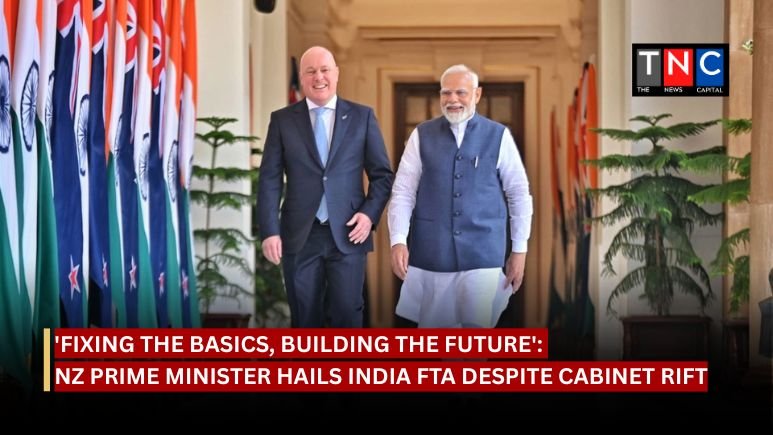

Prime Minister Christopher Luxon has celebrated the conclusion of a “landmark” free trade agreement with India, ignoring a public revolt from his Foreign Minister who has branded the deal “neither free nor fair.”
New Zealand Prime Minister Christopher Luxon celebrated the successful conclusion of the India–New Zealand Free Trade Agreement on Saturday (27 December), calling it a “historic milestone” that will double bilateral trade within five years. But the achievement has sparked a major coalition crisis in Wellington, as Deputy Prime Minister and Foreign Minister Winston Peters has vowed to vote against the deal in Parliament, calling it a “low-quality” agreement that sacrifices New Zealand’s dairy interests for immigration concessions.
The FTA, wrapped up in a record nine months following Luxon’s visit to New Delhi in March 2025, aims to transform the economic relationship between the two countries.
- Economic Goals: The deal seeks to increase bilateral trade to $5 billion by 2030 and unlock $20 billion in New Zealand investment into India over the next 15 years.
- Tariff Relief: New Zealand will eliminate tariffs on 100% of Indian goods, while India will reduce or remove tariffs on 95% of New Zealand’s exports, including kiwifruit, apples, wool, and timber.
- Skilled Mobility: A key part of the pact is a new Temporary Employment Entry Visa pathway, granting up to 5,000 Indian professionals at any given time the right to work in New Zealand for up to three years.
The ‘Dairy’ Dilemma
The main point of contention is the total exclusion of New Zealand’s most critical export: dairy. For the first time in New Zealand’s trade history, a major FTA excludes milk, cheese, and butter, sectors that account for nearly 30% of the country’s total exports ($24 billion annually). Winston Peters argued that while India maintained its “red lines” on agriculture to protect its domestic farmers, the New Zealand government “rushed” the negotiations and failed to secure a balanced deal.
“We said we’d secure an FTA with India in our first term, and we’ve delivered. This landmark deal means more jobs, higher incomes, and more exports by opening the door to 1.4 billion Indian consumers,” Prime Minister Christopher Luxon posted on X.
On the other hand, Foreign Minister Winston Peters slammed the deal: “New Zealand First is regrettably opposed… We consider the India–New Zealand Free Trade Agreement to be neither free nor fair. It gives too much away, especially on immigration, and does not get enough in return for New Zealanders, including on dairy.”
The rift has forced the Luxon government to rely on the Opposition Labour Party to pass the legislation in Parliament. While the coalition agreement includes an “agree to disagree” clause, having a senior minister vote against a flagship government policy is rare in New Zealand politics. For India, the deal marks its third major FTA in 2025, following agreements with the UK and Oman, as New Delhi tries to diversify its trade partners amid rising global protectionism.
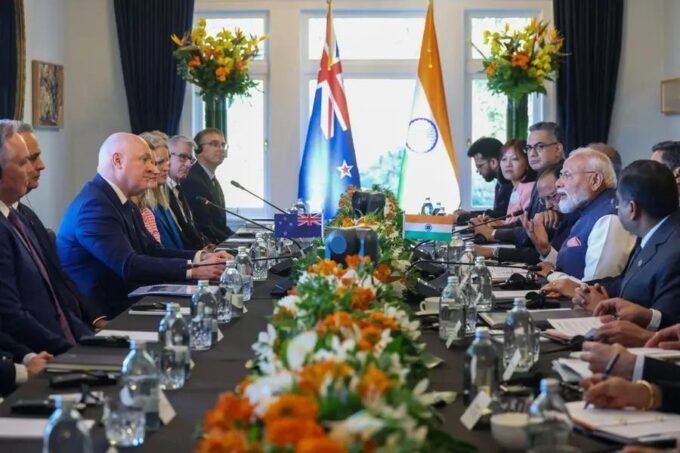
Formal signing of the agreement is expected in the first half of 2026, with implementation following shortly after. Despite the domestic political friction, both Luxon and Indian Prime Minister Narendra Modi expressed confidence that the “strategic milestone” would cement the Indo-Pacific partnership for decades to come.
Also Read / PM Modi condemns ‘ghastly’ terror attack on Jewish gathering in Sydney.










Leave a comment